20' 22U1 / 40' 42U1
Open top
Pareti e tetto in telone al posto del tetto rigido, per caricare dall'alto con la gru. Da 20 e da 40 piedi. Tutto ciò che sporge oltre i montanti è out of gauge e cambia il discorso permessi.
Fuori, dentro, e la porta
Come si presenta
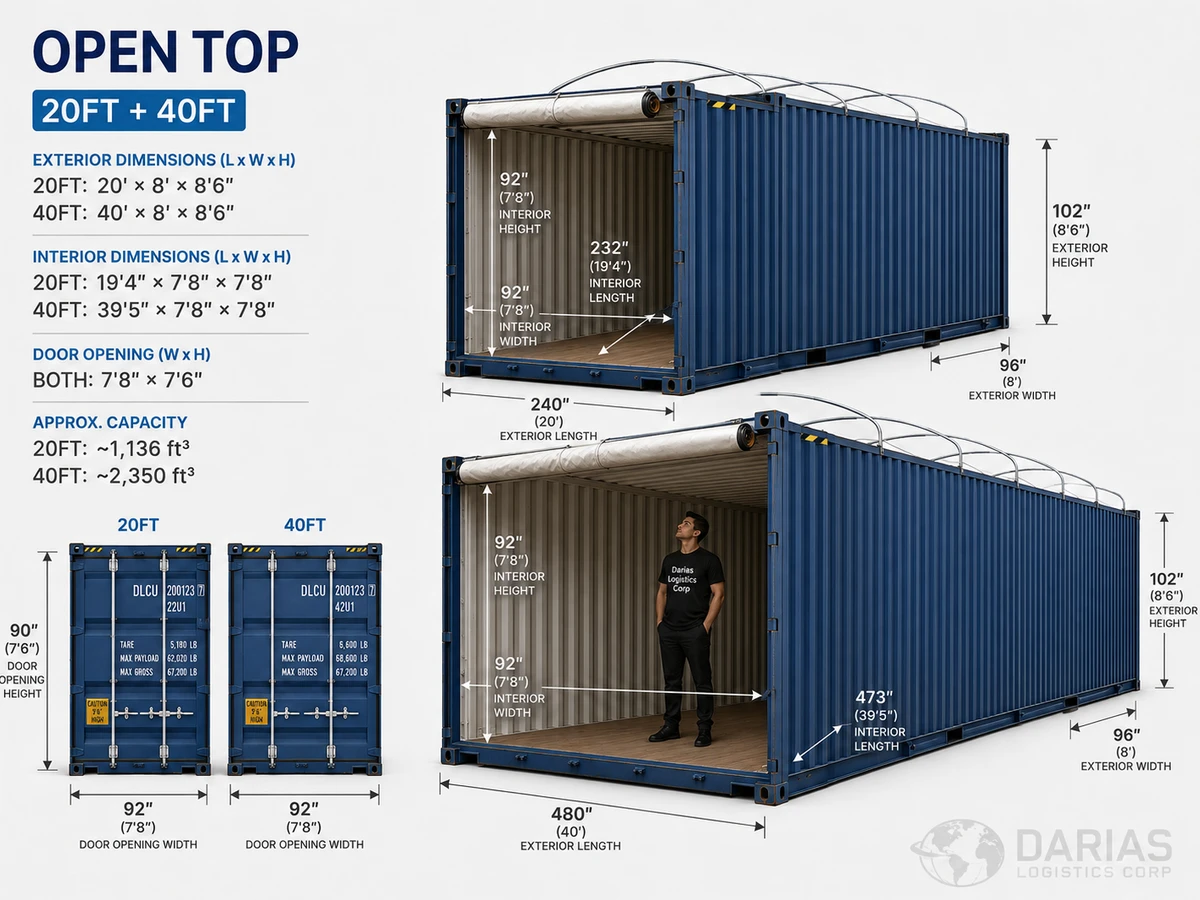
Specifiche
| Misura | Open top |
|---|---|
| Lunghezza esterna | 480″ 40′ |
| Larghezza esterna | 96″ 8′ |
| Altezza esterna | 102″ 8′ 6″ |
| Lunghezza interna | 473″ 39′ 5″ |
| Larghezza interna | 92″ 7′ 8″ |
| Altezza interna | 92″ 7′ 8″ |
| Larghezza porta | 92″ 7′ 8″ |
| Altezza porta | 90″ 7′ 6″ |
| Tara | 8,600 lb |
| Portata max | 58,600 lb |
| Peso legale max su strada | 44,000 lb |
| Peso lordo max | 67,200 lb |
| Capacità | 2,350 piedi³ |
| Chassis | Standard, to the box length |
| Dati riferiti a | 40ft |
| Esiste anche da | 20ft |
Questi sono valori nominali per questo tipo di attrezzatura. I container reali variano per costruttore, compagnia e anno, e la tara è stampigliata sulla porta dell'unità che le arriva. Ci mandi il numero del container e lo verifichiamo su quello vero.
What an open top container is
An open top is an ordinary container with the steel roof replaced by removable bows and a tarpaulin. Four walls, a floor, doors at one end, and an opening above so a crane can lower cargo straight in. The figures shown here are for the 40 ft version: about 40 ft by 8 ft by 8 ft 6 in outside, roughly 39 ft 5 in by 7 ft 8 in by 7 ft 8 in inside, a door opening near 7 ft 8 in by 7 ft 6 in, and around 2,350 cu ft. It also runs as a 20.
These are nominal figures for the type. The one difference worth noting against a dry box is the interior height: at roughly 7 ft 8 in it is slightly lower than a standard container's ceiling, because the roof structure is built to be taken off rather than to be part of the shell. Typical tare is near 8,600 lb.
When an open top is the right answer
Choose it when the cargo will not go through a door but will sit inside the walls. Machinery lifted in by crane, a tall crated piece, timber or pipe that is easier to drop in than to push in, anything where the loading method rather than the size is the obstacle. The walls still do their job: the load is enclosed, secured to lashing points and reasonably protected.
If the piece is wider than the container, the open top cannot help and a flat rack is the answer, since it has no sides to be wider than. If the piece is simply tall and the trip is over the road rather than over water, a step deck or a double drop trailer often makes more sense than a container at all. And if it fits through a door and hates the weather, use a dry box: an open top is a tarpaulin, not a roof.
What people get wrong: the rails are the line between in gauge and out of gauge
Everything changes at the top rail. Below it, with the bows in and the sheet closed, this is an ordinary container that moves on an ordinary chassis under an ordinary booking. Above it, the shipment is out of gauge: the tarpaulin will not close, the height has to be measured from the road rather than guessed, and the move is permitted and routed rather than simply dispatched. Florida's legal travel height is 13 ft 6 in, and what has to fit under it is the chassis deck plus the box plus whatever is standing proud of it.
That has a local consequence worth knowing before the booking rather than at the gate. An over dimensional box cannot use the PortMiami Tunnel, so it leaves over the Port Boulevard bridge and through downtown instead, which is a routing and a timing decision as much as a permit one. Measure the cargo on its cradle or skid, including the securing gear, and send that height rather than the cargo's own dimensions.
What to send to get it booked
The container number, the steamship line and the terminal as always, and the box length, since a 20 and a 40 take different chassis. Then the thing that is specific to this equipment: how high the cargo stands, measured from the container floor, and whether anything is above the rails.
If it is out of gauge, send the piece's length, width and height, its weight, and where its lifting or securing points are, because the permit and the routing are worked out from those numbers. Say whether a crane is available at the delivery end and whether the tarpaulin will be closed for the road leg. Those answers decide the equipment, the route and the day, and they take a minute to give at the start.
Work it out first
Esce da
Va a
More in this section
Domande
Risposte dirette
What is the difference between an open top and a flat rack?
An open top is a complete container with four walls and a tarpaulin instead of a steel roof, so it is loaded from above but still encloses the cargo. A flat rack has a deck and two collapsible end walls and no sides at all, so it takes cargo that is too wide as well as too tall. If your freight fits within the walls and only the roof is in the way, the open top is the simpler and better protected answer.
Can cargo stick out of the top of an open top container?
Yes, and that is a large part of why the box exists, but the moment anything stands above the rails the shipment is out of gauge. The tarpaulin cannot be closed, the load has to be measured and permitted as an over dimensional move on the road, and the routing can change. In gauge, with everything below the rails and the tarpaulin on, it travels like any other container.
How is an open top container loaded?
From above, with a crane or a gantry, which is the entire point of the type. The removable roof bows and the tarpaulin come off, the piece is lowered in and secured to the lashing points, and the bows and sheet go back on if the cargo is in gauge. Many open tops also have a swinging door header, so a long piece can be fed in through the end when lifting straight down is not possible.
Does an open top container keep the rain out?
With the bows in place and the tarpaulin correctly closed and roped, it keeps out weather the way a tarped load does, which is well but not perfectly. It is not a sealed steel roof and it should not be treated as one for cargo that cannot take any moisture at all. If the freight is genuinely weather sensitive and fits through a door, an ordinary dry container is the drier choice.
Do open tops come in 20ft as well as 40ft?
Both, and the figures on this page are the 40 ft ones. A 20 ft open top has the same construction in the short shell, so interior length drops to roughly a 20's dimensions while the width, the door and the way it is loaded stay the same. Which one you want follows the cargo footprint. Say the length when you ask, since the chassis is matched to the box.
Quali sono le misure interne di un Open top?
Lunghezza, larghezza e altezza interne sono nella tabella delle specifiche di questa pagina, accanto alle misure esterne e all'apertura della porta. È l'apertura della porta a decidere se una macchina ci passa, ed è più piccola dell'interno.
Che chassis serve per un Open top?
Standard, to the box length. Lo chassis lo portiamo noi, così la prenotazione non dipende da cosa il terminal ha disponibile quella mattina.
Lo gestite in sovrappeso?
Sì, con lo chassis giusto e il permesso giusto. Il sovrappeso è una questione a parte rispetto alla dimensione del container, e i porti hanno limiti propri oltre a quelli dello stato.
Da dove ritirate un Open top?
Port of Miami, Port Everglades, Port of Palm Beach, POMTOC, South Florida Container Terminal, Seaboard Marine, Florida International Terminal, Port Everglades Terminal, Crowley, King Ocean, MSC, Tropical Shipping, Antillean Marine, FEC Port Everglades ICTF, FEC Hialeah rail ramp and CSX ramp.
Cos'è il last free day?
L'ultimo giorno in cui il suo container può restare dentro il terminal prima che partano gli addebiti di stoccaggio. Se lo si supera, il demurrage matura ogni giorno, ed è per questo che un pre-pull costa quasi sempre meno dell'attesa.
Cos'è un pre-pull?
Ritiriamo il container dal terminal prima che lei sia pronto e lo teniamo in un piazzale. Ferma il demurrage a tariffe di terminal e toglie pressione ai suoi orari di ricevimento.
Che differenza c'è tra demurrage, per diem e detention?
Tre addebiti diversi, da soggetti diversi. Il demurrage è il terminal che le addebita la merce ferma dentro il gate oltre il tempo libero. Il per diem è la compagnia di navigazione che le addebita il suo container tenuto fuori oltre il tempo libero. Il detention è il tempo del trasportatore, addebitato quando un autista aspetta alla sua banchina oltre la finestra libera. Possono correre insieme, ed è così che una fattura diventa pesante in fretta.
Come ottengo una tariffa?
Ci mandi la tratta, il mezzo, la dimensione del container e il porto, e le rispondiamo con un numero. Preventivi e dispatch 24 ore su 24 a quotes@dariaslogistics.com.
Cosa comprende davvero un preventivo di drayage?
Il trasporto in sé, più gli accessori che poi sorprendono: chassis, pre-pull, per diem, demurrage, detention e stoccaggio. Preferiamo indicarli subito piuttosto che aggiungerli a una fattura.