外尺寸、内尺寸和箱门
外观示意
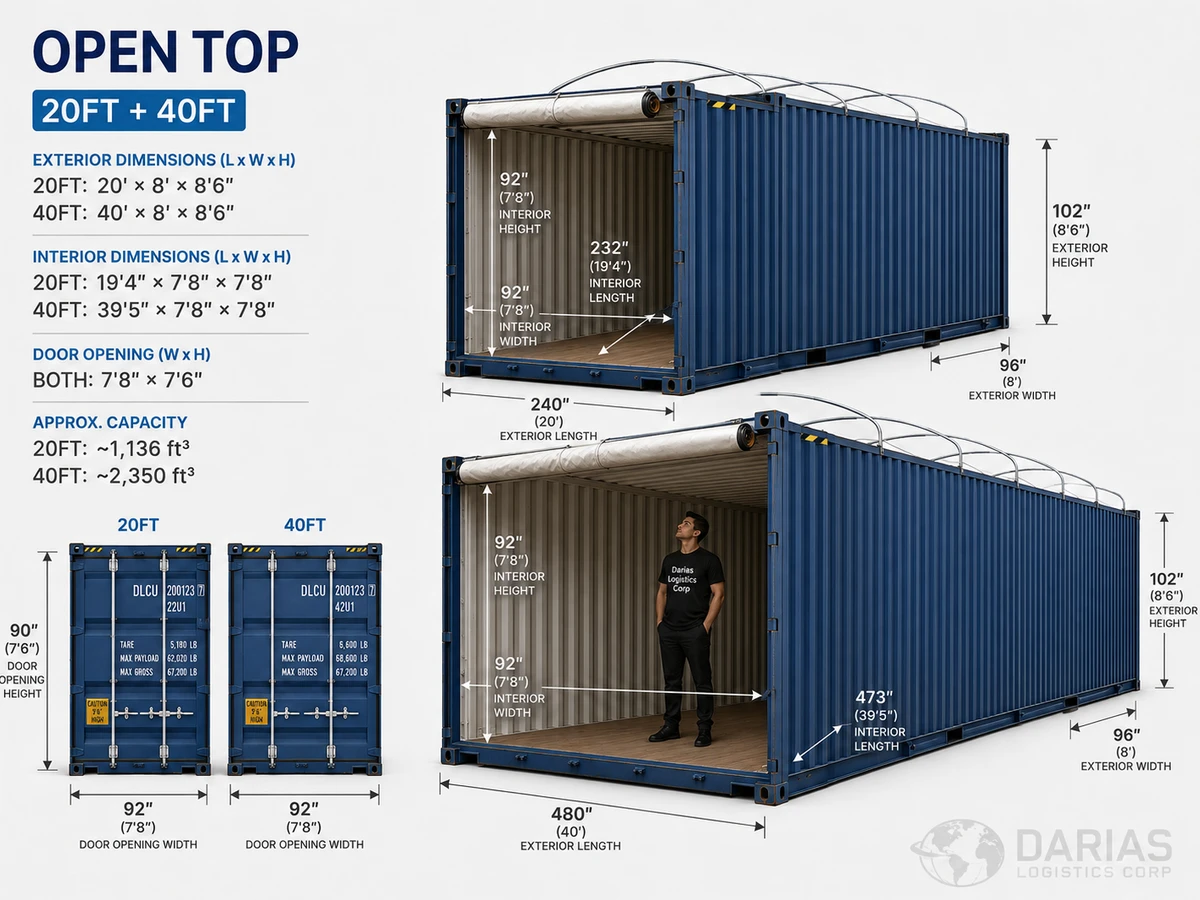
规格参数
| 项目 | 开顶箱 |
|---|---|
| 外长 | 480″ 40′ |
| 外宽 | 96″ 8′ |
| 外高 | 102″ 8′ 6″ |
| 内长 | 473″ 39′ 5″ |
| 内宽 | 92″ 7′ 8″ |
| 内高 | 92″ 7′ 8″ |
| 门宽 | 92″ 7′ 8″ |
| 门高 | 90″ 7′ 6″ |
| 皮重 | 8,600 lb |
| 最大载重 | 58,600 lb |
| 公路合法最大载重 | 44,000 lb |
| 最大总重 | 67,200 lb |
| 容积 | 2,350 立方英尺 |
| 底盘车 | Standard, to the box length |
| 表中数据对应 | 40ft |
| 另有 | 20ft |
这些是该类设备的标称数据。 实际箱子会因厂家、船公司和年份而不同,皮重以您拿到那只箱子门上的钢印为准。把箱号发给我们,我们按实际箱子核对。
What an open top container is
An open top is an ordinary container with the steel roof replaced by removable bows and a tarpaulin. Four walls, a floor, doors at one end, and an opening above so a crane can lower cargo straight in. The figures shown here are for the 40 ft version: about 40 ft by 8 ft by 8 ft 6 in outside, roughly 39 ft 5 in by 7 ft 8 in by 7 ft 8 in inside, a door opening near 7 ft 8 in by 7 ft 6 in, and around 2,350 cu ft. It also runs as a 20.
These are nominal figures for the type. The one difference worth noting against a dry box is the interior height: at roughly 7 ft 8 in it is slightly lower than a standard container's ceiling, because the roof structure is built to be taken off rather than to be part of the shell. Typical tare is near 8,600 lb.
When an open top is the right answer
Choose it when the cargo will not go through a door but will sit inside the walls. Machinery lifted in by crane, a tall crated piece, timber or pipe that is easier to drop in than to push in, anything where the loading method rather than the size is the obstacle. The walls still do their job: the load is enclosed, secured to lashing points and reasonably protected.
If the piece is wider than the container, the open top cannot help and a flat rack is the answer, since it has no sides to be wider than. If the piece is simply tall and the trip is over the road rather than over water, a step deck or a double drop trailer often makes more sense than a container at all. And if it fits through a door and hates the weather, use a dry box: an open top is a tarpaulin, not a roof.
What people get wrong: the rails are the line between in gauge and out of gauge
Everything changes at the top rail. Below it, with the bows in and the sheet closed, this is an ordinary container that moves on an ordinary chassis under an ordinary booking. Above it, the shipment is out of gauge: the tarpaulin will not close, the height has to be measured from the road rather than guessed, and the move is permitted and routed rather than simply dispatched. Florida's legal travel height is 13 ft 6 in, and what has to fit under it is the chassis deck plus the box plus whatever is standing proud of it.
That has a local consequence worth knowing before the booking rather than at the gate. An over dimensional box cannot use the PortMiami Tunnel, so it leaves over the Port Boulevard bridge and through downtown instead, which is a routing and a timing decision as much as a permit one. Measure the cargo on its cradle or skid, including the securing gear, and send that height rather than the cargo's own dimensions.
What to send to get it booked
The container number, the steamship line and the terminal as always, and the box length, since a 20 and a 40 take different chassis. Then the thing that is specific to this equipment: how high the cargo stands, measured from the container floor, and whether anything is above the rails.
If it is out of gauge, send the piece's length, width and height, its weight, and where its lifting or securing points are, because the permit and the routing are worked out from those numbers. Say whether a crane is available at the delivery end and whether the tarpaulin will be closed for the road leg. Those answers decide the equipment, the route and the day, and they take a minute to give at the start.
Work it out first
提自
运往
常见问题
直接回答
What is the difference between an open top and a flat rack?
An open top is a complete container with four walls and a tarpaulin instead of a steel roof, so it is loaded from above but still encloses the cargo. A flat rack has a deck and two collapsible end walls and no sides at all, so it takes cargo that is too wide as well as too tall. If your freight fits within the walls and only the roof is in the way, the open top is the simpler and better protected answer.
Can cargo stick out of the top of an open top container?
Yes, and that is a large part of why the box exists, but the moment anything stands above the rails the shipment is out of gauge. The tarpaulin cannot be closed, the load has to be measured and permitted as an over dimensional move on the road, and the routing can change. In gauge, with everything below the rails and the tarpaulin on, it travels like any other container.
How is an open top container loaded?
From above, with a crane or a gantry, which is the entire point of the type. The removable roof bows and the tarpaulin come off, the piece is lowered in and secured to the lashing points, and the bows and sheet go back on if the cargo is in gauge. Many open tops also have a swinging door header, so a long piece can be fed in through the end when lifting straight down is not possible.
Does an open top container keep the rain out?
With the bows in place and the tarpaulin correctly closed and roped, it keeps out weather the way a tarped load does, which is well but not perfectly. It is not a sealed steel roof and it should not be treated as one for cargo that cannot take any moisture at all. If the freight is genuinely weather sensitive and fits through a door, an ordinary dry container is the drier choice.
Do open tops come in 20ft as well as 40ft?
Both, and the figures on this page are the 40 ft ones. A 20 ft open top has the same construction in the short shell, so interior length drops to roughly a 20's dimensions while the width, the door and the way it is loaded stay the same. Which one you want follows the cargo footprint. Say the length when you ask, since the chassis is matched to the box.
开顶箱 的内尺寸是多少?
内长、内宽和内高都列在本页的规格表里,外尺寸和箱门开口也在同一张表上。真正决定一台机器进不进得去的是箱门开口,它比内尺寸更小。
开顶箱 需要什么底盘车?
Standard, to the box length. 底盘车由我们自备,所以订不订得成,不取决于码头那天早上有什么车。
超重的能拉吗?
能,用对的底盘车,配上对的许可。超重和箱型尺寸是两个分开的问题,而且各港口在州的限值之外还有自己的限值。
你们从哪里提 开顶箱?
Port of Miami, Port Everglades, Port of Palm Beach, POMTOC, South Florida Container Terminal, Seaboard Marine, Florida International Terminal, Port Everglades Terminal, Crowley, King Ocean, MSC, Tropical Shipping, Antillean Marine, FEC Port Everglades ICTF, FEC Hialeah rail ramp and CSX ramp.
什么是免堆期最后一天(last free day)?
您的箱子可以免费停在码头里面的最后一天。过了这一天,滞港费就开始按天累计,所以提前提箱几乎总是比干等便宜。
什么是提前提箱(pre-pull)?
在您准备好收货之前,我们先把箱子从码头提出来,放在堆场上。这样滞港费就不会按码头的费率往上跑,您的收货安排也不用再赶。
滞港费、滞箱费和车辆滞留费有什么区别?
这是三笔来自不同收费方的费用。滞港费是码头向您收的,因为超过免费时间之后货还留在闸口里面。滞箱费是船公司向您收的,因为超过免费时间之后您还占着他们的箱子。车辆滞留费是卡车方的时间成本,司机在您的月台等候超过免费时段之后开始计算。这三笔可以同时在跑,账单就是这样很快变得难看的。
怎么拿到运价?
把线路、设备、集装箱尺寸和港口发过来,我们回一个数字。报价和调度24小时都有人,邮箱 quotes@dariaslogistics.com。
一份拖车报价里到底包含什么?
运输本身,加上那些事后最容易让人措手不及的附加费:底盘车、提前提箱、滞箱费、滞港费、车辆滞留费和仓储费。我们宁可一开始就把它们说清楚,也不愿意事后加到账单上。