外观示意
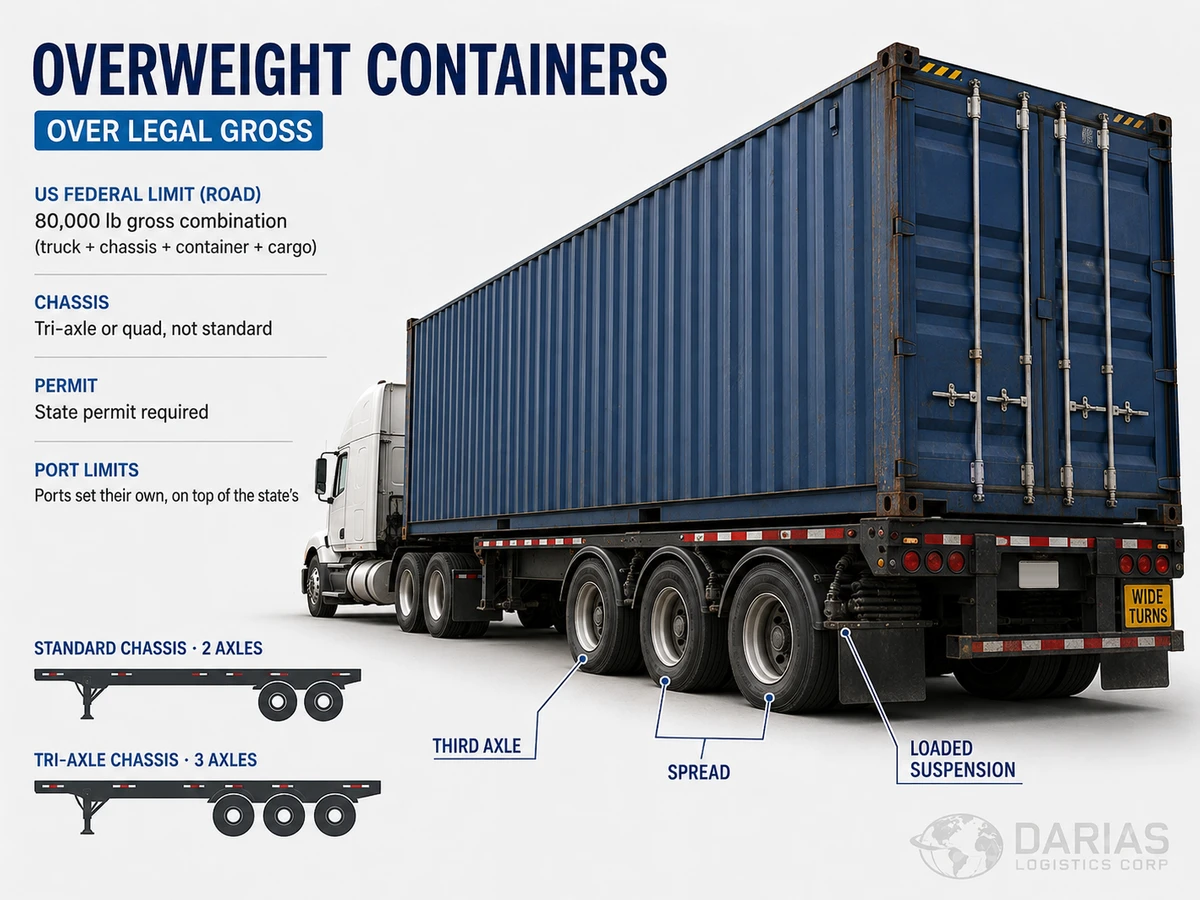
规格参数
| 项目 | 超重集装箱 |
|---|---|
| 底盘车 | Tri-axle, and a permit |
What to do with an overweight box
Reference
What it weighs empty, and what it may legally carry
Florida legal gross is 80,000 lb for the whole combination, 34,000 lb on a tandem and 20,000 lb on a single axle, and the bridge formula ties the allowance to axle spacing. The tractor, the chassis or trailer and the empty box all come out of that 80,000 before the cargo does, which is why the empty weights matter. Over the legal figure the load is a permitted overweight move, not a forbidden one.
| Equipment | Empty weight, typical | Who publishes the figure |
|---|---|---|
| Day cab tractor, fueled | 15,000 to 20,000 lb | no maker publishes a curb weight; scale tickets |
| 40 ft gooseneck chassis, 2 axles | 6,400 lb | Cheetah Chassis |
| 20 ft extendable chassis | 6,450 lb | Cheetah Chassis |
| 20/40 ft tri-axle chassis | 9,350 to 9,700 lb | Cheetah Chassis |
| 平板车 | 10,300 lb | Fontaine Infinity 48 ft combo, 10,180 to 10,420 |
| step deck 凹板车 | 11,000 lb | Fontaine Infinity drop deck 10,495; Velocity steel 11,480 |
| 低平板车(lowboy) | 17,900 lb | Pitts 35 ton fixed neck from 17,900; 17,000 to 24,000 by build |
| RGN 可拆卸鹅颈低平板车 | 22,500 lb | Talbert 55 ton 22,510; Kalyn Siebert 21,592; 23,300 with a flip axle |
| 厢式挂车 | 13,600 lb | Great Dane 13,300; Wabash DuraPlate 13,600 to 13,900 |
| 冷藏挂车 | 14,500 lb | Utility 3000R with unit 14,455; Great Dane Everest 15,200 |
| Container | Weight of the empty box | Max cargo on a normal chassis | Max cargo on a tri-axle chassis | Max cargo with an overweight permit |
|---|---|---|---|---|
| 20英尺标准箱 | 4,850 lb | 38,000 lb | 44,000 lb | 46,000 lb |
| 20英尺高柜 | 5,200 lb | 38,000 lb | 44,000 lb | 46,000 lb |
| 40英尺标准箱 | 8,380 lb | 44,000 lb | 51,000 lb | |
| 40英尺高柜 | 8,750 lb | 44,000 lb | 51,000 lb | |
| 45英尺高柜 | 10,580 lb | 41,700 lb | ||
| 45 英尺 high cube,102 英寸宽 | 10,220 lb | 41,700 lb | ||
| 20英尺冷藏箱 | 6,600 lb | 34,000 lb | 40,000 lb | 41,000 lb |
| 40英尺冷藏箱 | 10,500 lb | 40,000 lb | 43,000 lb | |
| 40英尺高柜冷藏箱 | 10,580 lb | 40,000 lb | 43,000 lb | |
| 开顶箱 | 8,600 lb | 44,000 lb | 51,000 lb |
| Trailer | Weight of the empty trailer | Max cargo, legal without a permit |
|---|---|---|
| 平板车 | 10,300 lb | 48,000 lb |
| step deck 凹板车 | 11,000 lb | 48,000 lb |
| 低平板车(lowboy) | 17,900 lb | 80,000 lbwhat the trailer is built to carry; anything near it moves under an overweight permit with extra axles |
| RGN 可拆卸鹅颈低平板车 | 22,500 lb | 150,000 lbwhat the trailer is built to carry; anything near it moves under an overweight permit with extra axles |
| 厢式挂车 | 13,600 lb | 45,000 lb |
| 冷藏挂车 | 14,500 lb | 44,000 lb |
Container figures: the Florida road weight table published for drayage, the ocean carriers' OCEMA guideline, and Crowley's equipment specifications; box tares are nominal for the type and the real one is stencilled on the door. Trailer and chassis figures: the makers and their dealers, as named. Empty weights move by build and options, so treat them as typical and weigh the real unit when a load is close to a limit.
这些是该类设备的标称数据。 实际箱子会因厂家、船公司和年份而不同,皮重以您拿到那只箱子门上的钢印为准。把箱号发给我们,我们按实际箱子核对。
What overweight actually means
A container is overweight when the truck under it breaks a road limit, and there is more than one limit to break. The combination is capped at 80,000 lb gross. A tandem axle set is capped at 34,000 lb and a single axle at 20,000 lb. On top of those, the bridge formula ties the allowable weight to how far apart the axles sit, so two identical weights on differently spaced axles are not equally legal.
None of this has anything to do with what the container is rated to hold. A box rated at 67,200 lb gross is describing its own steel and its behaviour in a ship. The road is a separate system of rules with separate numbers, and a shipment can be perfectly legal at sea, legal at the terminal, and illegal the moment it reaches a public road.
Two ways to solve it: permit it, or take the freight out
A permitted move keeps the freight in the box and puts the right equipment under it. More axles, spread further, so no group carries more than it may, plus a permit for the route and often a specific time to run it. That is the right answer for a short run: port to a consignee a few miles away, or port to a warehouse for devanning. The paperwork and the equipment are worth it over a small distance.
Transloading is the other answer, and it wins over distance. The container is emptied at a dock near the port and the freight is reloaded onto domestic trailers that run legal the whole way. It costs a handling, and it gives you two things back: a run with no permits and no route restrictions, and an empty container that can be returned immediately, which ends the line's per diem clock rather than letting it run to the receiver and back.
What people get wrong: gross is not the only limit, and a 20 is the worst offender
The most common error is checking one number. A load can sit at 76,000 lb gross, comfortably under the legal cap, and still be illegal because 36,000 lb of it lands on one tandem set. Axle limits are what scales weigh, and axle weight is decided by where the load sits and how the equipment is configured, not by the total on the bill of lading.
That is why short boxes cause most of the trouble. A 20 ft container sits forward and concentrates its whole load over a single tandem group, so it hits the 34,000 lb cap and the bridge formula long before the combination approaches 80,000 lb. The result catches people out every week: a 20 can need a permit at a weight a 40 would carry without comment, and arithmetic based on 80,000 lb minus the equipment will be wrong by about ten thousand pounds.
What to send to get it booked
The cargo weight as it reads on the bill of lading or the verified gross mass, not an estimate and not a number rounded down for convenience. The container number, the steamship line and the terminal, because the gate rules and the appointment follow them. The delivery address, since the route decides the permit and some routes are not permittable at all.
Then say how far the freight is going and what is in the box. Those two answers decide whether this is a permitted move or a transload, and the second is often cheaper than shippers expect. Settle it before an appointment is taken: a load that turns up at a gate heavier than the paperwork says has already cost the day, and the ports carry their own limits on top of the state's.
提自
运往
常见问题
直接回答
What counts as an overweight container in Florida?
Anything that puts the combination over a legal limit, and there are several. The whole vehicle is capped at 80,000 lb gross, a tandem axle set at 34,000 lb and a single axle at 20,000 lb, and the bridge formula ties what is allowed to how far the axles are spread. A container can breach the axle limits while sitting comfortably under 80,000 lb gross, which is exactly how a short box becomes overweight.
How heavy can a container be with an overweight permit?
It depends on the permit and on the axles under the load rather than on the box. Permitted port moves in this part of Florida are commonly worked well above the legal 80,000 lb gross, with the ceiling set by the permit that is issued for that route and that configuration. The equipment has to justify it: more axles, spread further apart, so the weight per axle stays inside what the permit and the pavement allow.
Is it cheaper to transload than to run a container overweight?
Often, and it depends almost entirely on how far the freight is going. A permitted overweight move is worth it for a short run from the port to a nearby consignee. For anything inland, taking the freight out of the container at a dock near the port and splitting it across domestic trailers usually wins twice: the trailers run legal all the way, and the line's box goes back early, which stops per diem instead of paying it.
Do the ports have their own weight limits?
Yes, and they sit on top of the state's rather than replacing them. A terminal can cap what it will gate out, and what is allowed on the roads immediately around a port is not always what is allowed on a state highway. That is why a load which is legal on paper for a highway run can still be refused at a gate, and why the weight is worth settling before an appointment is taken rather than at the scale.
What does a tri-axle chassis actually change?
It puts a third axle under the container, so the same weight is shared across more points of contact and spread over a longer wheelbase. Since the binding limits are per axle group and by axle spacing rather than simply total, that spreading is what turns an illegal load into a legal one. It is why the road figure for a 20 rises from roughly 38,000 lb of cargo on a standard chassis to around 44,000 lb on a tri-axle.
超重集装箱 需要什么底盘车?
Tri-axle, and a permit. 底盘车由我们自备,所以订不订得成,不取决于码头那天早上有什么车。
超重的能拉吗?
能,用对的底盘车,配上对的许可。超重和箱型尺寸是两个分开的问题,而且各港口在州的限值之外还有自己的限值。
你们从哪里提 超重集装箱?
Port of Miami, Port Everglades, Port of Palm Beach, POMTOC, South Florida Container Terminal, Seaboard Marine, Florida International Terminal, Port Everglades Terminal, Crowley, King Ocean, MSC, Tropical Shipping, Antillean Marine, FEC Port Everglades ICTF, FEC Hialeah rail ramp and CSX ramp.
什么是免堆期最后一天(last free day)?
您的箱子可以免费停在码头里面的最后一天。过了这一天,滞港费就开始按天累计,所以提前提箱几乎总是比干等便宜。
什么是提前提箱(pre-pull)?
在您准备好收货之前,我们先把箱子从码头提出来,放在堆场上。这样滞港费就不会按码头的费率往上跑,您的收货安排也不用再赶。
滞港费、滞箱费和车辆滞留费有什么区别?
这是三笔来自不同收费方的费用。滞港费是码头向您收的,因为超过免费时间之后货还留在闸口里面。滞箱费是船公司向您收的,因为超过免费时间之后您还占着他们的箱子。车辆滞留费是卡车方的时间成本,司机在您的月台等候超过免费时段之后开始计算。这三笔可以同时在跑,账单就是这样很快变得难看的。
怎么拿到运价?
把线路、设备、集装箱尺寸和港口发过来,我们回一个数字。报价和调度24小时都有人,邮箱 quotes@dariaslogistics.com。
一份拖车报价里到底包含什么?
运输本身,加上那些事后最容易让人措手不及的附加费:底盘车、提前提箱、滞箱费、滞港费、车辆滞留费和仓储费。我们宁可一开始就把它们说清楚,也不愿意事后加到账单上。