服务
Damaged container transport
The corner fitting is crushed, the twistlocks will not engage, and the box will not lock to a chassis. It still has to leave the terminal. It moves on a step deck, chained through the castings, and the height works out under the legal limit. Here is why, and what has to happen at each end.
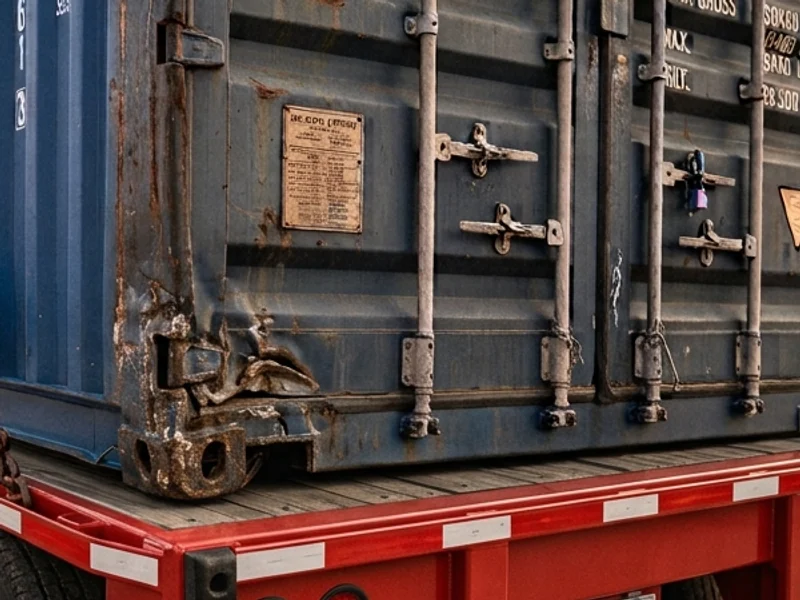
Why it will not go on a chassis
A container does not sit on a chassis, it locks to one. The federal securement rule, 49 CFR 393.126(b), asks for all four lower corners secured with devices that cannot unintentionally come unfastened, for the front and rear to be secured independently of each other, and for the whole thing to hold the box inside half an inch of movement fore, aft and sideways and one inch vertically. Four corners, not three.
So one crushed corner fitting takes the whole system out. Corner fitting is what ISO 1161 and the repair manuals call the part; every yard in Miami says corner casting, and both mean the same steel block at each of the eight corners, the thing every twistlock, crane and chassis pin grabs the container by. The securement rule never uses the word twistlock and does not name your box specifically. What it does say, at 49 CFR 393.104(c), is that the anchor points a load is secured through have to be sound, with no damaged or weakened components. A corner fitting is an anchor point. Bend it and there is nothing left to build a compliant chassis securement around, whatever the rest of the container looks like.
The tolerances are why a dent is enough. ISO 1161 fixes the hole in the underside of each bottom corner fitting at 124mm long by 63.5mm across the flats (the slot the twistlock cone passes up through), and it may run up to 1.5mm larger but never smaller. The largest standard twistlock cone is 100mm by 57mm. On the narrow axis that leaves roughly 3mm of daylight on each side, and the standard has already spent that 3mm on ordinary manufacturing variation in the container and in the chassis. Nothing in the budget is set aside for damage.
Which is why nobody publishes a maximum permitted distortion, and the inspection regimes do not try. They define the limit by what happens instead: deformation preventing correct twist-lock operation, in the Container Owners Association's words. The test in the yard is exactly what it sounds like, whether the lock goes in and turns. And there is no straightening it afterwards. IICL's repair manual is blunt about that: filling of cracks is not permitted, and corner fittings may be repaired only by replacement.
That is the honest version of why your driver said no. Not a preference, not a terminal policy, and not anybody being difficult about a dent.
Racking, and what it means with a tape measure
Damage that stops a box locking is not always a fitting you can see. A container that has been dropped or badly loaded can rack, which is the industry's own word for it and which ISO 3874 defines as deformation of the container end or side frames under transverse forces. In plain terms the box has been pushed out of shape sideways, so the corners are no longer in the rectangle the equipment expects, while every one of them still looks perfectly fine.
ISO 668 puts numbers on it. Measure the diagonals across the base and across the top, and the difference between them is what the standard calls K1 (how far out of true the box is, corner to corner). On a 40ft box K1 cannot exceed 19mm, about three quarters of an inch. On a 20ft it is 13mm, about half an inch. The end frame diagonals get their own limit of 10mm. Past those, the fittings are no longer where the equipment is built to meet them.
The repair industry has a code for what that means. Under CEDEX, the damage coding system the depots and lessors write their reports in, the unit gets marked NI, not within ISO dimensions, which the code list defines as equipment that is no longer usable because it has left the ISO dimensional envelope. Not damaged, not awaiting repair. Out.
There is a reason the same chassis takes every box you have ever seen: the corner fittings sit 2,259mm apart across the width on a 10ft container, a 20, a 40 and a 45 alike. That number never changes. It is the one dimension the whole intermodal system agrees on, and it is why a box a few millimetres out of true becomes a problem out of all proportion to how it looks.
It is not always the corners
Two other kinds of damage stop a box going on a chassis, and neither one is at a corner. Both are worth ruling out before anybody books a truck, because both produce the same phone call.
The first is the gooseneck tunnel (the recessed channel in the underside of a 40ft box that lets it drop over the raised neck of a gooseneck chassis). IICL treats a crushed one as a chassis-loading question rather than a cosmetic one, and says so in those terms: the tunnel rail needs work when it is deflected in such a manner as to impede loading the unit to a gooseneck chassis, or when it is out beyond the ISO tolerance by 10mm or more. A box with four perfect corners and a squashed tunnel still will not seat.
The second is underneath. ISO 1496-1 draws an imaginary plane 12.5mm above the bottom faces of the corner fittings and allows nothing except those fittings and the bottom side rails to hang below it. A bent crossmember (one of the steel ribs running across under the floor) that drops past that line fouls the chassis it is meant to sit on.
Neither is visible from the door end, which is where most people look.
The answer is a step deck, and the reason is arithmetic
Florida caps vehicle height at 13ft 6in, and the statute says inclusive of the load, so it is the whole thing from the road surface up. Worth saying plainly, because it gets called a federal rule constantly: there is no federal height limit. The states set it, and they run from 13ft 6in to about 14ft, so a load that is fine here can be over the line in the next state.
A step deck's lower deck sits between 36 and 42 inches off the ground, depending on the trailer and its tires. Put a 9ft 6in high cube on it and you are between 12ft 6in and 13ft 0in overall. It clears, with six to twelve inches in hand, and it needs no permit at all.
A flatbed deck is between 58 and 62 inches. The same box on one is 14ft 0in to 14ft 8in, and that is over the limit at every deck height any manufacturer builds. Over the limit is not the same as forbidden, and this is where a lot of bad advice lives: from 13ft 6in up to 14ft 6in Florida issues a routine overheight permit, no escort and no route survey, any day and any hour. Past 14ft 6in it changes character, because a high pole escort car has to run ahead of the load and movement drops to daytime on weekdays. So a flatbed can be done. It is a permitted move with a schedule attached, where the step deck is simply a truck.
One caveat on the margin, because it is the kind of thing that turns a legal load into an illegal one in the yard. Those six to twelve inches assume the container sits on the deck. Lay a 2x4 under the rails and you have spent an inch and a half of it. Crib it up on 4x4s and you have spent three and a half.
A step deck rides lower than the chassis the box could not sit on
This is the part people do not expect. A standard container chassis carries the box at 48 inches, give or take an inch. A step deck's lower deck is 36 to 42. The step deck is six to twelve inches lower than the equipment the container was supposed to travel on.
Which means the arithmetic that makes drayage people nervous about high cubes works in your favour here. A 9ft 6in box on a standard chassis comes out at exactly 13ft 6in, sitting on the legal limit before you have accounted for a road crown or a settled air bag. The same box on a step deck has real margin under it.
So this is not a compromise you accept because the box is damaged. On height it is better than the move you were originally trying to make. The chassis wins on load path, which is the next section, and on nothing else.
Why not a lowboy, and why we will say so
A lowboy or an RGN sits lower still, so people ask for one. It is the wrong tool, for two reasons that have nothing to do with how low it is.
The well is too short. Across ten manufacturer models the well runs from 24 to 29 feet. A 40ft container overhangs it by eleven to sixteen feet, so the box is not riding in the well at all, it is bridging across the ends of a trailer built to carry a machine down in the middle.
And the load path is wrong. ISO 3874, the standard for handling and securing containers, puts it in one sentence: on carrying vehicles, containers shall be supported by their corner fittings only, or by the intermediate load transferring areas in the base structure only. Those transfer areas are two 250mm wide strips running the length of the base, and an open deck is neither of them. A lowboy's rating is published as a concentrated load in a stated length, a point load centred in the deck, which is a beam number rather than a promise about the deck surface. One manufacturer's own manual says the rating covers the beams only and that crossmember spacing has to be checked separately for the application. Four container corners landing in the wrong places on that deck is exactly the case those warnings are written for.
Naming what we will not do is worth more than a list of everything we own. If somebody offers to put your 40 in a lowboy well, that tells you something.
How it is chained down
There is a federal rule for moving a container on something that is not a chassis, which surprises people. 49 CFR 393.126(c) covers a loaded box on a flat deck, and it is the paragraph most of these moves run under, because a damaged container usually still has the cargo in it. Every lower corner rests on the vehicle, or on a support structure strong enough to carry it that is itself secured to the trailer, and the box is then held either by chains or wire ropes fixed to all four lower corner fittings, or by crossed chains to the upper corners. Front and rear secured independently, again.
An empty box gets its own paragraph, 393.126(d), and it is the exception here rather than the rule. The case it covers is a client sending a damaged empty back to the depot or the return location. It relaxes the all four corners requirement for empties, provided the box is balanced and stable before a single chain goes on, does not hang more than five feet past either end of the trailer, and is secured against moving in any direction.
Two numbers underneath that catch people out. The chains together have to carry a working load limit of at least half the weight of the box, and a chain running from the deck up to a corner fitting only counts for half of its rating, because it lands on the cargo rather than passing over it and down the other side. And because a container on a deck is not contained by the walls of the vehicle the way freight in a trailer is, the securement has to press down on it with a fifth of its own weight on top of everything else.
Then the part that is a legal duty rather than good practice: the load gets checked inside the first fifty miles and again every three hours or hundred and fifty miles after that. Chains on a damaged box relax as it settles, more than they would on a sound one, and both the driver and the carrier answer for it.
Both ends of this move are places that handle containers
Here is what a chassis was quietly doing for you. It is not that the trailer drives out from under the container, because it does not, it is locked down the same as anywhere else. It is that with a container on a chassis nobody ever has to lift the box: the driver backs it to a dock, the doors open at dock height, and the cargo comes out. The container never touches the ground.
On a flat deck that is gone, so the move runs between places that own the machine. The terminal picks the box up and sets it on the trailer with its own top pick or reach stacker, and it comes off the same way at the other end, at a depot or another terminal. That is the normal routing for a damaged box, and it is why the delivery point is a container facility rather than somebody's dock.
It is also why a warehouse is not a substitute, however big the forklift looks. The federal lifting standard used for this work approves the forklift method for loaded 20ft containers and does not approve it for a loaded 40 at all. Most 40ft boxes have no fork pockets to begin with, and where pockets exist they are rated for an empty or lightly loaded box. Beyond the rating there is the geometry: a forklift is rated at a 24 inch load center and a container is eight feet wide, so the machine is nowhere near its plated capacity by the time the weight is where the box puts it, and you would need eight foot tines to span it. Going under the floor with standard forks bends the bottom rail, which turns a repair bill into a bigger one.
So the planning question is not whether the far end can lift a container. It is which depot or terminal the box is going to. That is the line people leave out of the first email, and it is the one that decides the routing.
It costs more than an ordinary drayage move
Worth saying plainly rather than letting it turn up on an invoice. This is priced above a straight container move, and the reason is the equipment, not the inconvenience.
A normal drayage move is a tractor and a chassis. This one is an open deck trailer instead, chains and binders and the time to rig them properly, a lift onto the trailer at the terminal, and a lift or a plan at the far end. Every one of those is a piece of equipment or a machine hour that an ordinary pull does not use.
What we will not do is discover that halfway through. You get the number before the truck is booked, with whatever the move actually needs listed out, so the difference is a decision you made rather than a surprise.
What we need from you to quote it
Container number and size, and whether it is loaded or empty, because that decides which securement rule the move runs under and most of what it costs.
Where the damage is, in whatever words you have. A bottom corner fitting, a bent or bowed bottom side rail, a gooseneck tunnel that has been hit, a door end that will not close, or simply a box that will not lock down and nobody has said why. A photograph of the corner tells us more than a paragraph does.
Where it is now and which depot or terminal it is going to. That is the line people leave out of the first email, and it is the one that decides the routing.
设备
港口
More in this section
常见问题
直接回答
My container will not lock onto a chassis. Can you still move it?
Yes, on a step deck, chained through the corner fittings. A container locks to a chassis at all four bottom corners, so one crushed casting takes the whole securement system out and there is no way to make the chassis work. Moving it on an open deck is a different federal rule, 49 CFR 393.126(c) and (d), and it is a normal move for anyone equipped to do it.
Is a container on a step deck legal on height?
Yes. A step deck's lower deck sits 36 to 42 inches up, so a 9ft 6in high cube comes out between 12ft 6in and 13ft 0in, under Florida's 13ft 6in limit with six to twelve inches to spare and no permit needed. It is actually lower than a standard container chassis, which carries the box at 48 inches and puts that same high cube at exactly 13ft 6in.
Can it go on a flatbed instead?
A flatbed deck is 58 to 62 inches, so a high cube on one is 14ft 0in to 14ft 8in and over Florida's limit at every deck height built. That is not the same as forbidden: from 13ft 6in to 14ft 6in it is a routine overheight permit with no escort and no route survey. Past 14ft 6in a high pole escort car has to run ahead and you lose nights and weekends. A step deck avoids all of it. A standard 8ft 6in box is a different question, and it depends on the individual trailer closely enough that we check rather than assume.
Would a lowboy or an RGN be better, since they sit lower?
A step deck is the better trailer for a container, and that is what we put it on. The well on a lowboy or RGN runs 24 to 29 feet, so a 40ft container overhangs it by eleven to sixteen feet and is bridging the ends rather than riding in the well. A container is built to be carried on its corner fittings or on the load transfer strips under its base, and a lowboy deck is neither. Height is not the only thing that has to work.
Does the move need a permit?
On a step deck, normally not, because the load stays under 13ft 6in. Worth knowing that 13ft 6in is Florida's limit rather than a federal one. There is no federal height limit at all: the states set it and they range from 13ft 6in to about 14ft, so a load that is legal here can be over the line in the next state and a long run gets checked against every state it crosses.
How does the container come off at the other end?
The same way it went on. The terminal sets it on the trailer with a top pick or a reach stacker, and it comes off with the same kind of machine at the other end, at a depot or another terminal rather than at a dock. That is the normal routing for a damaged box, and it is why both ends of the move are places built to handle containers. A warehouse forklift is not an alternative: a loaded 40ft is not an approved forklift lift, and most 40s have no fork pockets at all.
Can a damaged corner fitting just be repaired?
Not straightened, no. IICL's repair manual is explicit that filling cracks is not permitted and that corner fittings may be repaired only by replacement, which is a shipyard-grade job on the line's own equipment, not something done at the kerb. That is why the question is how the box moves in the state it is in, rather than how to make it lock again.
Why does it cost more than a normal container move?
Because of the equipment it takes. An ordinary pull is a tractor and a chassis. This one needs an open deck trailer, chains and binders and the time to rig them, a lift onto the trailer, and a lift or a plan at the far end. You get the number before the truck is booked, with what the move needs listed, rather than finding out on the invoice.
What do you need from me?
The container number and size, whether it is loaded or empty, where the damage is, and which depot or terminal it is going to. A photograph of the damaged corner is worth more than a description of it.
怎么拿到运价?
把线路、设备、集装箱尺寸和港口发过来,我们回一个数字。报价和调度24小时都有人,邮箱 quotes@dariaslogistics.com。
一份拖车报价里到底包含什么?
运输本身,加上那些事后最容易让人措手不及的附加费:底盘车、提前提箱、滞箱费、滞港费、车辆滞留费和仓储费。我们宁可一开始就把它们说清楚,也不愿意事后加到账单上。