外观示意
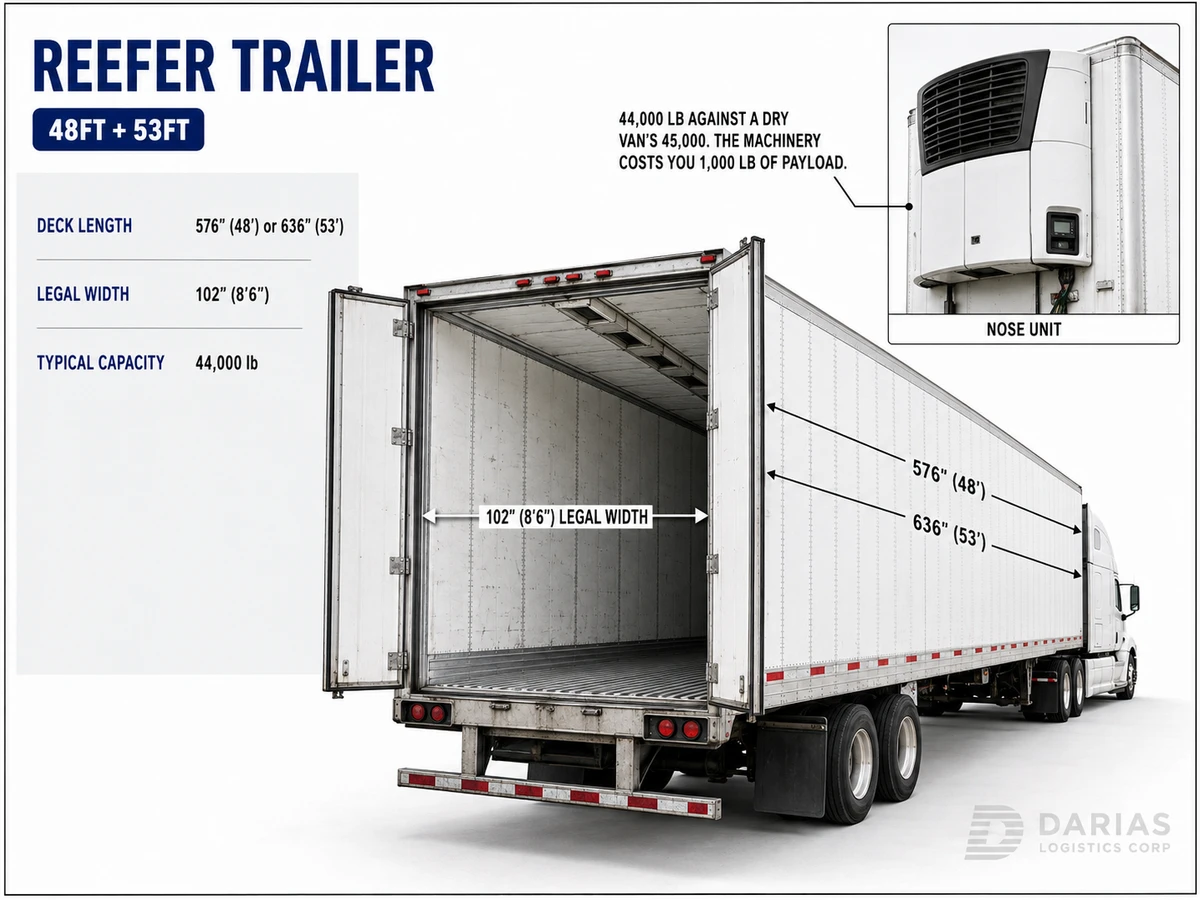
规格参数
| 项目 | 冷藏挂车 |
|---|---|
| 板长 | 48′ 或 53′ |
| 合法宽度 | 8′ 6″ |
| 常规载重 | 44,000 lb |
这些是该类设备的标称数据。 实际箱子会因厂家、船公司和年份而不同,皮重以您拿到那只箱子门上的钢印为准。把箱号发给我们,我们按实际箱子核对。
What a reefer trailer is
A reefer trailer is an insulated highway van with a refrigeration unit built into the front wall and its own diesel tank to run it. It comes in 48 ft and 53 ft lengths, is 8 ft 6 in wide like any legal trailer, and typically carries around 44,000 lb of freight. Inside, a duct or chute along the ceiling carries cold air to the back of the load and the air returns along the floor to the unit.
Because the unit carries its own fuel, the trailer can be dropped at a dock and left running, which is why so much refrigerated distribution works on drop trailers. These are typical figures for the type rather than one trailer's specification, and both interior size and payload vary with the insulation and the unit fitted.
When a reefer trailer is the right equipment
Whenever freight has to hold a temperature over the road. Produce, seafood, dairy, meat, flowers, pharmaceuticals, chocolate in a Florida summer, and a long list of goods that are not obviously perishable but have a temperature on the specification sheet. It is also used as a plain insulated van for freight that simply must not get hot, with the unit set accordingly.
Against a reefer container, the choice is about what the trip is. A container makes sense when the cold chain has to stay in one sealed box from the ship to the receiver. A trailer makes sense for the domestic leg, and transloading a container into one at a dock near the port often costs less overall, because the empty container goes straight back and the line's per diem clock stops instead of running to the destination and back.
What people get wrong: holding is not cooling, and the air has to move
A refrigeration unit is sized to hold a temperature against the heat coming through the walls. It is not sized to remove heat from a full load of warm product, and on a Miami dock in summer the difference is measured in hours the freight does not have. Pre cool the trailer to the set point, load freight that is already at temperature, and keep the doors closed while it happens. Loading warm and expecting the unit to catch up is the single most expensive habit in refrigerated freight.
The second thing is airflow. Cold air is delivered along the ceiling chute to the back of the trailer and has to return along the floor, so the load needs a gap above it and grooved floor channels kept clear. Stacking to the roof or blocking the chute at the nose closes that circuit, and a unit that cannot circulate will read a perfect temperature at the front while the rear of the load drifts. Weight is the quieter limit: around 44,000 lb of typical capacity means dense refrigerated loads run out of pounds before pallets.
What to send to get it booked
The set point with its units, the commodity, and whether the freight will be at temperature when it is loaded. Say whether the unit should run continuously or on a cycle, since that follows the cargo rather than the driver, and say whether a temperature record is required at delivery.
Then the ordinary load details: pallet count and size, total weight, and the tallest piece on its pallet. Describe both sites, including whether the receiver expects a drop trailer or a live unload and whether appointments apply. If this is coming out of a refrigerated container, send the container number and the terminal as well, because transloading near the port and returning the empty early is frequently the cheaper way to run the same freight inland.
Lanes this trailer runs
提自
运往
常见问题
直接回答
How is a reefer trailer different from a reefer container?
The refrigeration works the same way, the shape does not. A trailer has wheels, landing gear and a fuel tank, so it can be dropped at a dock and left running without a tractor, and it needs no genset because the unit carries its own engine. A container has to sit on a chassis, belongs to a shipping line and needs a clip on genset off the terminal plug. One is built for highways, the other for ships.
Does a reefer trailer need to run the whole trip?
It needs to hold the set point the whole trip, which for most loads means running. The unit burns its own diesel and the tank is sized for days rather than hours, so a long run is normal. What it cannot do is recover a cold chain that was already lost: a trailer holds a temperature against outside heat, so the freight should arrive cold and the box should be at temperature before the doors open.
Why does a reefer trailer hold less than a dry van?
Insulation and machinery. Every wall, the roof and the floor carry insulation, and the refrigeration unit occupies the front wall along with its fuel, so both the interior space and the payload come down. Typical capacity is around 44,000 lb against a dry van's 45,000, and the usable interior is smaller in every direction. On a dense refrigerated load that difference shows up as a pallet or two left behind.
Can one reefer trailer carry frozen and chilled freight together?
Only if it is set up for it. Multi temperature trailers exist, with movable bulkheads and separate evaporators so two compartments hold different set points, and they are common on distribution work. An ordinary single temperature trailer holds one set point for the whole box, and mixing commodities that want different temperatures in it means one of them is being carried wrong for the entire trip.
Should a reefer unit run continuously or start and stop?
It depends on the commodity. Continuous running holds a steadier temperature and keeps air moving, which matters for fresh produce that needs constant circulation. A start and stop cycle saves fuel and suits frozen freight, which is far more forgiving of small swings. It is a decision that belongs to the shipper and the cargo rather than to the driver, so it is worth stating with the set point at booking.
冷藏挂车 装什么货?
控温厢式挂车,有48英尺和53英尺两种。冷藏集装箱的货换装之后继续走内陆段,换的就是这种车。
许可你们来办吗?
办。凡是超出法定宽度、高度或重量的货,都先办好许可、定好路线再动,路线有要求的护航也一并安排。
冷藏箱你们做吗?
做,配发电机组,让箱子在码头到门点之间一直运行。在同样的外尺寸下,冷藏箱能装的比干货箱明显少,因为保温层和机组那一端占掉实打实的空间。
根本装不进集装箱的货怎么办?
超限货用框架箱和开顶箱,或者走敞开式平板:平板车、step deck 凹板车、低平板车、RGN 和 double drop 双下沉平板车。订舱之前先量好,因为只要超出限界,许可的问题就不一样了。
怎么拿到运价?
把线路、设备、集装箱尺寸和港口发过来,我们回一个数字。报价和调度24小时都有人,邮箱 quotes@dariaslogistics.com。
一份拖车报价里到底包含什么?
运输本身,加上那些事后最容易让人措手不及的附加费:底盘车、提前提箱、滞箱费、滞港费、车辆滞留费和仓储费。我们宁可一开始就把它们说清楚,也不愿意事后加到账单上。