Open deck
Reefer trailer
Temperature-controlled van, in 48ft and 53ft. What a reefer container becomes when the freight transloads for an inland run.
What it looks like
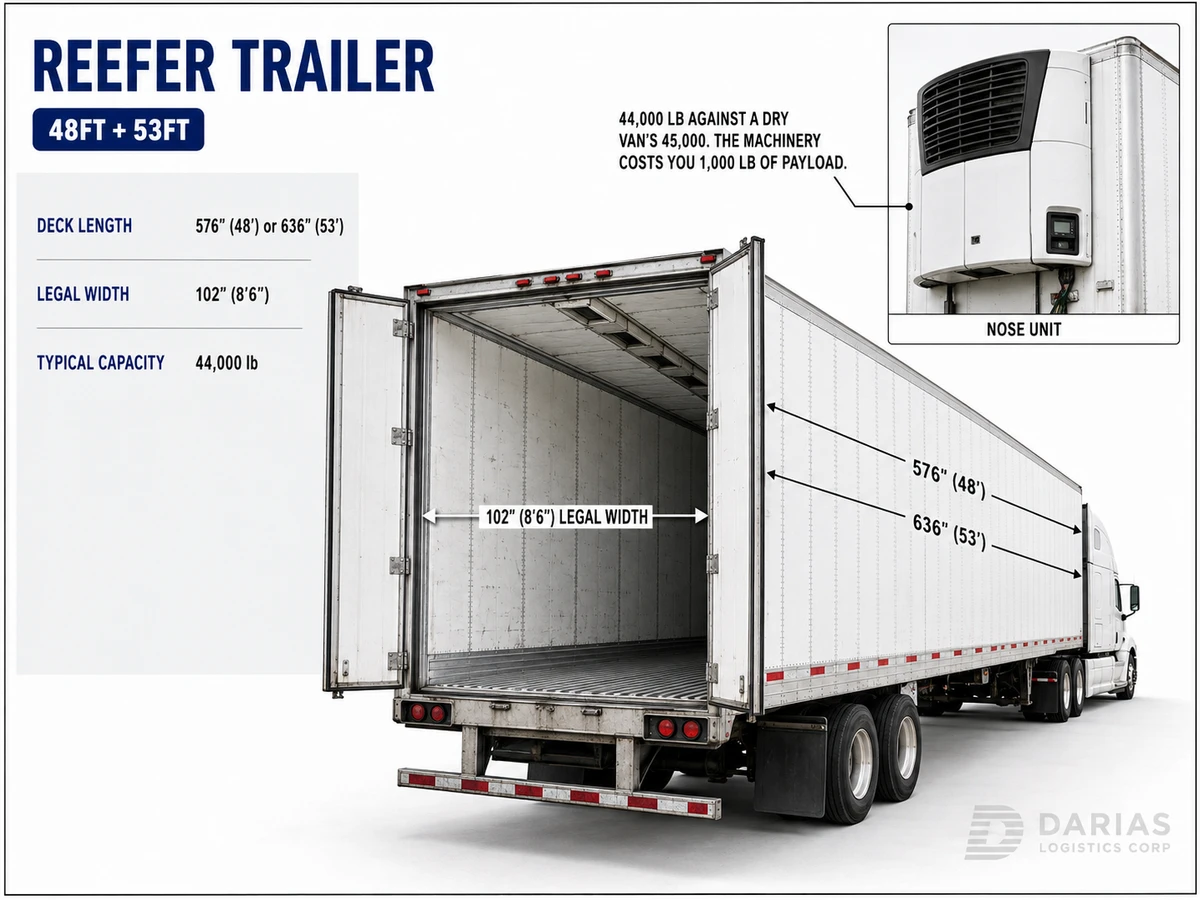
Specification
| Measure | Reefer trailer |
|---|---|
| Deck length | 48′ or 53′ |
| Legal width | 8′ 6″ |
| Typical capacity | 44,000 lb |
These are nominal figures for this equipment type. Real boxes vary by manufacturer, line and build year, and the tare is stencilled on the door of the unit you are actually getting. Send us the container number and we will confirm against the real one.
What a reefer trailer is
A reefer trailer is an insulated highway van with a refrigeration unit built into the front wall and its own diesel tank to run it. It comes in 48 ft and 53 ft lengths, is 8 ft 6 in wide like any legal trailer, and typically carries around 44,000 lb of freight. Inside, a duct or chute along the ceiling carries cold air to the back of the load and the air returns along the floor to the unit.
Because the unit carries its own fuel, the trailer can be dropped at a dock and left running, which is why so much refrigerated distribution works on drop trailers. These are typical figures for the type rather than one trailer's specification, and both interior size and payload vary with the insulation and the unit fitted.
When a reefer trailer is the right equipment
Whenever freight has to hold a temperature over the road. Produce, seafood, dairy, meat, flowers, pharmaceuticals, chocolate in a Florida summer, and a long list of goods that are not obviously perishable but have a temperature on the specification sheet. It is also used as a plain insulated van for freight that simply must not get hot, with the unit set accordingly.
Against a reefer container, the choice is about what the trip is. A container makes sense when the cold chain has to stay in one sealed box from the ship to the receiver. A trailer makes sense for the domestic leg, and transloading a container into one at a dock near the port often costs less overall, because the empty container goes straight back and the line's per diem clock stops instead of running to the destination and back.
What people get wrong: holding is not cooling, and the air has to move
A refrigeration unit is sized to hold a temperature against the heat coming through the walls. It is not sized to remove heat from a full load of warm product, and on a Miami dock in summer the difference is measured in hours the freight does not have. Pre cool the trailer to the set point, load freight that is already at temperature, and keep the doors closed while it happens. Loading warm and expecting the unit to catch up is the single most expensive habit in refrigerated freight.
The second thing is airflow. Cold air is delivered along the ceiling chute to the back of the trailer and has to return along the floor, so the load needs a gap above it and grooved floor channels kept clear. Stacking to the roof or blocking the chute at the nose closes that circuit, and a unit that cannot circulate will read a perfect temperature at the front while the rear of the load drifts. Weight is the quieter limit: around 44,000 lb of typical capacity means dense refrigerated loads run out of pounds before pallets.
What to send to get it booked
The set point with its units, the commodity, and whether the freight will be at temperature when it is loaded. Say whether the unit should run continuously or on a cycle, since that follows the cargo rather than the driver, and say whether a temperature record is required at delivery.
Then the ordinary load details: pallet count and size, total weight, and the tallest piece on its pallet. Describe both sites, including whether the receiver expects a drop trailer or a live unload and whether appointments apply. If this is coming out of a refrigerated container, send the container number and the terminal as well, because transloading near the port and returning the empty early is frequently the cheaper way to run the same freight inland.
Lanes this trailer runs
Comes off
Goes to
Questions
Straight answers
How is a reefer trailer different from a reefer container?
The refrigeration works the same way, the shape does not. A trailer has wheels, landing gear and a fuel tank, so it can be dropped at a dock and left running without a tractor, and it needs no genset because the unit carries its own engine. A container has to sit on a chassis, belongs to a shipping line and needs a clip on genset off the terminal plug. One is built for highways, the other for ships.
Does a reefer trailer need to run the whole trip?
It needs to hold the set point the whole trip, which for most loads means running. The unit burns its own diesel and the tank is sized for days rather than hours, so a long run is normal. What it cannot do is recover a cold chain that was already lost: a trailer holds a temperature against outside heat, so the freight should arrive cold and the box should be at temperature before the doors open.
Why does a reefer trailer hold less than a dry van?
Insulation and machinery. Every wall, the roof and the floor carry insulation, and the refrigeration unit occupies the front wall along with its fuel, so both the interior space and the payload come down. Typical capacity is around 44,000 lb against a dry van's 45,000, and the usable interior is smaller in every direction. On a dense refrigerated load that difference shows up as a pallet or two left behind.
Can one reefer trailer carry frozen and chilled freight together?
Only if it is set up for it. Multi temperature trailers exist, with movable bulkheads and separate evaporators so two compartments hold different set points, and they are common on distribution work. An ordinary single temperature trailer holds one set point for the whole box, and mixing commodities that want different temperatures in it means one of them is being carried wrong for the entire trip.
Should a reefer unit run continuously or start and stop?
It depends on the commodity. Continuous running holds a steadier temperature and keeps air moving, which matters for fresh produce that needs constant circulation. A start and stop cycle saves fuel and suits frozen freight, which is far more forgiving of small swings. It is a decision that belongs to the shipper and the cargo rather than to the driver, so it is worth stating with the set point at booking.
What does a reefer trailer carry?
Temperature-controlled van, in 48ft and 53ft. What a reefer container becomes when the freight transloads for an inland run.
Do you handle the permits?
Yes. Anything over legal width, height or weight is permitted and routed before it moves, including escorts where the route needs them.
Can you handle reefers?
Yes, with a genset so the box keeps running between the terminal and the door. A reefer holds noticeably less than a dry container of the same outside size, because the insulation and the machinery end take real space.
What about cargo that does not fit in a container at all?
Flat rack and open top for out-of-gauge, or open deck: flatbed, step deck, lowboy, RGN and double drop. Measure it before you book, because anything over gauge changes the permit picture.
How do I get a rate?
Send the lane, the equipment, the container size and the port, and we come back with a number. Quotes and dispatch run 24 hours a day at quotes@dariaslogistics.com.
What does a drayage quote actually include?
The move itself, plus the accessorials people get surprised by later: chassis, pre-pull, per diem, demurrage, detention and storage. We would rather name them up front than add them to an invoice.