Open deck
Lowboy
The lowest deck there is, for tall and heavy machines. Short well, so length is usually the constraint rather than weight.
What it looks like
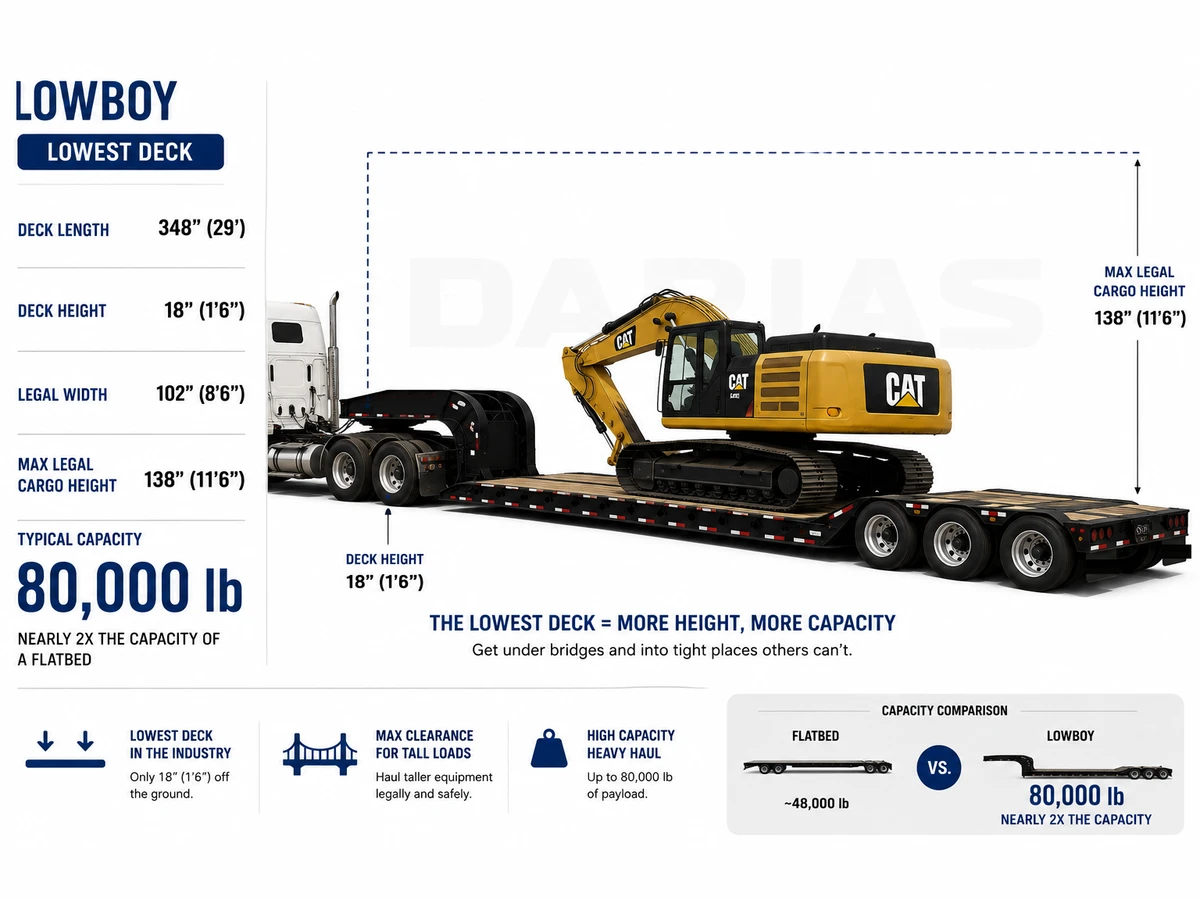
Specification
| Measure | Lowboy |
|---|---|
| Deck length | 29′ |
| Deck height | 1′ 6″ |
| Legal width | 8′ 6″ |
| Max legal cargo height | 11′ 6″ |
| Typical capacity | 80,000 lb |
These are nominal figures for this equipment type. Real boxes vary by manufacturer, line and build year, and the tare is stencilled on the door of the unit you are actually getting. Send us the container number and we will confirm against the real one.
What a lowboy is
A lowboy is the heavy machine trailer: a short well slung as close to the road as the design allows, with a gooseneck at the front and the axles behind. The well floor sits about 1 ft 6 in up, runs around 29 ft, and is 8 ft 6 in wide. Typical capacity is in the region of 80,000 lb, which puts it in a different class from the other open decks.
Two things follow from that low deck. Tall freight travels legally, with something like 11 ft 6 in of usable cargo height under Florida's 13 ft 6 in limit. And on the removable gooseneck versions, the front of the trailer detaches so the deck becomes a ramp and the machine drives into the well under its own power. These are typical figures for the type rather than one trailer's specification.
Choosing between a lowboy and its neighbours
Against a double drop, the difference is weight and loading. Both put the cargo in a low well and both carry tall freight, but a double drop typically carries around 45,000 lb and has a fixed gooseneck, so the load has to be lifted in. A lowboy is built heavy and, in its removable gooseneck form, lets the machine drive itself on. Excavators, dozers, cranes, presses and transformers end up here for both reasons at once.
Against a step deck, the lowboy wins on height and weight and loses on length and simplicity. A step deck gives 53 ft of deck and around 10 ft of cargo height, which suits anything that is merely large. When the load outgrows even a lowboy, the answer is more axles rather than a different shape: a multi-axle heavy haul trailer spreads the same deck over enough axles to make the weight permittable.
What people get wrong: capacity is not permission, and length runs out first
The 80,000 lb capacity is what the trailer is built to hold. It is not what a truck may weigh. A combination is capped at 80,000 lb gross in total on ordinary roads, so a lowboy carrying anywhere near its rating is by definition a permitted move, usually with extra axles underneath to spread the load. Reading the capacity as a green light is the commonest misunderstanding on this trailer, and it is the one that produces a machine sitting loaded with nowhere legal to go.
The other surprise is length. The well is about 29 ft because that is what fits between the gooseneck and the axles, so a long machine runs out of floor while the trailer still has weight to spare. Booms, counterweights and attachments often travel separately for this reason. And because the deck rides so low, ground clearance becomes a site question: a steep apron, a curb cut or a rutted yard can stop a lowboy that the road never would.
What to send to get it booked
The machine's make and model is worth more than any other single line, because the published figures follow from it. Then the numbers as it will travel: length, width, height and weight, with attachments on or off stated plainly, since a boom left on changes all four.
Say how it loads. Does it drive on, and if so what is its ground clearance and how does it behave on a ramp. Does it need to be craned. Then describe both sites: the approach, the surface, the room to turn, and anything low overhead. If the load is over width, over height or over the legal axle weight, say so at the start, because permits, routes and escorts are arranged in advance and are the part of a heavy haul that takes the time.
Comes off
Goes to
Questions
Straight answers
How much can a lowboy carry?
A typical figure is 80,000 lb of freight, and that number needs context, because 80,000 lb is also the legal gross weight of an entire combination. A trailer rated to carry that much is built for loads that will be moved under permit with extra axles underneath, not for loads that slip through unnoticed. The structural capacity of the trailer and what a given move is allowed to weigh are two separate questions.
How low is a lowboy deck?
The well floor sits about 1 ft 6 in off the road, which is the lowest deck in ordinary use and a few inches below a double drop. Those inches are the reason the trailer exists: they turn into cargo height under Florida's 13 ft 6 in limit, and they are what lets a tall machine travel without a height permit. The same low ride is what makes ground clearance a real consideration on rough sites.
How does a machine get onto a lowboy?
Usually it drives on. On a removable gooseneck version the front of the trailer detaches and the deck itself becomes the ramp, so a tracked or wheeled machine climbs straight into the well. On a fixed gooseneck lowboy it is ramps at the rear or a crane. Either way the machine's ground clearance and its breakover angle decide whether the loading works, which is why those come up early on plant moves.
Why is a lowboy well so short?
Because the well has to fit between the gooseneck and the rear axles, and both of those are fixed points on a legal trailer. That leaves around 29 ft of low floor. It is why length rather than weight is usually what stops a lowboy job: the machine is heavy enough and the trailer will take it, but the piece will not sit inside the well. Extendable and multi-axle versions exist for exactly that reason.
When does a load on a lowboy need a permit?
Whenever it breaks a legal limit, and heavy plant tends to break more than one at a time. Over 8 ft 6 in wide, over 13 ft 6 in tall measured from the road, or over the weight the axles may legally carry, and the move is permitted and routed rather than simply dispatched. Escorts come in as width and length grow. That is normal work for this trailer and it is planned before the machine is loaded.
What does a lowboy carry?
The lowest deck there is, for tall and heavy machines. Short well, so length is usually the constraint rather than weight.
Do you handle the permits?
Yes. Anything over legal width, height or weight is permitted and routed before it moves, including escorts where the route needs them.
Can you handle reefers?
Yes, with a genset so the box keeps running between the terminal and the door. A reefer holds noticeably less than a dry container of the same outside size, because the insulation and the machinery end take real space.
What about cargo that does not fit in a container at all?
Flat rack and open top for out-of-gauge, or open deck: flatbed, step deck, lowboy, RGN and double drop. Measure it before you book, because anything over gauge changes the permit picture.
How do I get a rate?
Send the lane, the equipment, the container size and the port, and we come back with a number. Quotes and dispatch run 24 hours a day at quotes@dariaslogistics.com.
What does a drayage quote actually include?
The move itself, plus the accessorials people get surprised by later: chassis, pre-pull, per diem, demurrage, detention and storage. We would rather name them up front than add them to an invoice.