Open deck
Double drop
A fixed well between two raised decks, for tall freight that does not need to be driven on.
What it looks like
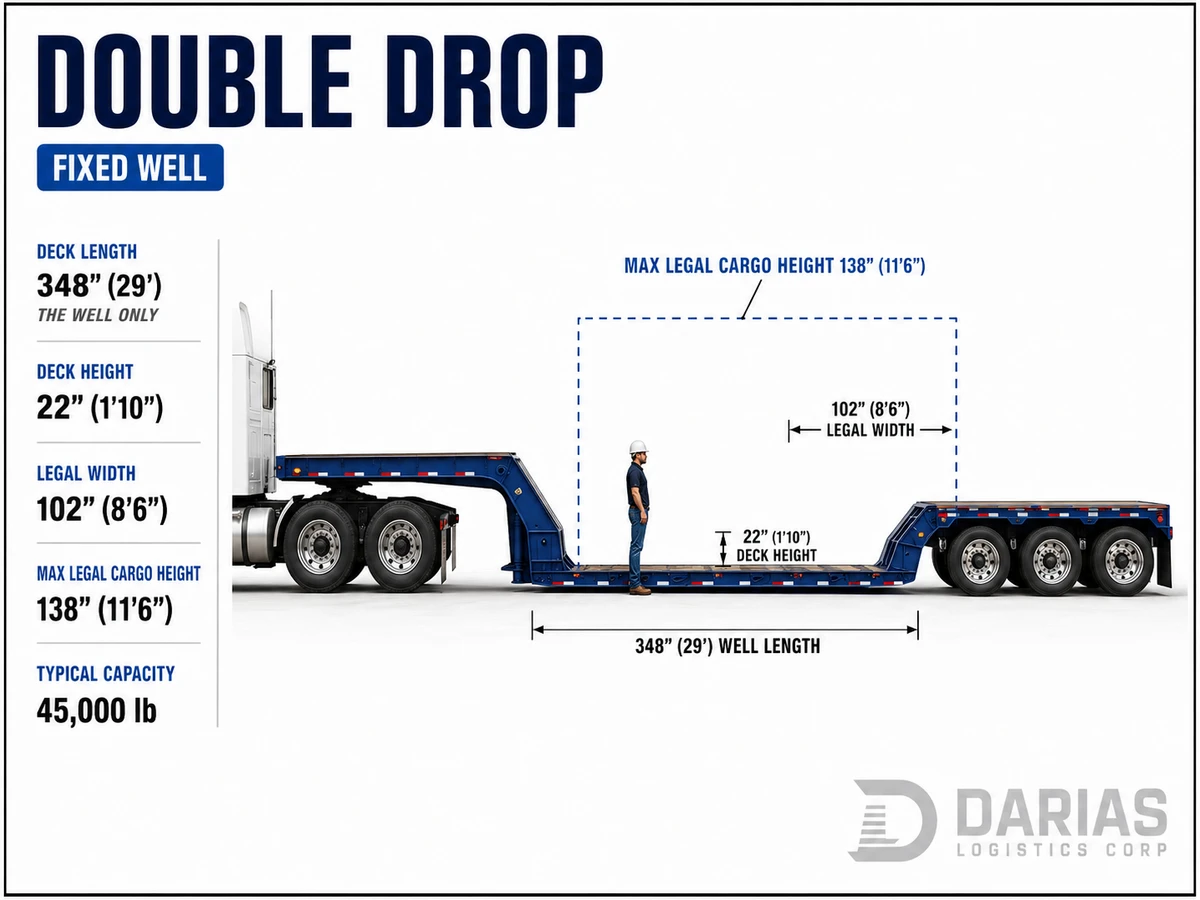
Specification
| Measure | Double drop |
|---|---|
| Deck length | 29′ |
| Deck height | 1′ 10″ |
| Legal width | 8′ 6″ |
| Max legal cargo height | 11′ 6″ |
| Typical capacity | 45,000 lb |
These are nominal figures for this equipment type. Real boxes vary by manufacturer, line and build year, and the tare is stencilled on the door of the unit you are actually getting. Send us the container number and we will confirm against the real one.
What a double drop is
A double drop is an open deck trailer that drops twice: once behind the tractor and once again in front of the axles, leaving a low well in the middle with a raised deck at either end. The well floor sits about 1 ft 10 in off the road, runs around 29 ft long, and is 8 ft 6 in wide like any legal trailer. A typical unit carries something like 45,000 lb of freight.
The gooseneck at the front is fixed, so cargo comes into the well from above or from the side rather than being driven on. That single fact separates it from the removable gooseneck trailers, and it is why a double drop suits crated and lifted freight while wheeled and tracked machines usually go elsewhere. These are typical figures for the type rather than one trailer's.
When a double drop is the right trailer
When the freight is tall and not especially heavy. Around 11 ft 6 in of legal cargo height is available in the well against roughly 10 ft on a step deck and 8 ft 6 in on a flatbed, so tanks, vessels, machinery with a high housing, and anything that would otherwise need a height permit tend to end up here. Being able to move legally is usually cheaper than moving permitted.
It is the wrong trailer when the load is heavy, because a lowboy is built for weight and a double drop is not. It is also the wrong trailer when the piece is long, because the well is short and everything outside it rides high. And if the cargo is under 10 ft, a step deck is easier to load and easier to place, with far more of them on the road.
What people get wrong: the well is the trailer
People book a double drop against the trailer's overall length and then discover that the usable floor is the 29 ft well. A piece that is 34 ft long and 11 ft tall does not fit a standard well, and putting the ends on the raised decks defeats the point, since the raised decks sit at flatbed height and the load is over height again. Measure the piece and compare it to the well, not to the trailer.
The height sum works the same way as on any open deck: Florida's limit is 13 ft 6 in measured from the road, the well floor takes its share, and the freight gets what is left. Anything above that is a permitted, routed move rather than a normal dispatch. Weight has a similar trap in reverse: the 45,000 lb figure is what the trailer typically carries, and where the piece sits in the well decides how that weight lands on the axles.
What to send to get it booked
Length, width, height and weight of the piece, measured as it will sit, including the cradle or skid it rides on. Then say how it will be lifted, because a fixed gooseneck trailer needs the cargo to come in from above or from the side, and lifting points or fork pockets decide what happens at both ends.
Add the sites. A low trailer has less ground clearance than an ordinary one, so a steep driveway apron, a curb cut or a rough yard is worth mentioning before a driver is committed. If the piece is over 11 ft 6 in tall, over 8 ft 6 in wide or longer than the well, say so at the start: that is where permits, escorts and a different trailer come into the conversation, and all three are planned rather than improvised.
Comes off
Goes to
Questions
Straight answers
What is the well on a double drop trailer?
It is the low section in the middle, between the raised front deck over the kingpin and the raised rear deck over the axles. The trailer drops twice, which is where the name comes from, and the floor of that middle section sits about 1 ft 10 in off the road. Tall freight rides in the well and nowhere else, so the well is the part of the trailer that has to fit the cargo.
How tall can freight be in a double drop well?
Around 11 ft 6 in as a working figure against Florida's 13 ft 6 in travel limit, because the well floor starts so low. That is roughly 18 in more than a step deck allows and three feet more than a flatbed. It is a lot of height, and it is bought with length: the well is only about 29 ft, so a tall piece has to be short enough to sit inside it.
How long is the well on a double drop?
About 29 ft on a standard trailer, which is the number that decides most jobs. The raised decks at each end can carry freight too, but they sit high and give you nothing on height, so a load that needs the clearance is working with 29 ft of floor and not the trailer's overall length. Where the piece is longer than that, the conversation moves to an extendable or a stretched deck.
What is the difference between a double drop and a lowboy?
Mainly weight and how the cargo gets on. A double drop has a fixed gooseneck, so the freight is lifted into the well, and a typical trailer carries something like 45,000 lb. A lowboy sits lower still and is built heavy, commonly around 80,000 lb, and the removable gooseneck versions let a machine drive on. Tall but ordinary weight goes on the double drop, tall and heavy goes on the lowboy.
Can freight overhang the ends of a double drop well?
It can sit on the raised decks and it can overhang the rear, but both cost you the thing you came for. Anything resting on a raised deck is back to flatbed height, and a rear overhang has to be flagged, lit and measured into the combination's overall length. If the piece is long and tall at the same time, that is usually an extendable or a stretch deck rather than a standard well.
What does a double drop carry?
A fixed well between two raised decks, for tall freight that does not need to be driven on.
Do you handle the permits?
Yes. Anything over legal width, height or weight is permitted and routed before it moves, including escorts where the route needs them.
Can you handle reefers?
Yes, with a genset so the box keeps running between the terminal and the door. A reefer holds noticeably less than a dry container of the same outside size, because the insulation and the machinery end take real space.
What about cargo that does not fit in a container at all?
Flat rack and open top for out-of-gauge, or open deck: flatbed, step deck, lowboy, RGN and double drop. Measure it before you book, because anything over gauge changes the permit picture.
How do I get a rate?
Send the lane, the equipment, the container size and the port, and we come back with a number. Quotes and dispatch run 24 hours a day at quotes@dariaslogistics.com.
What does a drayage quote actually include?
The move itself, plus the accessorials people get surprised by later: chassis, pre-pull, per diem, demurrage, detention and storage. We would rather name them up front than add them to an invoice.