Service
Flatbed freight in Miami and across Florida
Open-deck freight that will not fit, or does not belong, in a van.
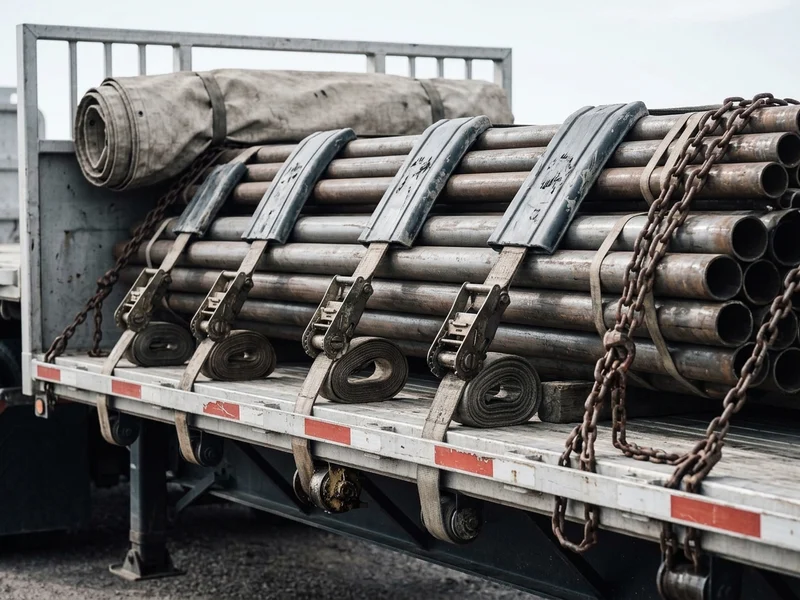
When the freight will not go in a van
Open deck is for anything that has to be loaded from the side or the top, is too tall or too wide for a dry van, or is simply built in a shape a van door does not forgive. Machinery, steel, pipe, lumber, equipment on skids, anything craned on.
The trailer choice follows the load rather than the other way round. A standard flatbed, a step deck for height, or a lowboy when the piece is tall enough that even a step deck will not keep it legal.
Securement and weather are the job
Open deck freight is held on by straps, chains and dunnage, and the load plan is not an afterthought: it is what keeps the piece on the trailer and the driver legal. Tarping matters too, and whether a load needs it changes the price, so say if it cannot get wet.
Once a piece goes past legal width, height, length or weight, it stops being ordinary flatbed work and becomes permitted, routed and sometimes escorted. That is heavy haul and oversize, and the dimensions decide, not the description.
Straps, chains and the arithmetic underneath them
Securement is arithmetic before it is muscle. Every strap and chain carries a working load limit stamped on it, the total of the tie-downs has to come to at least half the weight of what they are holding, and there is a minimum number of them for the length of the piece. Straps suit lumber, packaged goods and anything with a surface a chain would mark. Chains suit steel, machinery and equipment with hard anchor points to pull against. That is why a coil and a crate are not secured the same way even when they weigh the same.
Dunnage goes under the freight to give the straps somewhere to pass and to keep the piece off the deck. Edge protection goes over every corner a strap crosses, both so the strap is not cut and so the freight is not marked. Anything on wheels or tracks gets blocked and braced so it cannot roll or walk. Then it all gets checked in the first fifty miles and again through the day, because a load settles, and a strap that was tight at the dock is not automatically tight at the state line.
Tarping, and which tarp
A tarp is labor. It means climbing on a loaded trailer, spreading heavy vinyl sheets over a piece that is rarely a neat rectangle, and strapping it down so it survives highway air for a thousand miles. That is why tarping moves the price and the loading time rather than being a small extra at the end.
A lumber tarp is deeper down the sides and made for a low, long, flat stack: lumber, board, packaged building materials. A steel tarp is shallower and made for a shorter, heavier load: coils, plate, machinery. A tall piece often takes both, one over the top and one down the sides. Say what the freight is and how it will be stacked when you ask for the rate, and the right tarps travel out with the truck instead of the wrong ones arriving at your dock.
The load plan, and loading from the side or the top
A load plan gets worked out before the trailer arrives. Where each piece sits so the weight lands over the axles, what goes on first because it comes off last, and how the height stacks up against Florida's 13 ft 6 in once the deck is counted in. Heavy pieces sit forward of center rather than at the tail, and a trailer that is legal on the gross weight can still be illegal on a single axle group if the load is in the wrong place on the deck.
Open deck also changes what the two ends have to provide. A flatbed is loaded by forklift from either side or craned from above, so the site needs room alongside the trailer, or overhead clearance for a lift, and firm ground for the machine to stand on. Tell us which end has what, and whether the crane or the forklift is yours or has to come with the job. A crane booked for an hour that spends forty minutes waiting for a truck to be positioned is the expensive part of an otherwise ordinary day.
What it costs
Work it out first
Long-haul lanes out of Miami
Equipment
Ports
Questions
Straight answers
When do I need a flatbed instead of a dry van?
When the freight has to be loaded from the side or the top, when it is too tall or too wide for a van, or when it is simply built in a shape a van door does not forgive. Machinery, steel, pipe, lumber, equipment on skids and anything craned on all live on open deck. The trailer then follows the load rather than the other way round: a standard flatbed, a step deck for height, or a lowboy when the piece is tall enough that even a step deck will not keep it legal.
What is the difference between a flatbed and a step deck?
Deck height, and what that buys you in cargo height. A step deck drops behind the gooseneck, so a taller piece still comes in under Florida's 13 foot 6 inch limit without a permit. A standard flatbed carries a higher deck and suits freight that is long or awkward rather than tall. When even a step deck will not keep the piece legal, the next moves are a lowboy or an RGN. Measure the piece as it will actually sit, including any skid or crate underneath it.
Does my flatbed load need to be tarped?
Say so at the rate request if it cannot get wet, because tarping changes both the price and the loading time. Open deck freight travels exposed unless it is covered, and tarps are labor as well as material. Steel and machinery are usually tarped as a matter of course; lumber and pipe often are not. The securement plan, the straps, chains and dunnage that keep the piece on the trailer and the driver legal, gets built with the tarping question settled rather than after it.
Where does flatbed freight go from Miami?
Anywhere in Florida and out to the other 47 states. Geography shapes the answer: almost everything leaving Florida travels north through a narrow corridor before it goes anywhere, so a run out of Miami carries several hundred miles before it is really on its way, and honest transit times start from that rather than from a mileage calculator. Local open-deck work around PortMiami, Port Everglades and the Hialeah rail ramps is the other half of the board.
When does flatbed work become heavy haul?
The moment the piece goes past legal width, height, length or weight. Then it is permitted, routed and sometimes escorted, and the dimensions decide that rather than the description. Two pieces that read the same on a packing list can be an ordinary flatbed lane and a permitted job with pilot cars. Send measured length, width, height and gross weight with the request and the answer comes back with the right trailer and the right paperwork already worked out.
How do I get a rate?
Send the lane, the equipment, the container size and the port, and we come back with a number. Quotes and dispatch run 24 hours a day at quotes@dariaslogistics.com.
What does a drayage quote actually include?
The move itself, plus the accessorials people get surprised by later: chassis, pre-pull, per diem, demurrage, detention and storage. We would rather name them up front than add them to an invoice.