Service
Piggyback delivery in Miami
A forklift that rides on the back of the trailer, unloads the freight where there is no dock and no forklift, and climbs back on. The truck arrives with its own unloading.
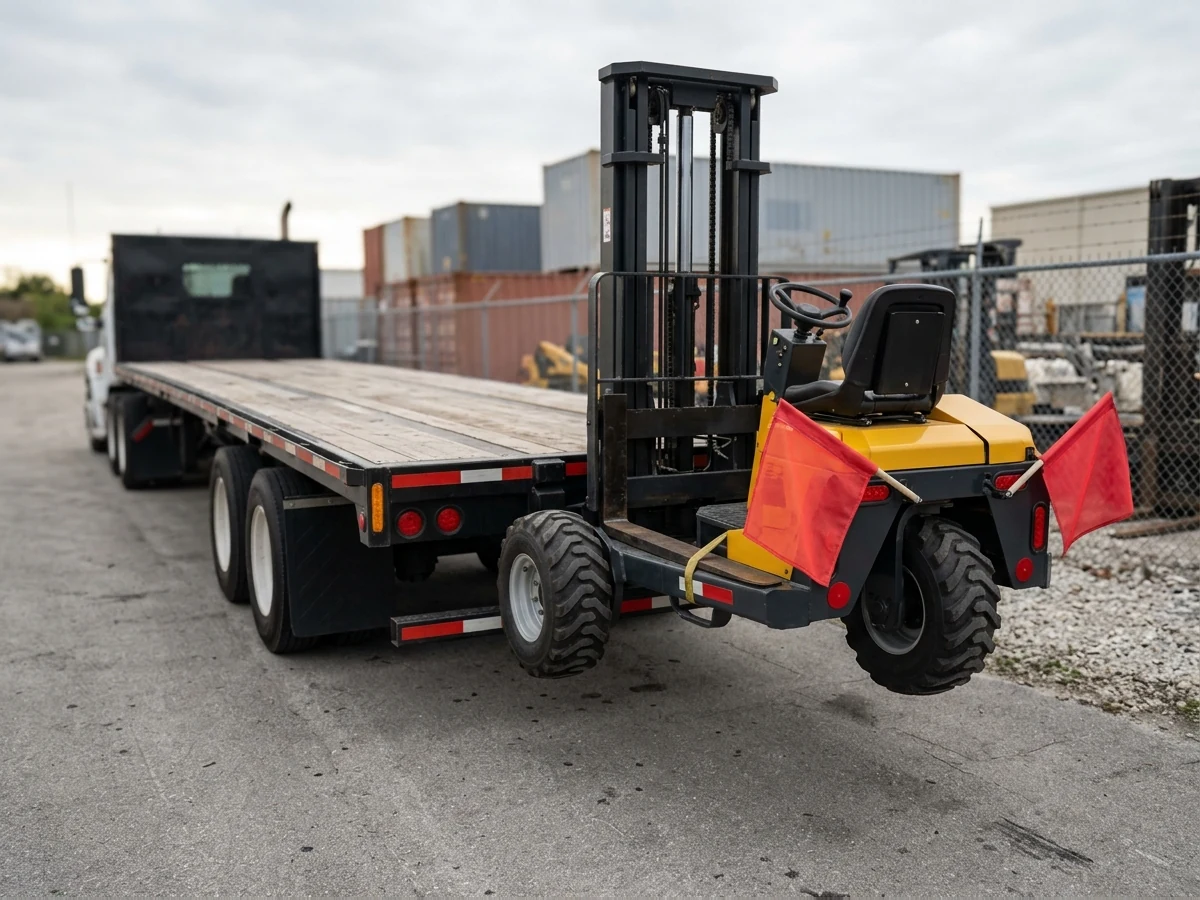
A forklift that rides with the freight
The industry calls it a Moffett the way tissues are called Kleenex; the generic names are piggyback or truck-mounted forklift. A compact rough-terrain machine hangs on a mounting kit at the rear of the flatbed, and at the delivery it drives itself off, places the freight, and lifts itself back on. The factory number for mounting or dismounting is under a minute; the honest planning number is 60 to 90 seconds each way including pinning and a walk-around.
That one machine changes what a delivery needs at the other end: no dock, no site forklift, no crew waiting. The driver unloads to the laydown area, photographs the placement, and is gone.
Where it earns its surcharge
Jobsites with nothing to unload with: lumber, drywall, roofing, pavers, sod, fencing, rebar, scaffolding, unit loads of 2,000 to 5,000 lb (907 to 2,268 kg) that no crew hand-carries economically. A liftgate puts one pallet at a time at the bumper, on pavement; the piggyback carries freight 50 to 300 ft (15 to 90 m) from the truck, over curbs, to where it will be used.
Multi-stop mornings are the signature play. The machine rides along, so one flatbed makes five or eight ground deliveries before noon with a one-minute mount cycle at each stop, 15 to 30 minutes on site against the hour or two a hand unload takes.
The 4-way variant turns all its wheels 90 degrees and drives sideways, which is how a 20 ft (6.1 m) bundle of lumber or rebar walks through a garden gate a normal forklift could never turn inside.
And it is the answer for unattended sites: gate code only, nobody there, freight placed and documented, truck gone.
The ground decides, and we ask about it first
A loaded machine is roughly 12,600 lb (5,715 kg) on three pneumatic tires. Firm ground carries that without a mark. Saturated fill, fresh grading after rain, and loose sand do not, and a piggyback buried to its axles needs a wrecker or a site machine to come out, both billable by the hour.
So booking a piggyback delivery here comes with questions, and they are not small talk: has it rained in the last 48 hours, is the surface paved, gravel, compacted or fresh fill, how far is the drop point from pavement, how wide is the gate. Ground protection mats can bridge a known soft stretch, and a shorter carry to the nearest firm ground beats a stuck machine every time.
The driver's judgment at the tailgate is final. When the lot is soft, freight goes to the road edge or the driveway apron, staged and photographed, and the site's own equipment makes the last move when the ground allows it.
What it will not do
Single picks are limited to roughly 4,500 to 7,000 lb (2,041 to 3,175 kg) at a 24 in load center depending on the machine, and capacity falls as the load center deepens. A machinery skid past that is a crane truck job, full stop.
Lift height tops out at 120 to 144 in (3.05 to 3.66 m): first-story eave height, not a second floor and not a roof. Shingles go to the driveway; loading the roof deck is a conveyor or boom service.
Published gradeability is 30 percent, and that is a traction figure for the bare machine, not permission to traverse a slope with a raised load. Overhead, the rule is the same as any mast: 10 ft (3.05 m) from power lines, and the drop point gets checked upward before anything goes up.
Weight, length and the law
The machine is dead weight against the 80,000 lb (36,287 kg) gross limit. With a 7,080 lb (3,211 kg) machine mounted on a forklift trailer, the freight payload runs about 43,300 lb (19,640 kg); the machine costs roughly two to four pallets of pavers in revenue weight. A max-payload lane where every pound is freight is a plain-flatbed lane, and quoting it honestly means saying so.
Behind the trailer, the mounted machine projects several feet and is flagged and lit as a projecting load under Florida law. Route legality is the carrier's problem, not the shipper's; it is part of what the rate buys.
How to book it
Ask for a piggyback delivery through the quote form and say what the ground is: paved, gravel, dirt, or unknown. Add what arrives and in how many unit loads, the drop address, and whether anyone will be on site. Multi-stop runs are priced as a morning, not as separate deliveries, which is where the machine beats every alternative.
Every rate is confirmed in writing before the truck moves.
The machine travels with the load, so these runs are not limited to the tri-county. A piggyback delivery goes anywhere in Florida the freight goes, and the questions about the ground travel with it.
The machine, the move, the ground
Off the trailer in under a minute: forks in the mounting kit, wheels on the ground, ready to work.
Placed where it will be used, 50 to 300 ft from the truck, on a site with no dock and no forklift.
The multi-stop morning: the machine rides along, so one flatbed makes five or eight ground drops before noon.
The honest limit: after rain, a loaded machine is 12,600 lb on three tires, and soft ground will take it. The freight goes to the road edge instead.
Ground protection mats bridge a known soft stretch: lay the path, drive it, recover the mats.
Sod and pavers to a residential street: the machine's oldest job, driveway by driveway.
Drywall to a bare-ground build: ground-level placement only. A second floor is a boom truck's job, and the page says so.
Equipment
Ports
Questions
Straight answers
What is a piggyback or Moffett delivery?
A compact rough-terrain forklift rides on a mounting kit at the rear of the flatbed. At the delivery it drives itself off, places the freight and lifts itself back on. The industry calls it a Moffett the way tissues are called Kleenex; the generic names are piggyback and truck-mounted forklift. The factory number for mounting or dismounting is under a minute, and the honest planning number is 60 to 90 seconds each way including pinning and a walk-around. The delivery needs no dock, no site forklift and no crew waiting.
How much can a piggyback forklift lift?
Single picks run roughly 4,500 to 7,000 lb, or 2,041 to 3,175 kg, at a 24 inch load center depending on the machine, and capacity falls as the load center deepens. A machinery skid past that is a crane truck job. Lift height tops out at 120 to 144 inches, which is first-story eave height and not a second floor or a roof. Shingles go to the driveway; loading a roof deck is a conveyor or boom service and it is better to know that at booking.
What ground does a piggyback delivery need?
Firm ground. A loaded machine is roughly 12,600 lb on three pneumatic tires, which firm surfaces carry without a mark. Saturated fill, fresh grading after rain and loose sand do not, and a machine buried to its axles needs a wrecker or a site machine to pull it out, both billable by the hour. So the booking questions are not small talk: has it rained in the last 48 hours, is the surface paved, gravel, compacted or fresh fill, how far is the drop from pavement, how wide is the gate.
How far from the truck can the freight be placed?
Typically 50 to 300 ft, or 15 to 90 m, over curbs and onto the spot where the freight will actually be used. That is the difference from a liftgate, which puts one pallet at a time at the bumper and only on pavement. The 4-way variant turns all its wheels 90 degrees and drives sideways, which is how a 20 ft bundle of lumber or rebar walks through a garden gate that a normal forklift could never turn inside. A shorter carry to firm ground beats a stuck machine every time.
How much payload does the machine cost me?
Roughly two to four pallets of pavers in revenue weight. The machine is dead weight against the 80,000 lb gross limit, and with a 7,080 lb machine mounted on a forklift trailer the freight payload runs about 43,300 lb. A max-payload lane where every pound has to be freight is a plain flatbed lane, and saying so is part of quoting it honestly. Behind the trailer the mounted machine projects several feet and is flagged and lit as a projecting load under Florida law.
Can a piggyback deliver to a site with nobody there?
Yes, and unattended sites are one of the things it is best at: gate code only, nobody on site, freight placed and photographed, truck gone. Multi-stop mornings are the other signature play, since the machine rides along and one flatbed can make five or eight ground deliveries before noon, 15 to 30 minutes on site against the hour or two a hand unload takes. Those runs are priced as a morning rather than as separate deliveries, which is where the machine beats the alternatives.
How do I get a rate?
Send the lane, the equipment, the container size and the port, and we come back with a number. Quotes and dispatch run 24 hours a day at quotes@dariaslogistics.com.
What does a drayage quote actually include?
The move itself, plus the accessorials people get surprised by later: chassis, pre-pull, per diem, demurrage, detention and storage. We would rather name them up front than add them to an invoice.