20' RF / 22R1
20ft reefer
Small box, and the machinery end takes a disproportionate bite out of it. Needs a genset the moment it leaves the terminal plug.
Outside, inside, and the door
What it looks like
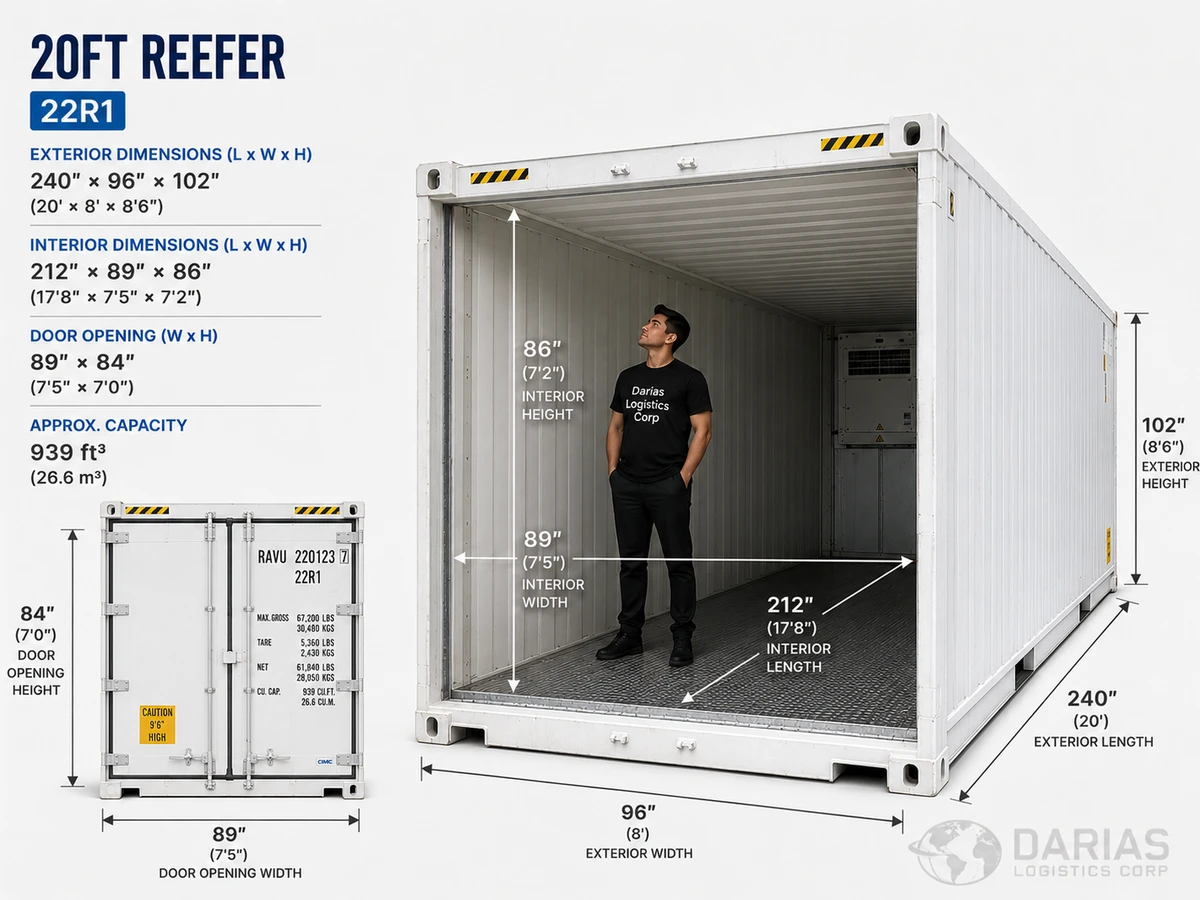
Specification
| Measure | 20ft reefer |
|---|---|
| Exterior length | 238.5″ 19′ 10.5″ |
| Exterior width | 96″ 8′ |
| Exterior height | 102″ 8′ 6″ |
| Interior length | 212″ 17′ 8″ |
| Interior width | 89″ 7′ 5″ |
| Interior height | 86″ 7′ 2″ |
| Door opening width | 89″ 7′ 5″ |
| Door opening height | 84″ 7′ |
| Tare weight | 6,600 lb |
| Max payload | 60,600 lb |
| Max legal cargo weight | 34,000 lb |
| Max gross | 67,200 lb |
| Capacity | 939 cu ft |
| Chassis | Standard 20ft, plus a genset |
These are nominal figures for this equipment type. Real boxes vary by manufacturer, line and build year, and the tare is stencilled on the door of the unit you are actually getting. Send us the container number and we will confirm against the real one.
What a 20ft reefer is
A 20ft reefer is a refrigerated container in the short box: an insulated steel shell with a refrigeration unit built into the front wall and a T section floor that delivers air along the deck. Outside it matches a dry 20, about 19 ft 10.5 in long, 8 ft wide and 8 ft 6 in tall. Inside, the nominal figures are roughly 17 ft 8 in by 7 ft 5 in by 7 ft 2 in, with a door opening around 7 ft 5 in wide by 7 ft tall, and about 939 cu ft of space.
Those interior numbers are the point of the page. A fifth of the box is gone before any freight goes in, taken by the machinery at one end and the insulation everywhere else. Typical tare is near 6,600 lb against a dry 20's 4,850, and the tare stencilled on the door of the unit you receive is the one to plan against.
When a 20ft reefer is the right box
It is for temperature controlled freight that is dense, or small in volume, or going somewhere a longer box cannot reach. Seafood, pharmaceuticals, specialist produce, anything where the pallet count is modest and the value is high. Against a 40ft reefer it gives you 939 cu ft rather than 2,002, and against a 40ft high cube reefer less again, so the choice follows the cargo rather than habit.
Against a reefer trailer, the difference is what the freight is doing. A container is the right answer when the cold chain starts or ends at sea and the same box moves through. A reefer trailer is the right answer for a domestic run, and transloading a container into one at a dock near the port can be the cheaper way to get freight up the state, since it releases the line's box and stops the per diem clock on it.
What people get wrong: the genset, and the weight
A reefer is only refrigerated while it is plugged in. At the terminal that is shore power. On the road it is a clip on genset, and that genset weighs something: plan on roughly 3,000 lb with fuel. The published road figure for this box is about 36,000 lb of cargo on a standard chassis and around 40,000 lb on a tri-axle, and both are written as though nothing were hanging off the container. Fit a genset and each is about three thousand pounds optimistic.
The weight also lands badly. A 20 rides forward and puts its load over a single set of tandems, so the tandem cap and the bridge formula stop it long before the combination reaches 80,000 lb. That is why a 20 has a tri-axle figure at all. The second common error is loading: stack above the load line and you close the air return, and a unit that cannot circulate will hold a perfect set point at the machinery end while the door end drifts.
What to send to get it booked
The container number, the steamship line and the terminal, as with any box, and then the things that belong to a reefer. The set point and the units it is written in. What the commodity is. Whether the freight is already at temperature or expects to be pulled down, since a reefer holds a temperature rather than creating one.
Say whether a genset is needed and for how long, because it is equipment that has to be on the chassis before the truck reaches the gate rather than found afterwards. Add the cargo weight from the bill of lading, remembering the genset comes out of the same 80,000 lb. And say whether the delivery has a plug: a box that arrives before the receiver can take it either keeps running on diesel or starts losing the cold chain.
Comes off
Goes to
Questions
Straight answers
Does a 20ft reefer need a genset?
Once it leaves the terminal, yes, if the cargo has to stay cold. Inside the terminal the box is plugged into shore power. The moment it comes off that plug the refrigeration unit needs its own diesel generator, normally a clip on genset hung on the container or the chassis. A reefer with no power is an insulated box, and insulation slows a temperature change in South Florida heat rather than preventing one.
How much does a genset take off the payload?
Plan on roughly 3,000 lb, since a clip on unit with fuel generally runs somewhere between 2,500 and 3,300 lb depending on the model and how full its tank is. That weight is part of the combination, so it comes straight out of what you can legally load. Every road weight figure for a reefer is written as though the genset were not there, which means it is about three thousand pounds optimistic the moment one is fitted.
Why is a 20ft reefer so much smaller inside than a 20ft dry?
Because of the two things that make it a reefer: insulation in every wall, and the refrigeration machinery built into the front end. The machinery takes well over a foot of length on its own, which is why the interior runs about 17 ft 8 in against a dry 20's 19 ft 4 in, and the insulation narrows and lowers the rest. The result is roughly 939 cu ft against 1,172, a fifth of the box gone before anything is loaded.
Does a reefer hold temperature while it is on the road?
Only while it has power. Running on a genset the unit holds the set point the same way it does on shore power, and the set point should already be right before the freight goes in rather than being used to pull warm cargo down. Without a genset the box coasts on its insulation, which buys hours rather than days, and in Miami summer heat that window is shorter than most shippers assume.
Can I load a 20ft reefer to the ceiling?
No, and this is the loading mistake that spoils cargo rather than the one that breaks a law. Cold air is delivered along the floor through the T section decking and has to return over the top of the load to the machinery end. Stack past the load line marked inside and the return path closes, so the unit reads its own delivered air, thinks it has done its job and lets the far end of the box warm up.
What are the inside dimensions of a 20ft reefer?
Interior length, width and height are listed in the specification table on this page, alongside the exterior dimensions and the door opening. The door opening is the one that decides whether a machine fits, and it is smaller than the interior.
What chassis does a 20ft reefer need?
Standard 20ft, plus a genset. We carry the chassis, so a booking does not depend on what the terminal has available that morning.
Can you handle it overweight?
Yes, on the right chassis and with the right permit. Overweight is a separate conversation from the container size, and the ports have their own limits on top of the state's.
Where do you pull 20ft reefers from?
Port of Miami, Port Everglades, Port of Palm Beach, POMTOC, South Florida Container Terminal, Seaboard Marine, Florida International Terminal, Port Everglades Terminal, Crowley, King Ocean, MSC, Tropical Shipping, Antillean Marine, FEC Port Everglades ICTF, FEC Hialeah rail ramp and CSX ramp.
What is the last free day?
The last day your container can sit inside the terminal before storage charges start. Miss it and demurrage begins accruing daily, which is why a pre-pull is almost always cheaper than waiting.
What is a pre-pull?
We collect the container from the terminal before you are ready for it and hold it on a yard. It stops demurrage running at terminal rates and it takes the pressure off your receiving schedule.
What is the difference between demurrage, per diem and detention?
Three different charges from different parties. Demurrage is the terminal charging you for cargo sitting inside the gate past free time. Per diem is the shipping line charging you for keeping their container out past free time. Detention is the trucker's time, charged when a driver waits at your dock beyond the free window. They can run at the same time, which is how a bill gets ugly fast.
How do I get a rate?
Send the lane, the equipment, the container size and the port, and we come back with a number. Quotes and dispatch run 24 hours a day at quotes@dariaslogistics.com.
What does a drayage quote actually include?
The move itself, plus the accessorials people get surprised by later: chassis, pre-pull, per diem, demurrage, detention and storage. We would rather name them up front than add them to an invoice.