20' RF / 22R1
Reefer de 20 pieds
Petit conteneur, et le bloc machine en prend une part disproportionnée. Il faut un genset dès qu'il quitte la prise du terminal.
Dehors, dedans, et la porte
À quoi ça ressemble
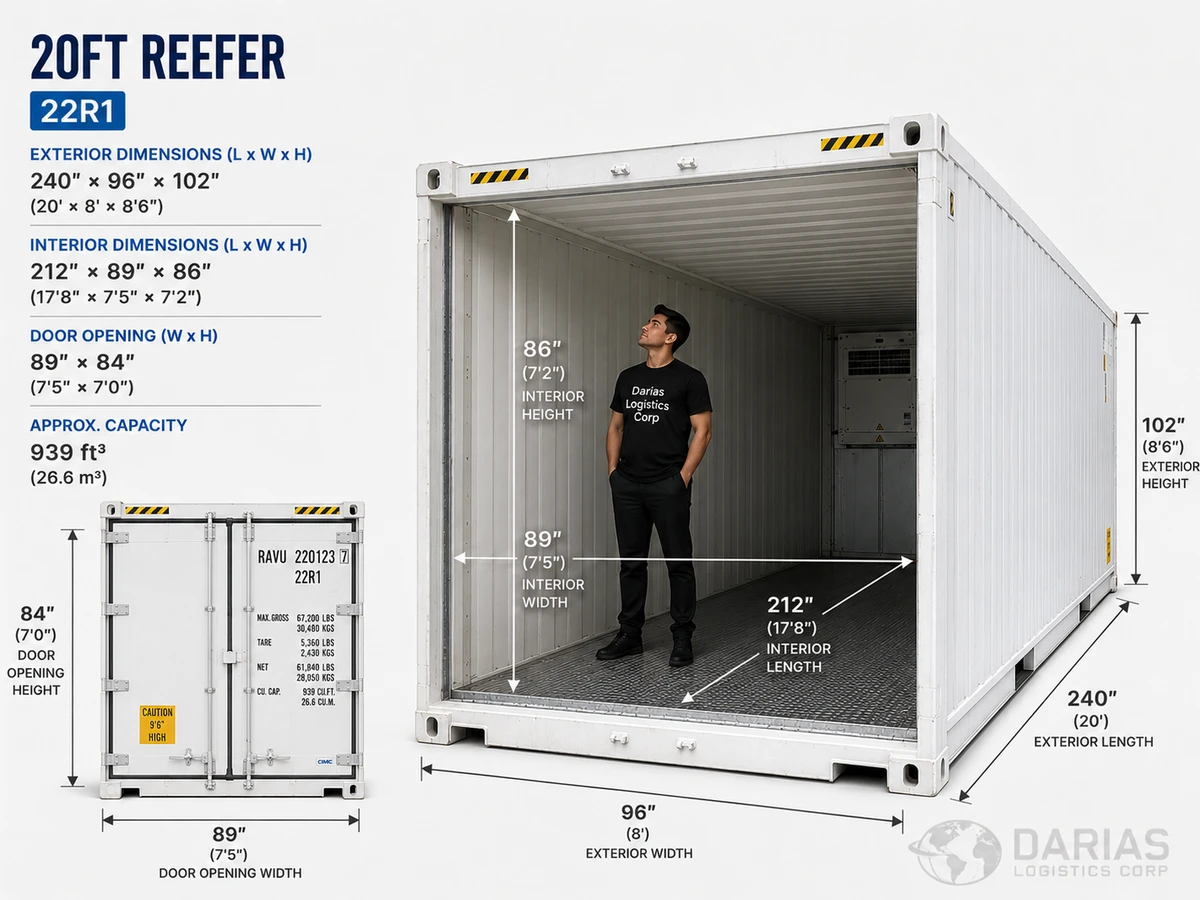
Spécification
| Mesure | Reefer de 20 pieds |
|---|---|
| Longueur extérieure | 238.5″ 19′ 10.5″ |
| Largeur extérieure | 96″ 8′ |
| Hauteur extérieure | 102″ 8′ 6″ |
| Longueur intérieure | 212″ 17′ 8″ |
| Largeur intérieure | 89″ 7′ 5″ |
| Hauteur intérieure | 86″ 7′ 2″ |
| Largeur de porte | 89″ 7′ 5″ |
| Hauteur de porte | 84″ 7′ |
| Tare | 6,600 lb |
| Charge utile max | 60,600 lb |
| Poids légal max sur route | 34,000 lb |
| Poids brut max | 67,200 lb |
| Capacité | 939 pi³ |
| Châssis | Standard 20ft, plus a genset |
Ce sont des chiffres nominaux pour ce type de matériel. Les caisses réelles varient selon le fabricant, la compagnie et l'année, et la tare est peinte sur la porte de l'unité que vous recevez. Envoyez le numéro de conteneur et nous vérifions sur le vrai.
What a 20ft reefer is
A 20ft reefer is a refrigerated container in the short box: an insulated steel shell with a refrigeration unit built into the front wall and a T section floor that delivers air along the deck. Outside it matches a dry 20, about 19 ft 10.5 in long, 8 ft wide and 8 ft 6 in tall. Inside, the nominal figures are roughly 17 ft 8 in by 7 ft 5 in by 7 ft 2 in, with a door opening around 7 ft 5 in wide by 7 ft tall, and about 939 cu ft of space.
Those interior numbers are the point of the page. A fifth of the box is gone before any freight goes in, taken by the machinery at one end and the insulation everywhere else. Typical tare is near 6,600 lb against a dry 20's 4,850, and the tare stencilled on the door of the unit you receive is the one to plan against.
When a 20ft reefer is the right box
It is for temperature controlled freight that is dense, or small in volume, or going somewhere a longer box cannot reach. Seafood, pharmaceuticals, specialist produce, anything where the pallet count is modest and the value is high. Against a 40ft reefer it gives you 939 cu ft rather than 2,002, and against a 40ft high cube reefer less again, so the choice follows the cargo rather than habit.
Against a reefer trailer, the difference is what the freight is doing. A container is the right answer when the cold chain starts or ends at sea and the same box moves through. A reefer trailer is the right answer for a domestic run, and transloading a container into one at a dock near the port can be the cheaper way to get freight up the state, since it releases the line's box and stops the per diem clock on it.
What people get wrong: the genset, and the weight
A reefer is only refrigerated while it is plugged in. At the terminal that is shore power. On the road it is a clip on genset, and that genset weighs something: plan on roughly 3,000 lb with fuel. The published road figure for this box is about 36,000 lb of cargo on a standard chassis and around 40,000 lb on a tri-axle, and both are written as though nothing were hanging off the container. Fit a genset and each is about three thousand pounds optimistic.
The weight also lands badly. A 20 rides forward and puts its load over a single set of tandems, so the tandem cap and the bridge formula stop it long before the combination reaches 80,000 lb. That is why a 20 has a tri-axle figure at all. The second common error is loading: stack above the load line and you close the air return, and a unit that cannot circulate will hold a perfect set point at the machinery end while the door end drifts.
What to send to get it booked
The container number, the steamship line and the terminal, as with any box, and then the things that belong to a reefer. The set point and the units it is written in. What the commodity is. Whether the freight is already at temperature or expects to be pulled down, since a reefer holds a temperature rather than creating one.
Say whether a genset is needed and for how long, because it is equipment that has to be on the chassis before the truck reaches the gate rather than found afterwards. Add the cargo weight from the bill of lading, remembering the genset comes out of the same 80,000 lb. And say whether the delivery has a plug: a box that arrives before the receiver can take it either keeps running on diesel or starts losing the cold chain.
Sort de
Va à
More in this section
Questions
Réponses directes
Does a 20ft reefer need a genset?
Once it leaves the terminal, yes, if the cargo has to stay cold. Inside the terminal the box is plugged into shore power. The moment it comes off that plug the refrigeration unit needs its own diesel generator, normally a clip on genset hung on the container or the chassis. A reefer with no power is an insulated box, and insulation slows a temperature change in South Florida heat rather than preventing one.
How much does a genset take off the payload?
Plan on roughly 3,000 lb, since a clip on unit with fuel generally runs somewhere between 2,500 and 3,300 lb depending on the model and how full its tank is. That weight is part of the combination, so it comes straight out of what you can legally load. Every road weight figure for a reefer is written as though the genset were not there, which means it is about three thousand pounds optimistic the moment one is fitted.
Why is a 20ft reefer so much smaller inside than a 20ft dry?
Because of the two things that make it a reefer: insulation in every wall, and the refrigeration machinery built into the front end. The machinery takes well over a foot of length on its own, which is why the interior runs about 17 ft 8 in against a dry 20's 19 ft 4 in, and the insulation narrows and lowers the rest. The result is roughly 939 cu ft against 1,172, a fifth of the box gone before anything is loaded.
Does a reefer hold temperature while it is on the road?
Only while it has power. Running on a genset the unit holds the set point the same way it does on shore power, and the set point should already be right before the freight goes in rather than being used to pull warm cargo down. Without a genset the box coasts on its insulation, which buys hours rather than days, and in Miami summer heat that window is shorter than most shippers assume.
Can I load a 20ft reefer to the ceiling?
No, and this is the loading mistake that spoils cargo rather than the one that breaks a law. Cold air is delivered along the floor through the T section decking and has to return over the top of the load to the machinery end. Stack past the load line marked inside and the return path closes, so the unit reads its own delivered air, thinks it has done its job and lets the far end of the box warm up.
Quelles sont les dimensions intérieures d'un Reefer de 20 pieds ?
La longueur, la largeur et la hauteur intérieures figurent dans le tableau de spécifications de cette page, à côté des dimensions extérieures et de l'ouverture de porte. C'est l'ouverture de porte qui décide si une machine passe, et elle est plus petite que l'intérieur.
Quel châssis faut-il pour un Reefer de 20 pieds ?
Standard 20ft, plus a genset. Nous apportons le châssis, donc une réservation ne dépend pas de ce que le terminal a de disponible ce matin-là.
Pouvez-vous le traiter en surpoids ?
Oui, sur le bon châssis et avec le bon permis. Le surpoids est une conversation distincte de la taille du conteneur, et les ports ont leurs propres limites en plus de celles de l'État.
D'où sortez-vous un Reefer de 20 pieds ?
Port of Miami, Port Everglades, Port of Palm Beach, POMTOC, South Florida Container Terminal, Seaboard Marine, Florida International Terminal, Port Everglades Terminal, Crowley, King Ocean, MSC, Tropical Shipping, Antillean Marine, FEC Port Everglades ICTF, FEC Hialeah rail ramp and CSX ramp.
Qu'est-ce que le last free day ?
Le dernier jour où votre conteneur peut rester à l'intérieur du terminal avant que les frais de stockage commencent. Passé ce jour, le demurrage s'accumule chaque jour, et c'est pour ça qu'un pre-pull revient presque toujours moins cher que d'attendre.
Qu'est-ce qu'un pre-pull ?
Nous récupérons le conteneur au terminal avant que vous soyez prêt et nous le gardons sur un parc. Ça arrête le demurrage aux tarifs du terminal et ça enlève la pression sur vos horaires de réception.
Quelle est la différence entre demurrage, per diem et detention ?
Trois frais différents, de parties différentes. Le demurrage, c'est le terminal qui vous facture la marchandise encore à l'intérieur du portail au-delà du temps franc. Le per diem, c'est la compagnie maritime qui vous facture le fait de garder son conteneur dehors au-delà du temps franc. Le detention, c'est le temps du transporteur, facturé quand un chauffeur attend à votre quai au-delà de la fenêtre franche. Ils peuvent courir en même temps, et c'est comme ça qu'une facture devient vite salée.
Comment obtenir un tarif ?
Envoyez la route, l'équipement, la taille du conteneur et le port, et nous revenons avec un chiffre. Tarifs et répartition 24h/24 à quotes@dariaslogistics.com.
Que comprend vraiment un devis de drayage ?
Le déplacement lui-même, plus les accessoires qui surprennent après coup : châssis, pre-pull, per diem, demurrage, detention et stockage. Nous préférons les nommer d'entrée plutôt que les ajouter à une facture.