Open deck
Plateaux extensibles
Des plateaux qui s'allongent pour une charge légale en poids mais bien trop longue, comme des poutres, des pales et de la tuyauterie. Le plancher s'étend pour soutenir la charge au lieu de la laisser dépasser.
À quoi ça ressemble
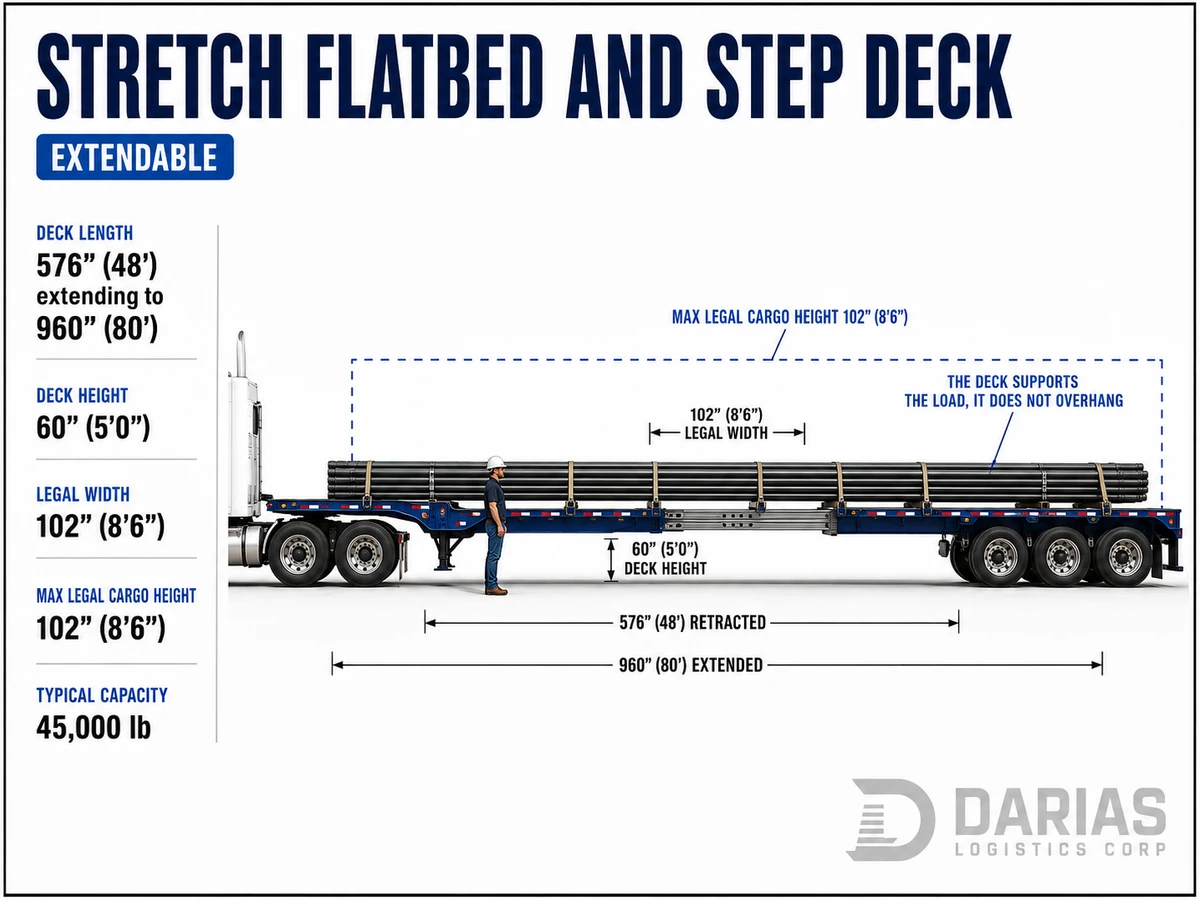
Spécification
| Mesure | Plateaux extensibles |
|---|---|
| Longueur de plateau | 48′ ou 80′ |
| Hauteur de plateau | 5′ |
| Largeur légale | 8′ 6″ |
| Hauteur légale max de chargement | 8′ 6″ |
| Capacité typique | 45,000 lb |
Ce sont des chiffres nominaux pour ce type de matériel. Les caisses réelles varient selon le fabricant, la compagnie et l'année, et la tare est peinte sur la porte de l'unité que vous recevez. Envoyez le numéro de conteneur et nous vérifions sur le vrai.
What a stretch trailer is
A stretch, or extendable, trailer is an open deck built to change length. A flatbed version starts around 48 ft closed and extends to something like 80 ft, and a step deck version does the same from a lower main deck. Legal width is 8 ft 6 in, the flatbed deck sits about 5 ft up, which leaves roughly 8 ft 6 in of cargo height under Florida's 13 ft 6 in limit, and typical capacity is near 45,000 lb.
The mechanism exists for one purpose: to put a support under a load that is longer than any ordinary deck. Beams, columns, pipe, poles, blades, trusses, tanks. Freight that is perfectly reasonable on weight and impossible on length. These are typical figures for the type rather than the specification of one trailer.
When to stretch, and when not to
Stretch when the piece is longer than the deck and cannot be supported at both ends by anything shorter. The trailer opens to the length the load needs, the freight is carried rather than cantilevered, and the move is permitted for its real overall length. That is a routine oversize move, planned in advance and run on a written route.
Do not stretch by reflex. If the piece fits a 53 ft deck, use one, because a shorter combination is easier to route, easier to place and cheaper to permit. If the load is long because it is several pieces, splitting it across two ordinary trailers is often faster than one oversize move with escorts. And if the freight is tall as well as long, start from the stretch step deck rather than the flatbed, since height cannot be fixed later.
What people get wrong: length is not capacity, and the overhang is not free
Extending a trailer does not make it carry more. Capacity stays around 45,000 lb whatever the setting. What changes is the distribution: a longer wheelbase spreads the axles further apart, and since the bridge formula ties allowable weight to axle spacing, a stretch can make a given weight legal without making a heavier weight possible. Those two ideas look alike on paper and behave completely differently at a scale.
The other habit worth breaking is treating overhang as a way to avoid all this. An unsupported end flexes and concentrates load at the last point of contact, it has to be flagged and lit, and it counts toward the overall length that the permit is written against. So the overhang usually buys damage risk rather than savings. Height is unchanged by any of it: a stretched flatbed still gives about 8 ft 6 in of cargo height, because the deck did not get any lower.
What to send to get it booked
The piece's real overall length, measured end to end as it will travel, plus width, height and weight. Then where it can be supported and where it must not be: a long item has bearing points, and putting a bolster in the wrong place bends freight that would have travelled perfectly well.
Say how many pieces there are, since two shorter items may travel as an ordinary load while one long one cannot. Describe both sites and the approach to each, because a combination stretched toward 80 ft needs room to turn that a normal trailer does not. And send all of it early: overlength moves are permitted and routed before they run, and escorts, times and approved roads are set in that planning rather than on the day.
Sort de
Va à
Questions
Réponses directes
How long can a stretch trailer extend?
A common extendable flatbed starts near 48 ft closed and opens out to around 80 ft, and step deck versions work the same way. You do not stretch it to the maximum because you can: you stretch it to the length that supports the piece properly, then stop. Every foot of extension makes the combination longer to turn, longer to permit and harder to place, so the right setting is the shortest one that carries the load.
Why not just let a long load overhang a flatbed?
Because an unsupported end is a structural problem before it is a legal one. A beam, a pipe or a blade hanging several feet past the deck flexes, bounces and concentrates stress at the last support, and that is how freight and trailers get damaged. Overhang also has to be flagged and lit, and it counts toward the combination's overall length anyway, so you rarely avoid the permit by letting it hang.
Is a stretch trailer the same as a stretch step deck?
Same mechanism, different deck. A stretch flatbed extends a level deck sitting around 5 ft off the road, and a stretch step deck extends a lower main deck, which buys cargo height in the same way an ordinary step deck does. The choice between them follows the freight's height exactly as it would on a fixed trailer. Long and tall needs the stepped version; long and low does not.
Does a long load need escorts in Florida?
Often, and it depends on the length, the route and the time of day rather than on a single threshold. Overlength moves are permitted and routed in advance, and escorts are added where the permit requires them, typically as length and width grow. That planning is why an oversize move is quoted with a lead time attached: the trailer is usually the easy part, and the route and the paperwork take the days.
How much weight can a stretched trailer carry?
Around 45,000 lb as a typical figure, and stretching the trailer does not increase it. What extending does is change where the weight sits and how far apart the axles are, which is often exactly what is needed, since the bridge formula ties allowable weight to axle spacing. So a stretch can help a load be legal without helping it be heavier, and those two things are easy to confuse.
Que transporte un Plateaux extensibles ?
Des plateaux qui s'allongent pour une charge légale en poids mais bien trop longue, comme des poutres, des pales et de la tuyauterie. Le plancher s'étend pour soutenir la charge au lieu de la laisser dépasser.
Vous occupez-vous des permis ?
Oui. Tout ce qui dépasse la largeur, la hauteur ou le poids légal reçoit son permis et son itinéraire avant de bouger, escortes comprises quand la route l'exige.
Traitez-vous les reefers ?
Oui, avec un genset pour que la caisse continue de tourner entre le terminal et la porte. Un reefer charge nettement moins qu'un conteneur sec de la même taille extérieure, parce que l'isolation et le côté machine prennent de la place réelle.
Et la marchandise qui ne rentre pas du tout dans un conteneur ?
Flat rack et open top pour le hors gabarit, ou plateau ouvert : flatbed, step deck, lowboy, RGN et double drop. Mesurez avant de réserver, parce que tout ce qui sort du gabarit change la question des permis.
Comment obtenir un tarif ?
Envoyez la route, l'équipement, la taille du conteneur et le port, et nous revenons avec un chiffre. Tarifs et répartition 24h/24 à quotes@dariaslogistics.com.
Que comprend vraiment un devis de drayage ?
Le déplacement lui-même, plus les accessoires qui surprennent après coup : châssis, pre-pull, per diem, demurrage, detention et stockage. Nous préférons les nommer d'entrée plutôt que les ajouter à une facture.