20' tank
ISO tank
Une citerne dans un cadre de 20 pieds, pour les liquides en vrac. Part souvent lourd, souvent en matières dangereuses, et la paperasse compte autant que l'équipement.
Dehors, dedans, et la porte
À quoi ça ressemble
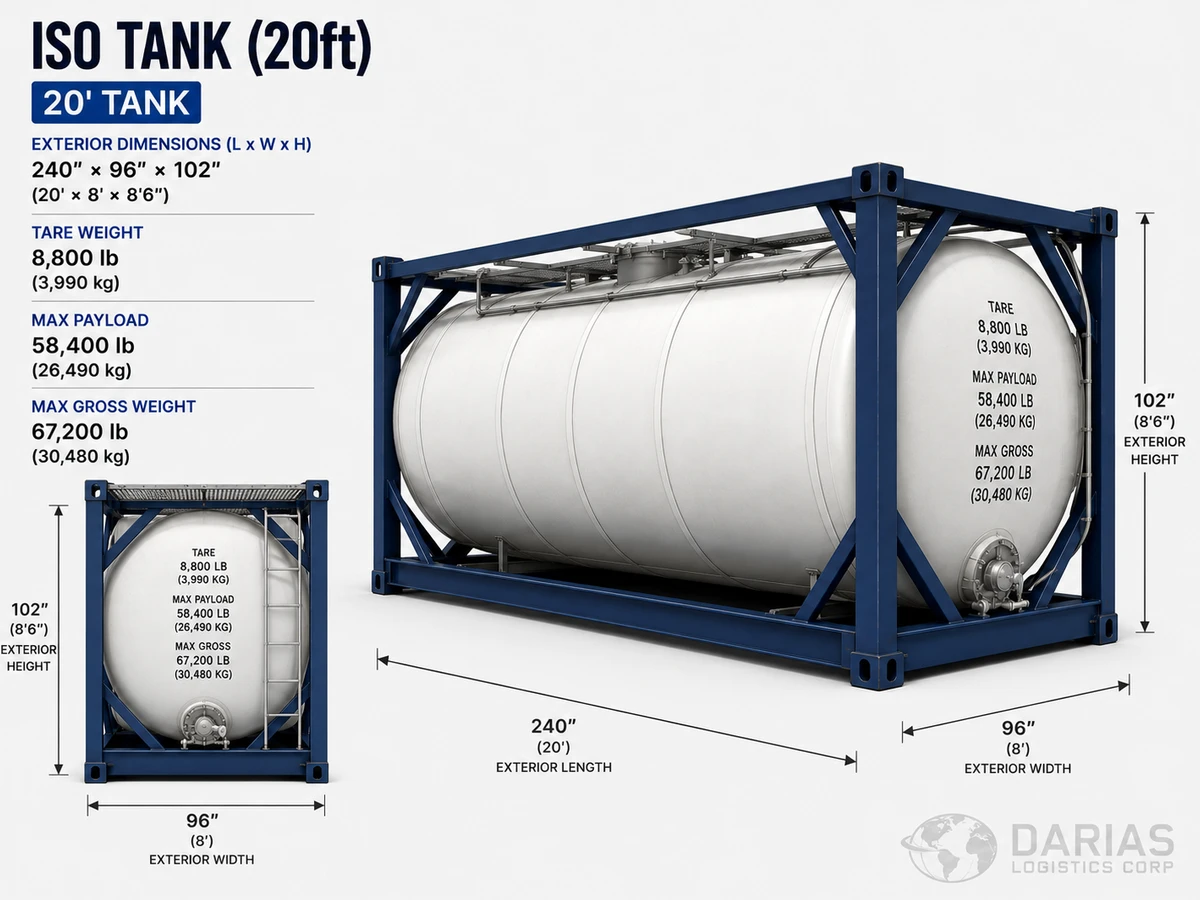
Spécification
| Mesure | ISO tank |
|---|---|
| Longueur extérieure | 240″ 20′ |
| Largeur extérieure | 96″ 8′ |
| Hauteur extérieure | 102″ 8′ 6″ |
| Tare | 8,800 lb |
| Charge utile max | 58,400 lb |
| Poids brut max | 67,200 lb |
| Châssis | Standard 20ft, tri-axle if it rides heavy |
Ce sont des chiffres nominaux pour ce type de matériel. Les caisses réelles varient selon le fabricant, la compagnie et l'année, et la tare est peinte sur la porte de l'unité que vous recevez. Envoyez le numéro de conteneur et nous vérifions sur le vrai.
What an ISO tank is
An ISO tank is a cylindrical pressure vessel held inside a 20 ft container frame, so a bulk liquid or gas can be handled by the same cranes, chassis and terminals as any other box. The frame measures about 20 ft by 8 ft by 8 ft 6 in and locks at the same four corners. Tare on a typical unit is near 8,800 lb, which is heavy for a 20 ft footprint and all of it is structure.
There are no interior or door dimensions, because there is no interior in the usual sense. What describes a tank instead is its data plate: capacity, test pressure, the date of its last inspection, and what it is approved to carry. Most standard chemical tanks hold somewhere around 5,500 to 7,000 US gallons, with the exact figure stamped on the unit rather than assumed from the type.
Four types, and why the type decides everything
A standard chemical tank is the common unit and the one people picture. A food grade tank is built and cleaned to a documented standard, and it travels with a cleaning certificate showing what it last carried and how it was washed. A pressurised gas tank is a different vessel with a different test regime. A cryogenic tank, for refrigerated liquefied gases, is different again.
Those differences drive availability far more than they drive price. A cryogenic unit also vents as it travels, which constrains where it can stand and for how long, so the schedule is part of the equipment question rather than separate from it. Saying which type you have and what is in it is the first useful sentence in any tank conversation, because the answer to whether it can move this week follows the type rather than the frame.
What people get wrong: the fill level, and the weight
A tank is not loaded to whatever volume is convenient. Filled somewhere between roughly 20 and 80 percent, the liquid inside has room to run from end to end, and under braking that moving mass arrives at the tank head hard enough to matter. The rule is to load either below about 20 percent or above about 80 percent, and a shipper planning a half load usually finds out about it late.
Weight is the second trap and it is arithmetic. Liquid is dense, the frame is short, and a 20 ft unit puts its whole load over one set of tandems, where the 34,000 lb tandem cap and the bridge formula bind long before the combination gets near 80,000 lb. A tank that loaded legally at origin and crossed an ocean without comment can still need a tri-axle chassis and an overweight permit for a delivery of a few miles in South Florida.
What to send to get it booked
Start with the type: chemical, food grade, pressurised gas or cryogenic. Then the product, the UN number and the placard class if it is regulated, because a placarded load is routed rather than simply dispatched, and in Miami that includes the fact that placarded freight cannot use the port tunnel and leaves over the bridge instead.
Add the tank number, the steamship line and the terminal, the gross weight of the loaded unit rather than the product weight alone, and the fill percentage. Say whether the tank needs heating, whether it vents, and what the receiving site can do: a tank discharges into something, and the pump, the connection and the hose at the far end are part of the job rather than a detail to settle on arrival.
Sort de
Va à
More in this section
Questions
Réponses directes
How much does an ISO tank hold?
Most standard chemical tanks in a 20 ft frame hold somewhere between about 5,500 and 7,000 US gallons, and the exact capacity is stamped on the tank's own data plate along with its test pressure and its last inspection. Capacity is rarely what limits a load, though. Weight is. A tank filled to its volume with a dense liquid will exceed what the road allows long before the shell runs out of room.
Why does an ISO tank have to be filled under 20 percent or over 80 percent?
Surge. A part filled tank lets the liquid run from end to end, and that moving weight arrives at the tank heads with real force under braking or in a turn. Loading either below about 20 percent or above about 80 percent keeps the free surface small enough to control. It is a rule people discover late, usually when a shipper wants to send a convenient half load, and it is not negotiable on the road.
Are all ISO tanks the same?
No, and the differences matter more than most shippers expect. A standard chemical tank, a food grade tank, a pressurised gas tank and a cryogenic tank for refrigerated liquefied gases are four distinct pieces of equipment with different fittings, different test regimes and very different availability. Whether a shipment can move this week usually depends on which type it needs rather than on the fact that it is a tank at all.
What makes a food grade tank different from a chemical tank?
The cargo history and the cleaning regime as much as the steel. A food grade tank is dedicated or cleaned to a documented standard, and the cleaning certificate travels with the unit as evidence of what was in it last and how it was washed out. A chemical tank may carry a product that permanently disqualifies the shell from food service. The certificate, not the appearance of the tank, is what a receiver will ask for.
Why does an ISO tank often ride overweight?
Because liquid is dense and the frame is short. Tare is around 8,800 lb before anything goes in, and a 20 ft unit concentrates its whole weight over one set of tandems, where the 34,000 lb cap and the bridge formula bind well before the combination reaches 80,000 lb. So a tank that is entirely legal at sea frequently needs a tri-axle chassis and an overweight permit for a short delivery in South Florida.
Quel châssis faut-il pour un ISO tank ?
Standard 20ft, tri-axle if it rides heavy. Nous apportons le châssis, donc une réservation ne dépend pas de ce que le terminal a de disponible ce matin-là.
Pouvez-vous le traiter en surpoids ?
Oui, sur le bon châssis et avec le bon permis. Le surpoids est une conversation distincte de la taille du conteneur, et les ports ont leurs propres limites en plus de celles de l'État.
D'où sortez-vous un ISO tank ?
Port of Miami, Port Everglades, Port of Palm Beach, POMTOC, South Florida Container Terminal, Seaboard Marine, Florida International Terminal, Port Everglades Terminal, Crowley, King Ocean, MSC, Tropical Shipping, Antillean Marine, FEC Port Everglades ICTF, FEC Hialeah rail ramp and CSX ramp.
Qu'est-ce que le last free day ?
Le dernier jour où votre conteneur peut rester à l'intérieur du terminal avant que les frais de stockage commencent. Passé ce jour, le demurrage s'accumule chaque jour, et c'est pour ça qu'un pre-pull revient presque toujours moins cher que d'attendre.
Qu'est-ce qu'un pre-pull ?
Nous récupérons le conteneur au terminal avant que vous soyez prêt et nous le gardons sur un parc. Ça arrête le demurrage aux tarifs du terminal et ça enlève la pression sur vos horaires de réception.
Quelle est la différence entre demurrage, per diem et detention ?
Trois frais différents, de parties différentes. Le demurrage, c'est le terminal qui vous facture la marchandise encore à l'intérieur du portail au-delà du temps franc. Le per diem, c'est la compagnie maritime qui vous facture le fait de garder son conteneur dehors au-delà du temps franc. Le detention, c'est le temps du transporteur, facturé quand un chauffeur attend à votre quai au-delà de la fenêtre franche. Ils peuvent courir en même temps, et c'est comme ça qu'une facture devient vite salée.
Comment obtenir un tarif ?
Envoyez la route, l'équipement, la taille du conteneur et le port, et nous revenons avec un chiffre. Tarifs et répartition 24h/24 à quotes@dariaslogistics.com.
Que comprend vraiment un devis de drayage ?
Le déplacement lui-même, plus les accessoires qui surprennent après coup : châssis, pre-pull, per diem, demurrage, detention et stockage. Nous préférons les nommer d'entrée plutôt que les ajouter à une facture.