Open deck
Charges lourdes à essieux multiples
Plus d'essieux sous le même plancher, pour que le poids se répartisse assez pour être permissible. C'est là que voyagent les transformateurs, les presses et les équipements d'usine.
À quoi ça ressemble
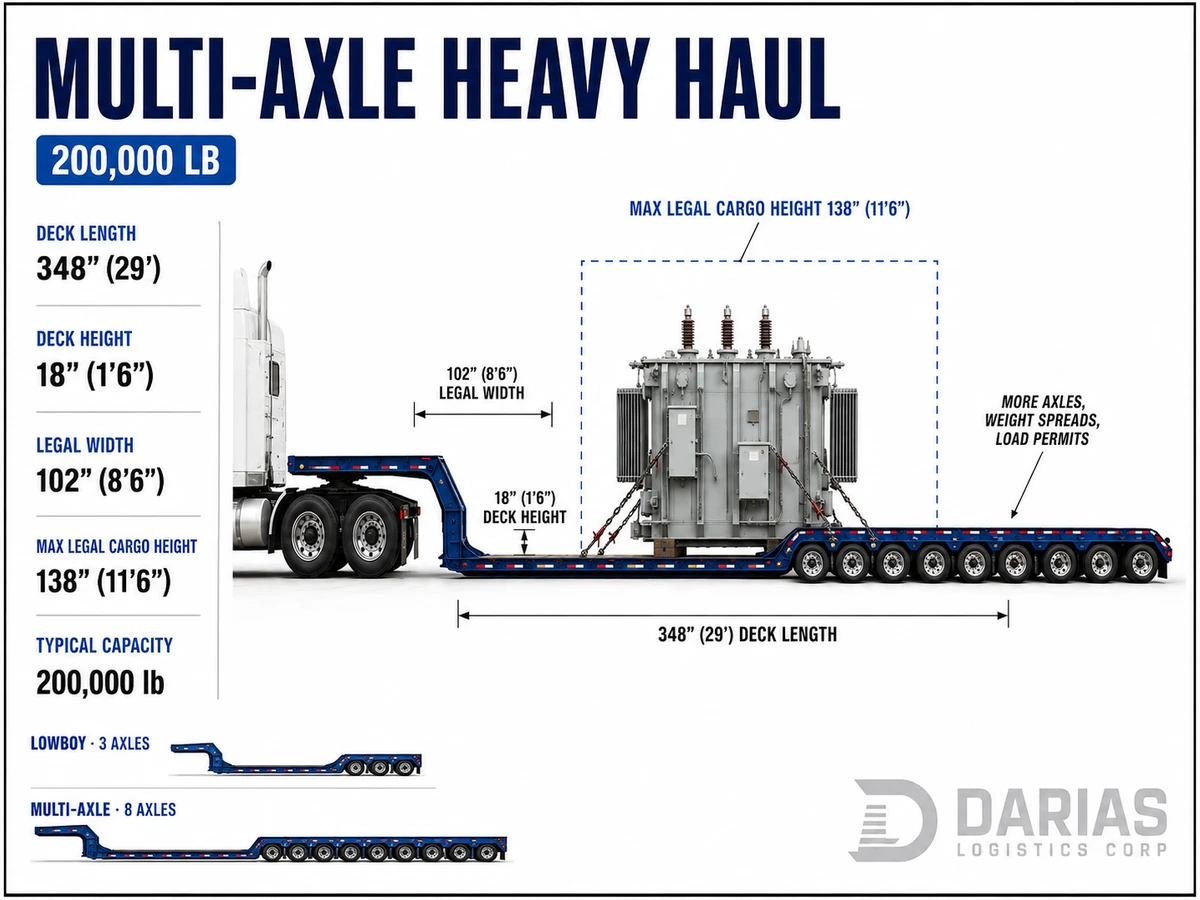
Spécification
| Mesure | Charges lourdes à essieux multiples |
|---|---|
| Longueur de plateau | 29′ |
| Hauteur de plateau | 1′ 6″ |
| Largeur légale | 8′ 6″ |
| Hauteur légale max de chargement | 11′ 6″ |
| Capacité typique | 200,000 lb |
Ce sont des chiffres nominaux pour ce type de matériel. Les caisses réelles varient selon le fabricant, la compagnie et l'année, et la tare est peinte sur la porte de l'unité que vous recevez. Envoyez le numéro de conteneur et nous vérifions sur le vrai.
What a multi-axle heavy haul trailer is
It is the same low deck idea as a lowboy with far more axles underneath. The well sits about 1 ft 6 in off the road and runs around 29 ft, width is 8 ft 6 in, and cargo height of something like 11 ft 6 in is available under Florida's 13 ft 6 in limit. What separates it is capacity: typical figures reach around 200,000 lb, which is more than twice the legal gross of an entire ordinary combination.
That capacity is only usable because of the axles. Spread across enough of them, a load that would crush the limits on a standard trailer arrives at each axle group inside what the rules allow. Transformers, presses, plant equipment, large vessels and industrial modules ride this way. These are typical figures for the class rather than the specification of one trailer, and the configuration is built around the piece.
When the load outgrows a lowboy
A lowboy or a removable gooseneck handles most heavy machinery, and it does it with a simpler combination that is easier to route. The move steps up to multi-axle when the weight can no longer be made legal by placement alone: when the piece is heavy enough that any reasonable arrangement of a standard trailer's axles is over on a group, or when the permit for that weight requires a specific configuration.
The step up is not only about the trailer. More axles mean a longer, heavier combination, which means more roads that do not work, more structures to check and often an escort requirement. So the sensible order is to establish the true weight first and choose the equipment second. A piece that turns out to weigh less than feared can move on ordinary heavy haul equipment for a fraction of the planning.
What people get wrong: the route is the job
People treat a heavy haul like a normal delivery with a bigger truck. It is closer to a small engineering project. The permit is written against a described load on named roads, and those roads are named because bridges, overpasses, surfaces, turning radii and overhead clearances have been checked against that weight and that configuration. A structure that cannot take the load does not become passable because the delivery is nearby, which is how a twenty mile delivery acquires an eighty mile route.
The sites matter as much as the road between them. A combination like this needs somewhere to turn, somewhere to stop, and ground that will carry the axle loads rather than rutting under them. Yards built for a dry van are frequently unusable. And the weight itself must be the real one: a figure that turns out to be optimistic invalidates the permit it was issued against, which stops the move rather than delaying it.
What to send to get it booked
The four numbers, as accurately as they can be had: length, width, height and weight of the piece as it will travel. Make and model if it is a machine, and a drawing or a specification sheet if it is not. Where it can be lifted, where it can be supported, and whether anything comes off for transport.
Then both sites. The address, the approach, the surface, the room to turn and anything overhead. Say what will load it and what will unload it, since a piece of this size normally needs a crane or a jacking arrangement at each end. Send all of it as early as you can, because the permits, the route review, the escorts and the travel windows are the timeline, and the driving is the short part.
Sort de
Va à
Questions
Réponses directes
Why do heavy loads need more axles?
Because the road is not damaged by the total weight, it is damaged by how much weight arrives at each point of contact. Limits are written per axle and per axle group for exactly that reason. Adding axles divides the same load into more, lighter footprints, and spreading them further apart satisfies the spacing rules too. That is what makes a 200,000 lb piece a permittable move rather than an impossible one.
What is the bridge formula?
A rule that ties how much a group of axles may carry to how far apart they are spread and how many there are. The further the spread, the more weight is allowed, because the load is distributed across a longer section of whatever structure is underneath. It is why two trucks at the same gross weight are not equally legal, and why a short heavy container gets stopped by it while a long trailer at the same weight does not.
Can a 200,000 lb load travel on any road?
No, and route is most of the work on a move like this. The permit names the roads, and it names them because bridges, overpasses, surfaces and turns have been checked against that specific weight and configuration. Some structures cannot take the load at all, which is how a delivery twenty miles away ends up with an eighty mile route. The route is engineered rather than chosen.
How far ahead does a heavy haul move need to be planned?
Longer than the driving takes, usually by a wide margin. Permits are issued against a described load on a described route, escorts and travel windows are attached to them, and any structure that needs review adds its own time. The trailer is rarely what holds a job up. The thing to do early is settle the real weight and the real dimensions, since every piece of the plan is built from those four numbers.
Does a heavy haul load travel at night?
Sometimes, and it is the permit and the route that decide rather than preference. Travel windows are attached to oversize and overweight permits to keep large loads away from peak traffic, and some roads and structures are only available at particular times. A move planned around those windows runs smoothly, and one planned around the customer's preferred hour usually has to be replanned.
Que transporte un Charges lourdes à essieux multiples ?
Plus d'essieux sous le même plancher, pour que le poids se répartisse assez pour être permissible. C'est là que voyagent les transformateurs, les presses et les équipements d'usine.
Vous occupez-vous des permis ?
Oui. Tout ce qui dépasse la largeur, la hauteur ou le poids légal reçoit son permis et son itinéraire avant de bouger, escortes comprises quand la route l'exige.
Traitez-vous les reefers ?
Oui, avec un genset pour que la caisse continue de tourner entre le terminal et la porte. Un reefer charge nettement moins qu'un conteneur sec de la même taille extérieure, parce que l'isolation et le côté machine prennent de la place réelle.
Et la marchandise qui ne rentre pas du tout dans un conteneur ?
Flat rack et open top pour le hors gabarit, ou plateau ouvert : flatbed, step deck, lowboy, RGN et double drop. Mesurez avant de réserver, parce que tout ce qui sort du gabarit change la question des permis.
Comment obtenir un tarif ?
Envoyez la route, l'équipement, la taille du conteneur et le port, et nous revenons avec un chiffre. Tarifs et répartition 24h/24 à quotes@dariaslogistics.com.
Que comprend vraiment un devis de drayage ?
Le déplacement lui-même, plus les accessoires qui surprennent après coup : châssis, pre-pull, per diem, demurrage, detention et stockage. Nous préférons les nommer d'entrée plutôt que les ajouter à une facture.