40' HC / 45G1
Conteneur de 40 pieds high cube
Un pied de hauteur intérieure de plus qu'un 40 standard. Attention à la hauteur totale sur un châssis standard ; un gooseneck récupère ce dégagement.
Dehors, dedans, et la porte
À quoi ça ressemble
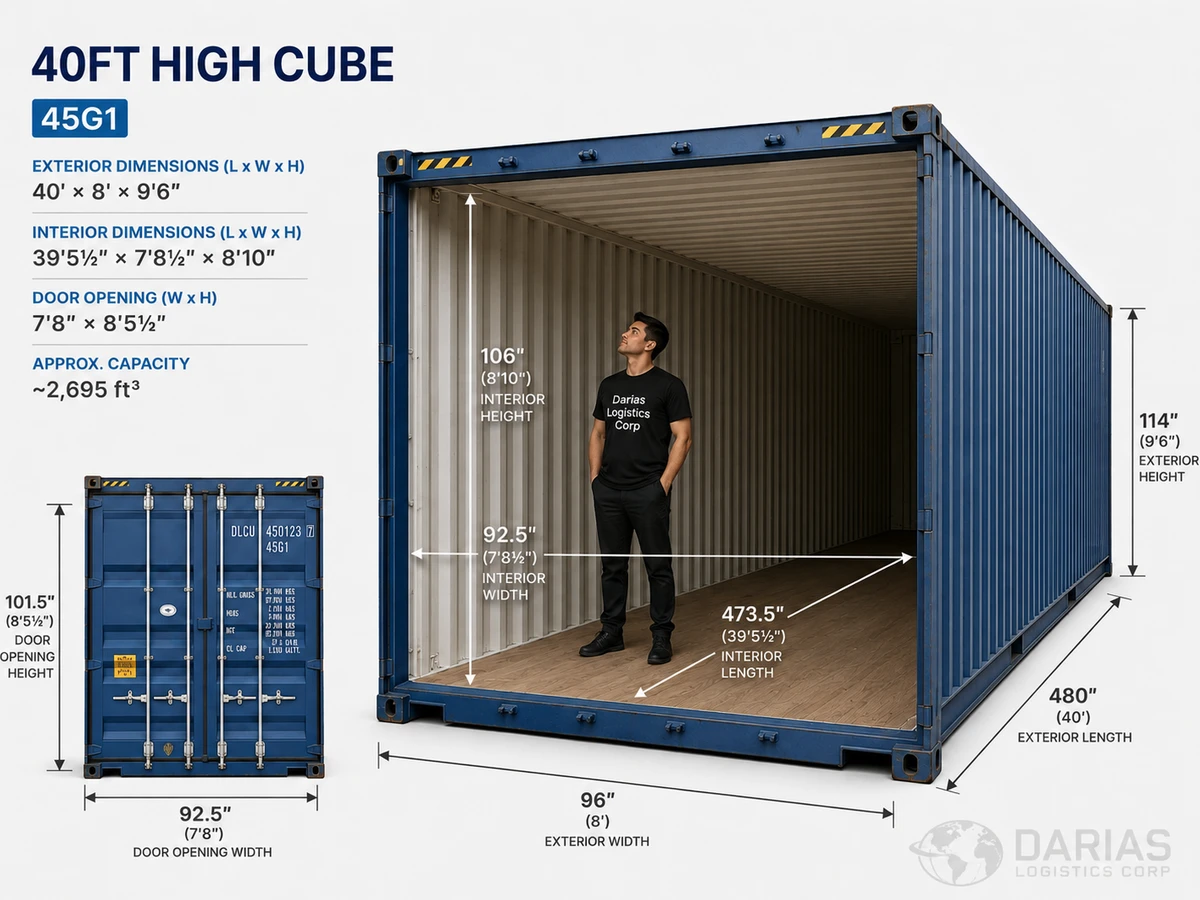
Spécification
| Mesure | Conteneur de 40 pieds high cube |
|---|---|
| Longueur extérieure | 480″ 40′ |
| Largeur extérieure | 96″ 8′ |
| Hauteur extérieure | 114″ 9′ 6″ |
| Longueur intérieure | 473.5″ 39′ 5.5″ |
| Largeur intérieure | 92.5″ 7′ 8.5″ |
| Hauteur intérieure | 106″ 8′ 10″ |
| Largeur de porte | 92″ 7′ 8″ |
| Hauteur de porte | 101.5″ 8′ 5.5″ |
| Tare | 8,750 lb |
| Charge utile max | 58,450 lb |
| Poids légal max sur route | 44,000 lb |
| Poids brut max | 67,200 lb |
| Capacité | 2,695 pi³ |
| Châssis | Standard 40ft, or a gooseneck to claw back travel height |
Ce sont des chiffres nominaux pour ce type de matériel. Les caisses réelles varient selon le fabricant, la compagnie et l'année, et la tare est peinte sur la porte de l'unité que vous recevez. Envoyez le numéro de conteneur et nous vérifions sur le vrai.
What a 40ft high cube is
A 40ft high cube is the standard 40 with a foot added to its height. Outside it is 40 ft long, 8 ft wide and 9 ft 6 in tall rather than 8 ft 6 in. Inside, the nominal figures are about 39 ft 5.5 in by 7 ft 8.5 in by 8 ft 10 in, which works out at roughly 2,695 cu ft against the standard box's 2,389. The door opening is around 7 ft 8 in wide by 8 ft 5.5 in tall.
It is the most common box on many trades now, so a shipment described simply as a 40 is often this one. The extra steel costs a little weight: tare runs near 8,750 lb where a standard 40 sits around 8,380, which takes a few hundred pounds off what you can legally load. These are nominal figures for the type, and the tare that counts is stencilled on the door of the actual unit.
When the extra foot earns its place
Height is the only thing that changes, so the high cube pays when the freight is tall. Machinery on a skid, crated equipment, racking, anything that wants a second tier and runs out of ceiling in a standard 40 at 7 ft 10 in. Across 39 ft of floor, one extra foot of height is a lot of usable volume, and it often collapses a two container shipment into one.
It does nothing for weight. Legal road cargo is 44,000 lb for both boxes on a standard chassis, so a dense load gains nothing and, with a few hundred pounds more tare, loses a little. It does nothing for width either: at about 7 ft 8.5 in inside, two 48 in pallet edges will not sit side by side in either box. If width is the problem, the 45 ft wide body run on the South Florida trades is 102 in outside and takes two 48 in pallets across. If the cargo will not fit any box at all, the conversation moves to an open top, a flat rack or an open deck trailer.
What people get wrong: travel height, and the door
Florida's legal travel height is 13 ft 6 in, and the thing being measured is the whole vehicle, not the container. A 9 ft 6 in box on a standard chassis deck can sit within inches of that, which is legal and perfectly normal on ordinary routes, but it leaves nothing spare for a low canopy at the receiving yard, an older overpass on a local approach, or a dock with a soffit over it. A gooseneck chassis drops the box and buys back clearance, and it is worth asking for before the route is set rather than after a driver has stopped short of a bridge.
The second mistake is measuring cargo against the ceiling. The interior stands about 8 ft 10 in and the door opening is roughly four inches less, so a crate that fits the box will not always pass the opening. Measure the load with its pallet or skid included, at both ends of the trip, because the customer's own dock door is frequently the tightest opening on the whole journey.
What to send to get it booked
Send the container number, the steamship line and the terminal first. Those decide the gate requirement and the appointment, and they are the difference between a move that is planned and one that waits. Add the last free day, the delivery address and the cargo weight as it reads on the bill of lading.
Then say the thing specific to this box: whether anything on the route or at the delivery is tight on height. A canopy, a gate with a bar across it, an overpass on the last mile, a dock door with a known clearance. That is what decides whether a standard chassis is fine or a gooseneck is the right call, and it is a ten second answer when it is asked early and a wasted trip when it is not.
Work it out first
Sort de
Va à
More in this section
Questions
Réponses directes
What is the door opening of a 40ft high cube?
About 7 ft 8 in wide by 8 ft 5.5 in tall on the nominal figures for the type. Both are smaller than the interior, and the height is the one that surprises people: there is roughly 8 ft 10 in of ceiling inside but only about 8 ft 5.5 in of way in. Anything loaded through the end has to clear the header and the sill, so measure the crate on its pallet against the opening rather than against the interior height.
How tall is a 40ft high cube on a chassis?
The box is 9 ft 6 in on its own, and what matters on the road is the box plus the deck it sits on. On a standard container chassis a high cube often ends up within inches of Florida's 13 ft 6 in legal height, which is fine on ordinary routes and unforgiving everywhere else: low canopies, older overpasses, a dock apron with a soffit above it. A gooseneck or drop frame chassis sits the box lower and buys the clearance back.
What is a gooseneck chassis for?
It is a chassis with a dropped frame behind the kingpin, so a tall container rides lower than it would on a flat deck. On a 9 ft 6 in high cube that difference is the margin against the 13 ft 6 in limit, which is why it comes up on high cubes and almost never on standard boxes. It is worth asking for when the route has a known low clearance, or when the delivery has a canopy the driver has to get under.
Is a 40ft high cube more expensive to move than a standard 40?
The move itself is the same work: the same chassis in most cases, the same terminal, the same appointment. What can change the price is height. If the route needs a gooseneck, or the delivery has a clearance that has to be planned around, that is equipment and planning rather than a surcharge on the box being taller. Weight behaves almost identically, since the extra steel only costs a few hundred pounds of payload.
How much more does a 40ft high cube hold than a standard 40?
About 2,695 cu ft against 2,389, so roughly 300 cu ft or one extra foot of height across the whole floor. The floor plan does not change at all: same 39 ft 5.5 in of length, same 7 ft 8.5 in of width, same pallet count on the deck. The gain is entirely vertical, which is why it helps tall single pieces and second tier stacking and does nothing for a load that was already width limited.
Quelles sont les dimensions intérieures d'un Conteneur de 40 pieds high cube ?
La longueur, la largeur et la hauteur intérieures figurent dans le tableau de spécifications de cette page, à côté des dimensions extérieures et de l'ouverture de porte. C'est l'ouverture de porte qui décide si une machine passe, et elle est plus petite que l'intérieur.
Quel châssis faut-il pour un Conteneur de 40 pieds high cube ?
Standard 40ft, or a gooseneck to claw back travel height. Nous apportons le châssis, donc une réservation ne dépend pas de ce que le terminal a de disponible ce matin-là.
Pouvez-vous le traiter en surpoids ?
Oui, sur le bon châssis et avec le bon permis. Le surpoids est une conversation distincte de la taille du conteneur, et les ports ont leurs propres limites en plus de celles de l'État.
D'où sortez-vous un Conteneur de 40 pieds high cube ?
Port of Miami, Port Everglades, Port of Palm Beach, POMTOC, South Florida Container Terminal, Seaboard Marine, Florida International Terminal, Port Everglades Terminal, Crowley, King Ocean, MSC, Tropical Shipping, Antillean Marine, FEC Port Everglades ICTF, FEC Hialeah rail ramp and CSX ramp.
Qu'est-ce que le last free day ?
Le dernier jour où votre conteneur peut rester à l'intérieur du terminal avant que les frais de stockage commencent. Passé ce jour, le demurrage s'accumule chaque jour, et c'est pour ça qu'un pre-pull revient presque toujours moins cher que d'attendre.
Qu'est-ce qu'un pre-pull ?
Nous récupérons le conteneur au terminal avant que vous soyez prêt et nous le gardons sur un parc. Ça arrête le demurrage aux tarifs du terminal et ça enlève la pression sur vos horaires de réception.
Quelle est la différence entre demurrage, per diem et detention ?
Trois frais différents, de parties différentes. Le demurrage, c'est le terminal qui vous facture la marchandise encore à l'intérieur du portail au-delà du temps franc. Le per diem, c'est la compagnie maritime qui vous facture le fait de garder son conteneur dehors au-delà du temps franc. Le detention, c'est le temps du transporteur, facturé quand un chauffeur attend à votre quai au-delà de la fenêtre franche. Ils peuvent courir en même temps, et c'est comme ça qu'une facture devient vite salée.
Comment obtenir un tarif ?
Envoyez la route, l'équipement, la taille du conteneur et le port, et nous revenons avec un chiffre. Tarifs et répartition 24h/24 à quotes@dariaslogistics.com.
Que comprend vraiment un devis de drayage ?
Le déplacement lui-même, plus les accessoires qui surprennent après coup : châssis, pre-pull, per diem, demurrage, detention et stockage. Nous préférons les nommer d'entrée plutôt que les ajouter à une facture.