40' HC / 45G1
Контейнер 40 футов high cube
На фут больше внутренней высоты, чем у стандартного 40-футового. Следите за общей высотой на стандартном шасси; gooseneck возвращает этот запас.
Снаружи, внутри и дверь
Как выглядит
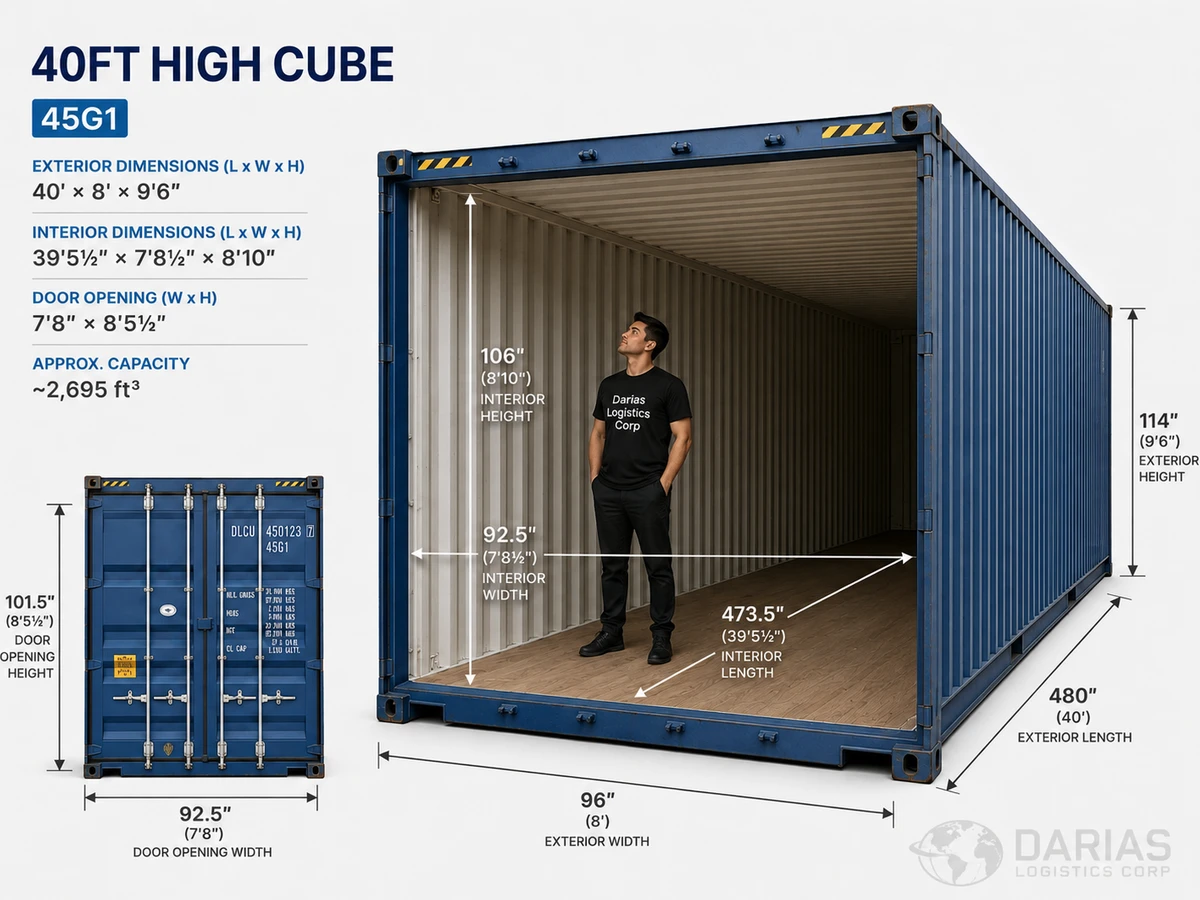
Характеристики
| Параметр | Контейнер 40 футов high cube |
|---|---|
| Длина снаружи | 480″ 40′ |
| Ширина снаружи | 96″ 8′ |
| Высота снаружи | 114″ 9′ 6″ |
| Длина внутри | 473.5″ 39′ 5.5″ |
| Ширина внутри | 92.5″ 7′ 8.5″ |
| Высота внутри | 106″ 8′ 10″ |
| Ширина двери | 92″ 7′ 8″ |
| Высота двери | 101.5″ 8′ 5.5″ |
| Тара | 8,750 lb |
| Макс. загрузка | 58,450 lb |
| Законный вес на дороге | 44,000 lb |
| Макс. полная масса | 67,200 lb |
| Объём | 2,695 фут³ |
| Шасси | Standard 40ft, or a gooseneck to claw back travel height |
Это номинальные значения для этого типа оборудования. Реальные контейнеры отличаются по производителю, линии и году, а тара выбита на двери той единицы, которую вы получите. Пришлите номер контейнера, и мы сверим с настоящим.
What a 40ft high cube is
A 40ft high cube is the standard 40 with a foot added to its height. Outside it is 40 ft long, 8 ft wide and 9 ft 6 in tall rather than 8 ft 6 in. Inside, the nominal figures are about 39 ft 5.5 in by 7 ft 8.5 in by 8 ft 10 in, which works out at roughly 2,695 cu ft against the standard box's 2,389. The door opening is around 7 ft 8 in wide by 8 ft 5.5 in tall.
It is the most common box on many trades now, so a shipment described simply as a 40 is often this one. The extra steel costs a little weight: tare runs near 8,750 lb where a standard 40 sits around 8,380, which takes a few hundred pounds off what you can legally load. These are nominal figures for the type, and the tare that counts is stencilled on the door of the actual unit.
When the extra foot earns its place
Height is the only thing that changes, so the high cube pays when the freight is tall. Machinery on a skid, crated equipment, racking, anything that wants a second tier and runs out of ceiling in a standard 40 at 7 ft 10 in. Across 39 ft of floor, one extra foot of height is a lot of usable volume, and it often collapses a two container shipment into one.
It does nothing for weight. Legal road cargo is 44,000 lb for both boxes on a standard chassis, so a dense load gains nothing and, with a few hundred pounds more tare, loses a little. It does nothing for width either: at about 7 ft 8.5 in inside, two 48 in pallet edges will not sit side by side in either box. If width is the problem, the 45 ft wide body run on the South Florida trades is 102 in outside and takes two 48 in pallets across. If the cargo will not fit any box at all, the conversation moves to an open top, a flat rack or an open deck trailer.
What people get wrong: travel height, and the door
Florida's legal travel height is 13 ft 6 in, and the thing being measured is the whole vehicle, not the container. A 9 ft 6 in box on a standard chassis deck can sit within inches of that, which is legal and perfectly normal on ordinary routes, but it leaves nothing spare for a low canopy at the receiving yard, an older overpass on a local approach, or a dock with a soffit over it. A gooseneck chassis drops the box and buys back clearance, and it is worth asking for before the route is set rather than after a driver has stopped short of a bridge.
The second mistake is measuring cargo against the ceiling. The interior stands about 8 ft 10 in and the door opening is roughly four inches less, so a crate that fits the box will not always pass the opening. Measure the load with its pallet or skid included, at both ends of the trip, because the customer's own dock door is frequently the tightest opening on the whole journey.
What to send to get it booked
Send the container number, the steamship line and the terminal first. Those decide the gate requirement and the appointment, and they are the difference between a move that is planned and one that waits. Add the last free day, the delivery address and the cargo weight as it reads on the bill of lading.
Then say the thing specific to this box: whether anything on the route or at the delivery is tight on height. A canopy, a gate with a bar across it, an overpass on the last mile, a dock door with a known clearance. That is what decides whether a standard chassis is fine or a gooseneck is the right call, and it is a ten second answer when it is asked early and a wasted trip when it is not.
Work it out first
Забираем из
Идёт в
Вопросы
Прямые ответы
What is the door opening of a 40ft high cube?
About 7 ft 8 in wide by 8 ft 5.5 in tall on the nominal figures for the type. Both are smaller than the interior, and the height is the one that surprises people: there is roughly 8 ft 10 in of ceiling inside but only about 8 ft 5.5 in of way in. Anything loaded through the end has to clear the header and the sill, so measure the crate on its pallet against the opening rather than against the interior height.
How tall is a 40ft high cube on a chassis?
The box is 9 ft 6 in on its own, and what matters on the road is the box plus the deck it sits on. On a standard container chassis a high cube often ends up within inches of Florida's 13 ft 6 in legal height, which is fine on ordinary routes and unforgiving everywhere else: low canopies, older overpasses, a dock apron with a soffit above it. A gooseneck or drop frame chassis sits the box lower and buys the clearance back.
What is a gooseneck chassis for?
It is a chassis with a dropped frame behind the kingpin, so a tall container rides lower than it would on a flat deck. On a 9 ft 6 in high cube that difference is the margin against the 13 ft 6 in limit, which is why it comes up on high cubes and almost never on standard boxes. It is worth asking for when the route has a known low clearance, or when the delivery has a canopy the driver has to get under.
Is a 40ft high cube more expensive to move than a standard 40?
The move itself is the same work: the same chassis in most cases, the same terminal, the same appointment. What can change the price is height. If the route needs a gooseneck, or the delivery has a clearance that has to be planned around, that is equipment and planning rather than a surcharge on the box being taller. Weight behaves almost identically, since the extra steel only costs a few hundred pounds of payload.
How much more does a 40ft high cube hold than a standard 40?
About 2,695 cu ft against 2,389, so roughly 300 cu ft or one extra foot of height across the whole floor. The floor plan does not change at all: same 39 ft 5.5 in of length, same 7 ft 8.5 in of width, same pallet count on the deck. The gain is entirely vertical, which is why it helps tall single pieces and second tier stacking and does nothing for a load that was already width limited.
Какие внутренние размеры у Контейнер 40 футов high cube?
Внутренние длина, ширина и высота приведены в таблице характеристик на этой странице, рядом с наружными размерами и дверным проёмом. Влезет ли машина, решает именно дверной проём, а он меньше внутреннего сечения.
Какое шасси нужно под Контейнер 40 футов high cube?
Standard 40ft, or a gooseneck to claw back travel height. Шасси у нас своё, поэтому бронь не зависит от того, что в это утро нашлось на терминале.
Можете взять его с перевесом?
Да, на правильном шасси и с правильным разрешением. Перевес это отдельный вопрос от размера контейнера, а у портов есть свои лимиты поверх лимитов штата.
Откуда вы вывозите Контейнер 40 футов high cube?
Port of Miami, Port Everglades, Port of Palm Beach, POMTOC, South Florida Container Terminal, Seaboard Marine, Florida International Terminal, Port Everglades Terminal, Crowley, King Ocean, MSC, Tropical Shipping, Antillean Marine, FEC Port Everglades ICTF, FEC Hialeah rail ramp and CSX ramp.
Что такое last free day?
Последний день, когда ваш контейнер может стоять внутри терминала до начала платы за хранение. Пропустите его, и demurrage начнёт капать ежедневно, поэтому pre-pull почти всегда дешевле, чем ждать.
Что такое pre-pull?
Мы забираем контейнер с терминала раньше, чем вы готовы его принять, и держим его на площадке. Это останавливает demurrage по терминальным ставкам и снимает нагрузку с вашего графика приёмки.
В чём разница между demurrage, per diem и detention?
Это три разных сбора от разных сторон. Demurrage это терминал берёт с вас деньги за груз, который стоит внутри ворот после свободного времени. Per diem это морская линия берёт с вас деньги за то, что её контейнер находится у вас дольше свободного времени. Detention это время перевозчика, когда водитель ждёт у вашего дока дольше свободного окна. Они могут идти одновременно, и именно так счёт быстро становится некрасивым.
Как получить ставку?
Пришлите направление, оборудование, размер контейнера и порт, и мы вернёмся с цифрой. Ставки и диспетчеризация работают круглосуточно на quotes@dariaslogistics.com.
Что на самом деле входит в ставку на drayage?
Сама перевозка плюс дополнительные сборы, которые потом становятся сюрпризом: шасси, pre-pull, per diem, demurrage, detention и хранение. Мы предпочитаем назвать их сразу, а не добавить в счёт.