Open deck
Dry van
Закрытый паллетированный груз, в 48 и 53 фута. Вариант по умолчанию для всего, что вышло из контейнера через transload и едет вглубь страны.
Как выглядит
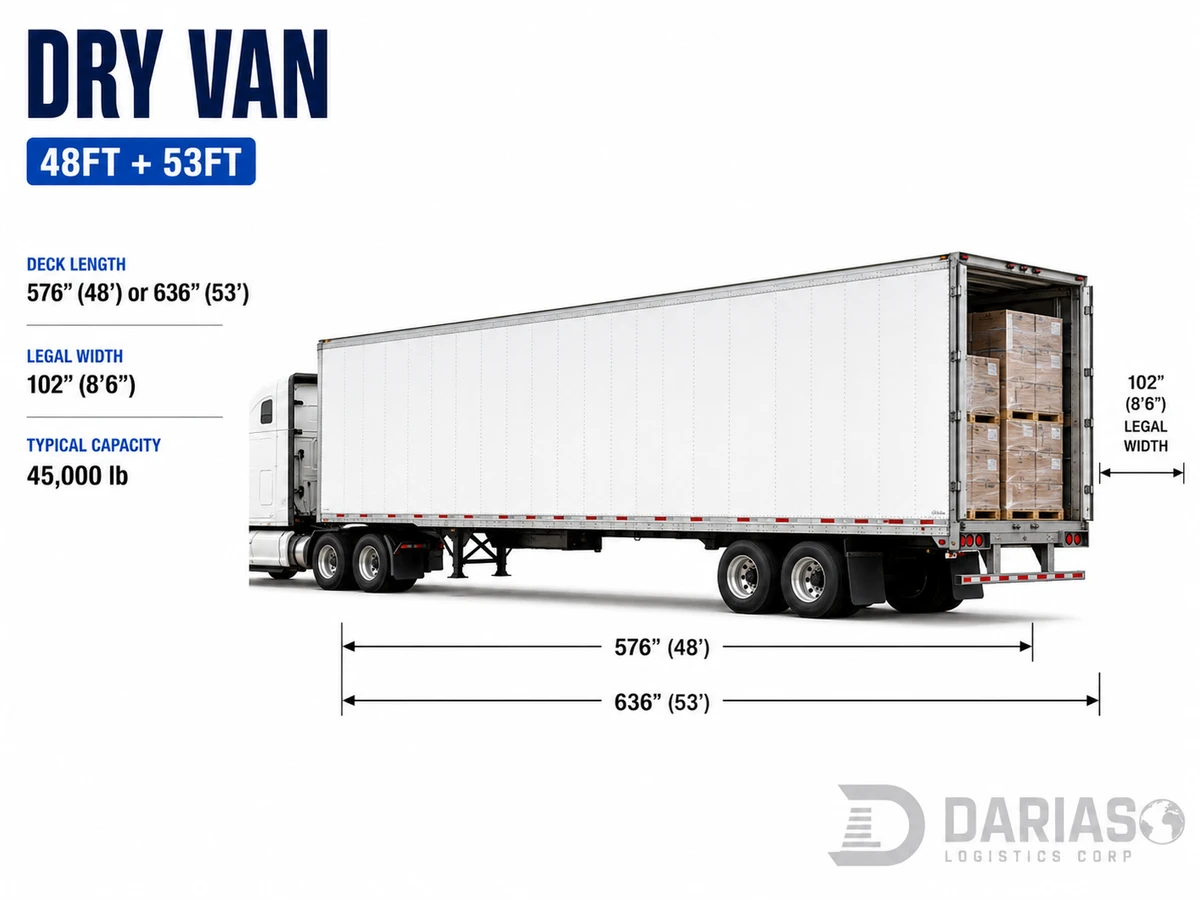
Характеристики
| Параметр | Dry van |
|---|---|
| Длина платформы | 48′ или 53′ |
| Законная ширина | 8′ 6″ |
| Обычная грузоподъёмность | 45,000 lb |
Это номинальные значения для этого типа оборудования. Реальные контейнеры отличаются по производителю, линии и году, а тара выбита на двери той единицы, которую вы получите. Пришлите номер контейнера, и мы сверим с настоящим.
What a dry van is
A dry van is the enclosed highway trailer that carries most of the freight in the country: a box on wheels, 48 ft or 53 ft long, 8 ft 6 in wide, with swinging doors at the back and a floor built for a forklift to drive on. A 53 ft van typically gives a little over 52 ft of interior length and around 26 pallet positions on the floor, and a typical capacity figure is near 45,000 lb of freight.
Nothing about it is clever, which is its strength. It locks, it keeps the weather out, it drops at a dock and waits without a tractor, and every warehouse in South Florida is built to receive one. These are typical figures for the type rather than one trailer's specification, and interior dimensions vary a little between builds.
When a dry van is the right trailer
Palletized, weatherproof freight that fits through a door. That is most freight. If it can be forked in from the back and does not need a temperature, the van is the cheapest and simplest way to move it, and it is the default for anything coming out of a container for an inland run.
The alternatives each solve something the van cannot. A reefer trailer is the same shape with refrigeration, for anything that has to hold a temperature. A conestoga takes freight that has to be loaded from the side or from above and still travel covered. A flatbed carries what will not go through a door at all, and it carries a few thousand pounds more while it is at it. And a container is the answer when the same box has to go to sea.
What people get wrong: the door, the pallet pattern and the weight
The doorway is smaller than the inside. A van that measures comfortably at the ceiling can still refuse a tall machine at the opening, and a forklift carrying a load high enough to clear its own mast can fail to get in at all. Measure the freight on its pallet and compare it to the door rather than to the trailer, and check the receiver's own door too, which is often tighter than anything on the truck.
Pallet arithmetic causes the rest. Two 40 by 48 in pallets sit across the width with the 40 in edge facing out, thirteen rows deep in a 53, which is where the number 26 comes from. Turn the pallets and it stops working. Weight then decides whether that floor plan is legal: at around 45,000 lb of typical capacity, a dense load fills the trailer on weight with half the floor empty, and where the weight sits decides the axle loads.
What to send to get it booked
Piece count, pallet count and pallet size, total weight, and the tallest piece measured on its pallet. That is usually enough to know whether the load fits the floor, fits the door and fits the axles. Say whether anything can be stacked, because a load that cannot double stack takes floor space rather than weight.
Then the two sites. Dock or ground level, forklift or no forklift, appointment or first come first served, and the room a 53 ft trailer has to get in and turn around. If the freight is coming out of a container, say the container number and the terminal too, since transloading it near the port and sending the empty straight back is often the cheaper shape of the same job.
Lanes this trailer runs
Забираем из
Идёт в
Вопросы
Прямые ответы
How many pallets fit in a 53 ft dry van?
Twenty six standard 40 by 48 in pallets on the floor, in thirteen rows of two, and twenty four in a 48 ft van. That pattern is the reason the 53 became the domestic default: it is two extra pallet positions for the same driver and the same trip. Whether anything stacks on top depends on the freight and the height available, and a load that cannot be stacked is often out of space long before it is out of weight.
What is the difference between a dry van and a container?
A van is a highway trailer with its own wheels and landing gear, so it can be dropped at a dock and left. A container is a box that has to sit on a chassis to move and that belongs to a shipping line, which keeps charging per diem while it is out. On the road a van is generally roomier inside and simpler to handle. The container's advantage is that it can cross an ocean.
Why transload a container into a dry van?
To stop the shipping line's clock and to run legal. Emptying a container at a dock near the port lets the empty go straight back, which ends per diem instead of paying it all the way inland and back. It also splits a heavy container across trailers that are each legal without permits. For anything beyond a short local run, that usually costs less in total than driving the box itself up the state.
Why does a dry van carry less weight than a flatbed?
Because the van is heavier before anything is loaded. Walls, a roof, a floor built for forklifts and two doors all weigh something, and every pound of that comes out of the same 80,000 lb legal gross. A typical van figure is around 45,000 lb of freight where a flatbed is nearer 48,000. For dense cargo that gap matters, and it is one of the reasons heavy freight often ends up on an open deck.
Does a dry van need a dock?
It is built for one, and everything about it assumes a dock: the floor sits at dock height, the doors swing at the back, and a forklift is expected to drive straight in. Ground level delivery is possible with a liftgate or with equipment on site, but it is slower and the trailer floor is still several feet up. If the receiver has no dock and no forklift, say so before the trailer is dispatched.
Что грузится на Dry van?
Закрытый паллетированный груз, в 48 и 53 фута. Вариант по умолчанию для всего, что вышло из контейнера через transload и едет вглубь страны.
Разрешения оформляете вы?
Да. Всё, что выходит за легальные ширину, высоту или вес, получает разрешение и проработанный маршрут до начала движения, включая сопровождение там, где маршрут его требует.
Работаете ли вы с reefer?
Да, с genset, чтобы контейнер работал по дороге от терминала до двери. Reefer вмещает заметно меньше, чем сухой контейнер того же наружного размера, потому что изоляция и машинное отделение забирают реальный объём.
А что с грузом, который вообще не помещается в контейнер?
Flat rack и open top для негабарита, либо открытая платформа: flatbed, step deck, lowboy, RGN и double drop. Замерьте до брони, потому что всё, что выходит за габарит, меняет картину с разрешениями.
Как получить ставку?
Пришлите направление, оборудование, размер контейнера и порт, и мы вернёмся с цифрой. Ставки и диспетчеризация работают круглосуточно на quotes@dariaslogistics.com.
Что на самом деле входит в ставку на drayage?
Сама перевозка плюс дополнительные сборы, которые потом становятся сюрпризом: шасси, pre-pull, per diem, demurrage, detention и хранение. Мы предпочитаем назвать их сразу, а не добавить в счёт.