Open deck
Piggyback forklift
A rough-terrain forklift that rides on a mounting kit at the rear of the flatbed and unloads where there is no dock and no site equipment. The freight pays for it twice: in the surcharge and in the payload its weight displaces, which is why it is quoted only where it saves more than it costs.
Как выглядит
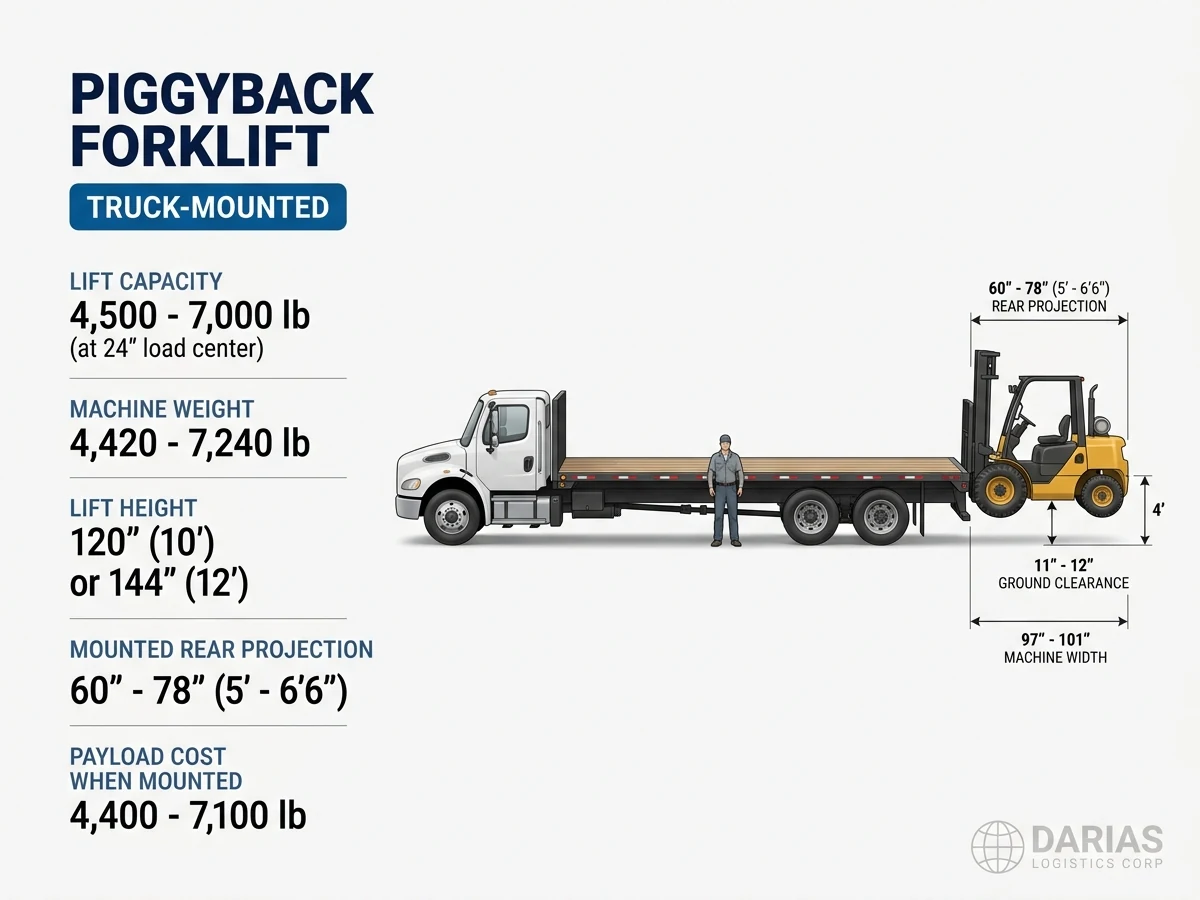
Характеристики
| Параметр | Piggyback forklift |
|---|---|
| Обычная грузоподъёмность | 5,500 lb |
| Параметр | Piggyback forklift |
|---|---|
| Lift capacity, single pick | 4,500 to 7,000 lb (2,041 to 3,175 kg) at 24 in load center |
| Machine weight | 4,420 to 7,240 lb (2,005 to 3,284 kg) |
| Lift height | 120 in standard, 144 in optional (3.05 / 3.66 m) |
| Width on the trailer | 97 to 101 in (2,464 to 2,565 mm), trailer width |
| Machine overhang, as published | 60 to 80 in (1,524 to 2,032 mm), measured with the rear wheel turned. No manufacturer publishes the projection behind a specific trailer: that depends on the mounting kit and is measured on the unit. Either way it is flagged and lit as a projecting load. |
| Ground clearance | 11 to 12 in (279 to 305 mm); 8 in (203 mm) on 4-way models |
| Max gradeability | 30 percent (15 percent in 4-way mode), traction spec, not a raised-load slope |
| Mount / dismount | under a minute by one operator; plan 60 to 90 seconds each way |
| Payload cost when mounted | 4,400 to 7,100 lb (2,000 to 3,220 kg) of legal freight weight |
| Tires | pneumatic rough-terrain, tractor grip |
The flatbed it rides on
| What it rides on | What that costs you |
|---|---|
| Straight truck, 20 to 26 ft body | The common configuration, and 24 ft is the usual body. Upfitters build the mounting kit onto the body rather than a trailer, which is why most piggyback delivery trucks are single units rather than tractor-trailers. |
| Straight truck, over 26 ft body | Rarely worth it. Florida caps a straight truck at 40 ft in extreme overall dimension, and the machine hanging at least 4 ft off the back counts toward that, so a longer body runs out of legal length before it runs out of deck. |
| Semi-trailer, 36 ft 6 in | 11,550 lb (5,239 kg) tare |
| Semi-trailer, 45 ft | 11,804 lb (5,354 kg) tare |
| Semi-trailer, 48 ft | 12,104 lb (5,490 kg) tare. The longest with a tare published by the factory; a 53 ft forklift trailer is listed by a trade publication but not on the maker's own page, so it is a dealer question rather than a spec. |
The four sizes, and what each one is for
| Class, by rated capacity | What it is normally used for |
|---|---|
| Compact, 2,750 to 3,600 lb | Beverage and route delivery, paved drops at retail. Small, light on payload, and wrong on a jobsite: one of these rates 15 percent gradeability. |
| Light, 4,000 to 4,630 lb | Sod and turf on dedicated wide tires, container stuffing and stripping with long forks, roofing and windows where the pick is light but may need height. |
| Standard, 5,000 to 5,500 lb | The ordinary delivery machine, and what most people mean by a piggyback. Lumber and drywall belong here, usually on a 4-way so a 20 ft bundle can walk through a gate sideways. |
| Heavy, 6,000 to 8,000 lb | Brick, block and pavers, where a dense cube hits the capacity limit long before the footprint does. Rental equipment, steel and machinery pallets. 8,000 lb is the ceiling of the whole category. |
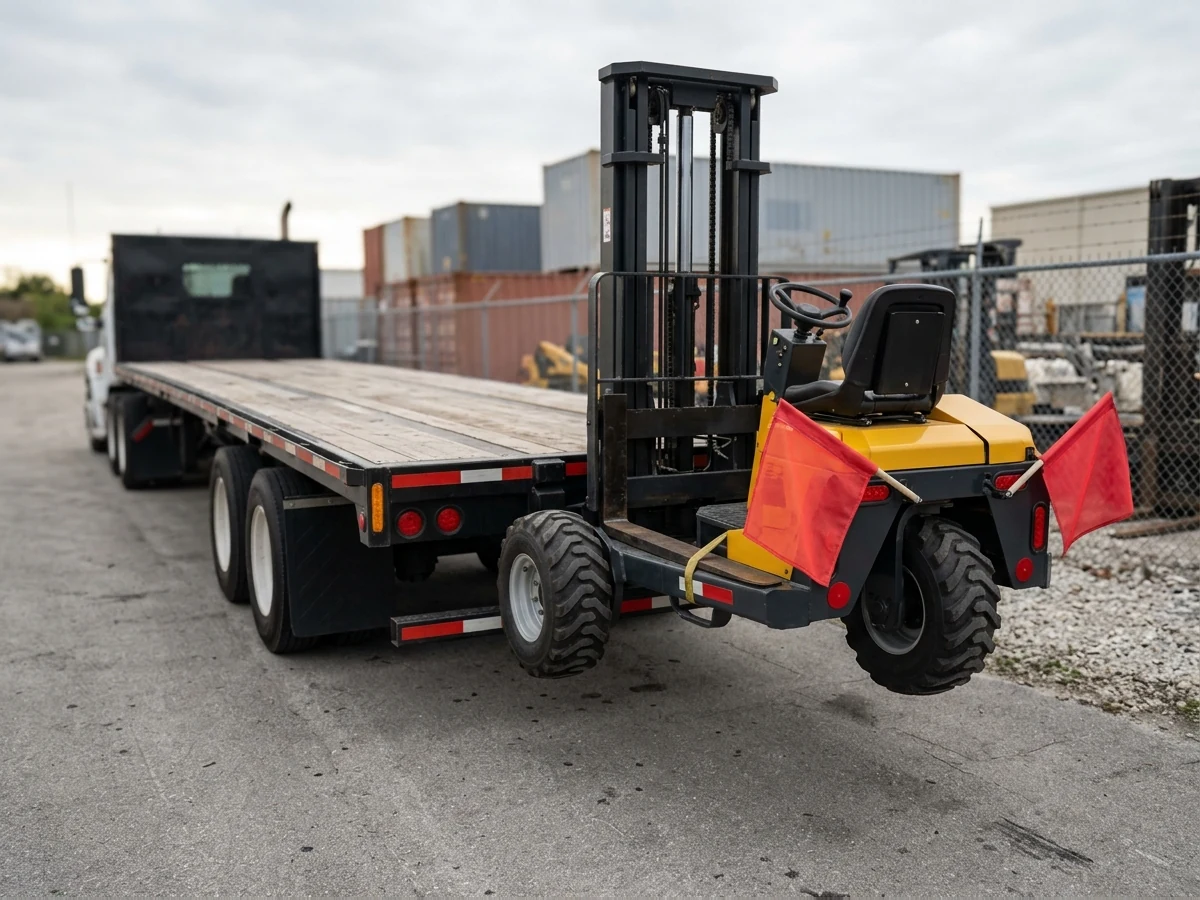
Mounted, the machine projects several feet behind the trailer and is flagged and lit as a projecting load; its weight also comes straight out of the legal payload.
Это номинальные значения для этого типа оборудования. Реальные контейнеры отличаются по производителю, линии и году, а тара выбита на двери той единицы, которую вы получите. Пришлите номер контейнера, и мы сверим с настоящим.
What a piggyback forklift is
A piggyback is a rough terrain forklift that travels on the back of the vehicle carrying the freight. It hangs on a mounting kit at the rear, comes off in under a minute when the truck arrives, unloads the load wherever it needs to go, and climbs back on before the vehicle leaves. One driver does all of it, which is the point: the delivery does not depend on the customer owning a dock, a forklift or a crew.
Most of them ride on straight trucks rather than trailers, usually on a body around 24 ft, because upfitters build the mounting kit onto the body. The standard delivery machines rate about 5,000 to 5,500 lb at the forks, weigh several thousand pounds themselves, and run pneumatic tires with real ground clearance so they can work on dirt, gravel and unfinished ground.
When it is worth sending one
It earns its place on deliveries to places that are not warehouses. Building sites, yards, farms, residential jobs, anywhere the freight has to be placed rather than dropped at a curb. Lumber, drywall, roofing, block, pavers, sod, windows, rental equipment: freight that arrives on pallets or bundles and has nothing at the far end to lift it off.
It is the wrong call where the receiver has its own equipment, or where a dock is available, because the machine costs money and payload on every trip whether it is used or not. A liftgate is the better tool for hand unloaded parcels, since it lowers freight to the ground rather than carrying it anywhere. The test is simple: does the machine save more than it costs on this delivery, counting the freight it displaced.
What people get wrong: it costs payload and it costs length
The freight pays for the machine twice. Once in the charge, and once in weight: between roughly 4,400 and 7,100 lb of the legal gross is occupied by a forklift, so that much freight does not travel. A load planned as though the truck were empty behind the cab will be planned over, and the correction happens at a scale rather than at the dock.
Length is the quieter problem. The machine projects behind the vehicle, commonly 60 to 80 in of published overhang, and that projection is added to the vehicle rather than absorbed by it. Florida caps a straight truck at 40 ft in extreme overall dimension and the mounted machine counts toward that, which is why bodies longer than 26 ft rarely make sense. It is flagged and lit as a projecting load. And the published gradeability figure is a traction spec: it is not a statement about handling a raised load on a slope.
What to send to get it booked
What the heaviest single pick weighs and how it is packaged, since capacity picks the class and the footprint picks the machine. Then the delivery site as it actually is: the surface, the slope, the gate width, whether there is room for a truck of this length to turn around, and how far the freight has to travel from the road to where it is being placed.
Say whether anything needs lifting above ordinary pallet height, because mast height is an option rather than a given. Send the total weight and piece count of the load, remembering the machine takes its share of the legal gross. And say whether the site will have anybody there at all: a delivery that can be completed without the receiver is the case this equipment was built for, and it is worth confirming rather than assuming.
Забираем из
Идёт в
Вопросы
Прямые ответы
What is a piggyback forklift?
A rough terrain forklift that rides on a mounting kit at the back of the truck or trailer that carries the freight, and comes off at the delivery to unload it. It is the answer to a site with no dock, no forklift and nobody to help: the machine travels with the load, dismounts in under a minute, works on dirt or gravel, and remounts before the vehicle leaves. Most people call it by a brand name.
How much payload does a piggyback forklift cost you?
Between roughly 4,400 and 7,100 lb of legal freight weight, because the machine is part of the combination the moment it is mounted and its weight counts against the same legal gross. That is the honest trade: you are carrying a forklift instead of a few pallets. It is why the machine is worth sending on a delivery that would otherwise need site equipment or a crew, and not worth sending on one that would not.
What size piggyback forklift do I need?
Capacity picks the class and the footprint picks the machine inside it. The ordinary delivery machines rate around 5,000 to 5,500 lb, which covers most palletized freight, lumber and drywall. Dense materials like brick, block and pavers hit the capacity limit while the pallet still looks small, so they need the heavy class. Beverage and route work uses compact machines that are wrong on a jobsite. Say the heaviest single pick and how it is packaged.
Can a piggyback forklift work on unpaved ground?
That is what it is built for. Pneumatic rough terrain tires, real ground clearance and enough traction to work a site that would strand a warehouse forklift. What it is not is a machine for steep ground with a raised load: published gradeability figures describe traction on a slope, not what is safe with a pallet in the air. Soft sand and fresh fill are still worth mentioning before the truck is dispatched.
Is a piggyback forklift better than a liftgate?
For anything on a pallet, usually yes. A liftgate lowers freight to the ground at the back of the truck and then it is someone else's problem to move it. A piggyback picks the pallet off the deck and carries it to where it is going, across gravel or grass if it has to, and can place it inside a gate or up against a building. For small parcels and hand unloading a liftgate is the simpler tool.
Что грузится на Piggyback forklift?
A rough-terrain forklift that rides on a mounting kit at the rear of the flatbed and unloads where there is no dock and no site equipment. The freight pays for it twice: in the surcharge and in the payload its weight displaces, which is why it is quoted only where it saves more than it costs.
Разрешения оформляете вы?
Да. Всё, что выходит за легальные ширину, высоту или вес, получает разрешение и проработанный маршрут до начала движения, включая сопровождение там, где маршрут его требует.
Работаете ли вы с reefer?
Да, с genset, чтобы контейнер работал по дороге от терминала до двери. Reefer вмещает заметно меньше, чем сухой контейнер того же наружного размера, потому что изоляция и машинное отделение забирают реальный объём.
А что с грузом, который вообще не помещается в контейнер?
Flat rack и open top для негабарита, либо открытая платформа: flatbed, step deck, lowboy, RGN и double drop. Замерьте до брони, потому что всё, что выходит за габарит, меняет картину с разрешениями.
Как получить ставку?
Пришлите направление, оборудование, размер контейнера и порт, и мы вернёмся с цифрой. Ставки и диспетчеризация работают круглосуточно на quotes@dariaslogistics.com.
Что на самом деле входит в ставку на drayage?
Сама перевозка плюс дополнительные сборы, которые потом становятся сюрпризом: шасси, pre-pull, per diem, demurrage, detention и хранение. Мы предпочитаем назвать их сразу, а не добавить в счёт.