any, under customs bond
In-bond et douane
Marchandise qui n'a pas encore été dédouanée, circulant in-bond entre un terminal, un CFS ou une installation sous douane.
À quoi ça ressemble
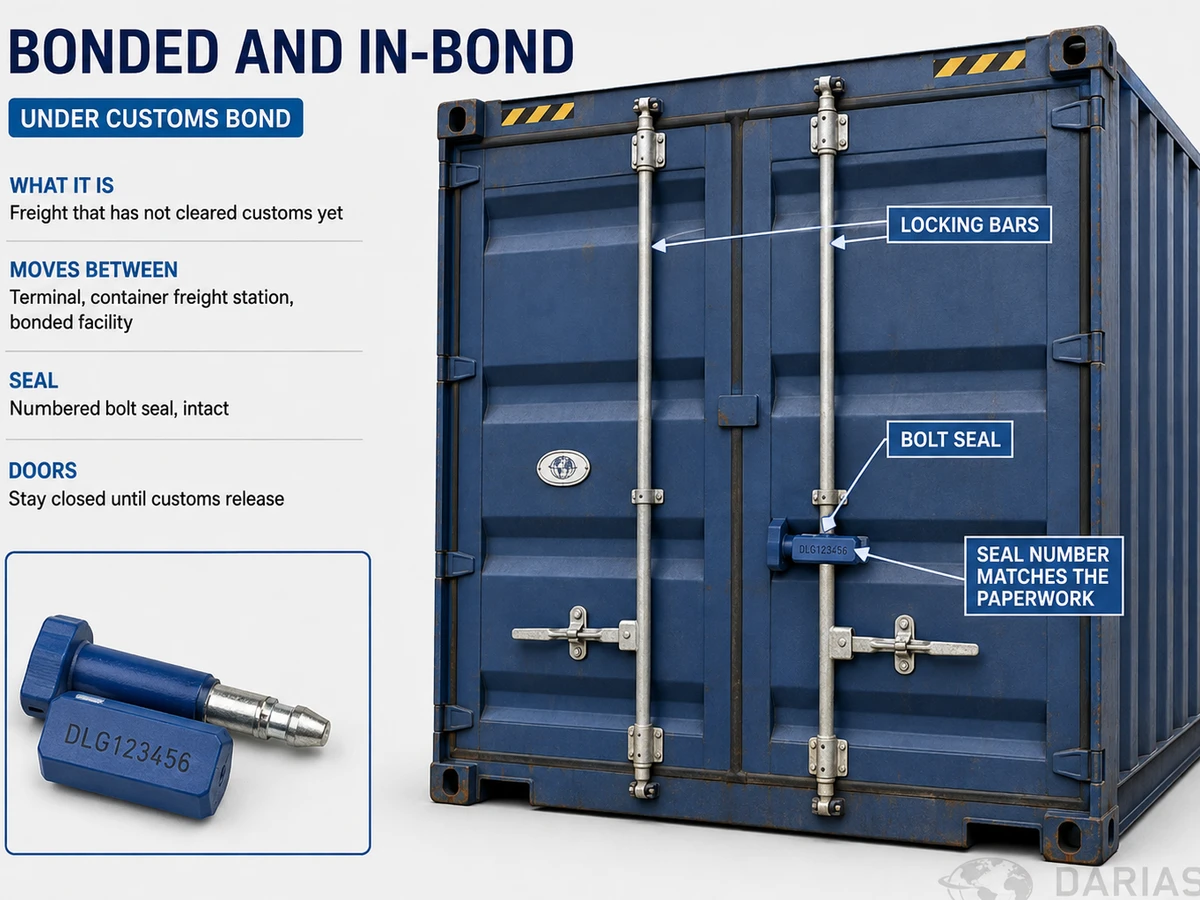
Spécification
| Mesure | In-bond et douane |
|---|---|
| Châssis | any |
Ce sont des chiffres nominaux pour ce type de matériel. Les caisses réelles varient selon le fabricant, la compagnie et l'année, et la tare est peinte sur la porte de l'unité que vous recevez. Envoyez le numéro de conteneur et nous vérifions sur le vrai.
What a bonded move is
A bonded, or in-bond, container is one that has landed in the United States but has not been entered and released yet. Duty has not been paid and customs has not let the goods into commerce, so the freight cannot simply be delivered. It can still be moved, under a bond that guarantees it will arrive where it is supposed to, sealed, on time, and reported.
Practically, that turns an ordinary drayage run into a documented one. The movement is authorized before it starts, the container travels sealed, the destination is named rather than chosen, and the arrival is reported. Nothing about the truck or the chassis changes. What changes is that the paperwork governs the move instead of describing it.
When freight moves under bond
Most often because the entry is going to be made somewhere other than where the ship landed. That is the immediate transportation case: the box leaves PortMiami or Port Everglades and travels to another port or an authorized facility inland, where it is entered. It also covers freight heading to a container freight station for deconsolidation, or to a place where an examination is going to happen.
The other two cases are exports in disguise. A transportation and exportation move carries freight that arrived here across the country to leave from somewhere else. An immediate exportation move sends it straight back out from the port it arrived at. In all three the freight is passing through rather than staying, which is why the bond exists: it is the guarantee that goods which never paid duty never quietly entered the market.
What people get wrong: the bond is not a clearance, and the seal is the proof
A bonded move does not clear anything. It moves uncleared freight legally from one authorized place to another, and the entry still has to be filed and released before the goods can be delivered to a buyer or sold. Shippers who expect a bonded pull to be the end of the customs process are usually surprised by a second step that was always going to be there, and by the storage clock running while they arrange it.
The seal is the other thing people underestimate. It is the evidence that the container reached its destination in the condition it left, and its number belongs on the file at the gate and is checked again at the door. A broken seal, or a seal whose number does not match, converts a routine delivery into an examination and a set of questions. Transit time matters for the same reason: a bonded movement carries a deadline, and arrival has to be reported rather than assumed.
What to send to get it booked
Say the word bonded at the first ask, because it changes how the move is planned rather than how it is priced. Then the in-bond number, the container number, the steamship line and the terminal, which together settle the gate requirement and the appointment.
Add the exact destination as it appears on the paperwork, not a street address that resembles it, and the name of the party who is filing. Send the seal number you expect and the deadline on the movement. If an examination is part of the plan, say so, since exam sites work on their own schedules and that changes what a realistic delivery day looks like. Nothing here is unusual: it is simply a move where the file and the freight have to stay together.
Sort de
Va à
More in this section
Questions
Réponses directes
What does in-bond mean?
It means the freight has arrived in the United States but has not been entered for consumption yet, so duty has not been paid and customs has not released it into commerce. It moves under a bond that guarantees it will turn up where it is supposed to, sealed and intact. Until that entry is filed and released, the cargo is in the custody of the system rather than in the hands of its owner, and every movement has to be authorized.
What is the difference between an IT, a T&E and an IE?
They are the three purposes a bonded move can have. An immediate transportation entry carries freight to another port inside the country so it can be entered there. A transportation and exportation entry carries it across the country to leave again. An immediate exportation entry takes freight that has arrived and sends it straight back out from the same port. Same idea, different destinations, and the paperwork type follows the plan rather than the truck.
How long can freight stay in-bond?
Not indefinitely. Customs sets a maximum transit time for a bonded movement, which for most inland moves is measured in weeks rather than months, and the arrival has to be reported promptly once the freight reaches its destination. Missing either is not a paperwork nuisance: it puts the bond at risk and it draws attention to every subsequent shipment. The dates belong on the file at the start rather than being reconstructed afterwards.
Who is responsible for freight moving under bond?
The party whose bond covers the movement, which is why a bonded move cannot simply be handed to whichever truck is free. The obligation is to deliver the cargo intact to the named destination, with the seal unbroken and the arrival reported. That is why the container number, the seal number and the in-bond number are treated as the load's identity on this kind of move rather than as reference data.
Can a bonded container be opened during the move?
No, not without authority. The seal is the evidence that nothing happened between the terminal and the destination, and a broken or mismatched seal turns a routine delivery into an investigation. If customs wants the box opened, that happens at an authorized place with the examination on record. Everywhere else, the seal number recorded at the gate should be the seal number read at the door on arrival.
Where do bonded containers get pulled from in South Florida?
PortMiami and Port Everglades for most ocean boxes, the Port of Palm Beach and the FEC and CSX ramps where the freight arrived that way. The pull itself is an ordinary container move on a chassis. What makes it a bonded one is the in-bond on file, the seal, the named destination and the arrival that has to be reported.
Does a bonded container have to go to a bonded warehouse?
It goes wherever the in-bond names, and that can be a bonded warehouse, a container freight station, a foreign-trade zone, an exam site, or another port for export. A bonded warehouse is a facility CBP has authorized to hold uncleared goods, so it is not interchangeable with ordinary storage. We handle the move and the bonded storage at the far end as one job.
Quel châssis faut-il pour un In-bond et douane ?
any. Nous apportons le châssis, donc une réservation ne dépend pas de ce que le terminal a de disponible ce matin-là.
Pouvez-vous le traiter en surpoids ?
Oui, sur le bon châssis et avec le bon permis. Le surpoids est une conversation distincte de la taille du conteneur, et les ports ont leurs propres limites en plus de celles de l'État.
D'où sortez-vous un In-bond et douane ?
Port of Miami, Port Everglades, Port of Palm Beach, POMTOC, South Florida Container Terminal, Seaboard Marine, Florida International Terminal, Port Everglades Terminal, Crowley, King Ocean, MSC, Tropical Shipping, Antillean Marine, FEC Port Everglades ICTF, FEC Hialeah rail ramp and CSX ramp.
Qu'est-ce que le last free day ?
Le dernier jour où votre conteneur peut rester à l'intérieur du terminal avant que les frais de stockage commencent. Passé ce jour, le demurrage s'accumule chaque jour, et c'est pour ça qu'un pre-pull revient presque toujours moins cher que d'attendre.
Qu'est-ce qu'un pre-pull ?
Nous récupérons le conteneur au terminal avant que vous soyez prêt et nous le gardons sur un parc. Ça arrête le demurrage aux tarifs du terminal et ça enlève la pression sur vos horaires de réception.
Quelle est la différence entre demurrage, per diem et detention ?
Trois frais différents, de parties différentes. Le demurrage, c'est le terminal qui vous facture la marchandise encore à l'intérieur du portail au-delà du temps franc. Le per diem, c'est la compagnie maritime qui vous facture le fait de garder son conteneur dehors au-delà du temps franc. Le detention, c'est le temps du transporteur, facturé quand un chauffeur attend à votre quai au-delà de la fenêtre franche. Ils peuvent courir en même temps, et c'est comme ça qu'une facture devient vite salée.
Comment obtenir un tarif ?
Envoyez la route, l'équipement, la taille du conteneur et le port, et nous revenons avec un chiffre. Tarifs et répartition 24h/24 à quotes@dariaslogistics.com.
Que comprend vraiment un devis de drayage ?
Le déplacement lui-même, plus les accessoires qui surprennent après coup : châssis, pre-pull, per diem, demurrage, detention et stockage. Nous préférons les nommer d'entrée plutôt que les ajouter à une facture.