45' HC / L5G1
Conteneur de 45 pieds high cube
Les 45 sont high cube par défaut ; il n'existe pas de 45 à hauteur standard. Il faut un châssis de 45 pieds ou extensible, ce qui est exactement pourquoi certains transporteurs les refusent sans le dire.
Dehors, dedans, et la porte
À quoi ça ressemble
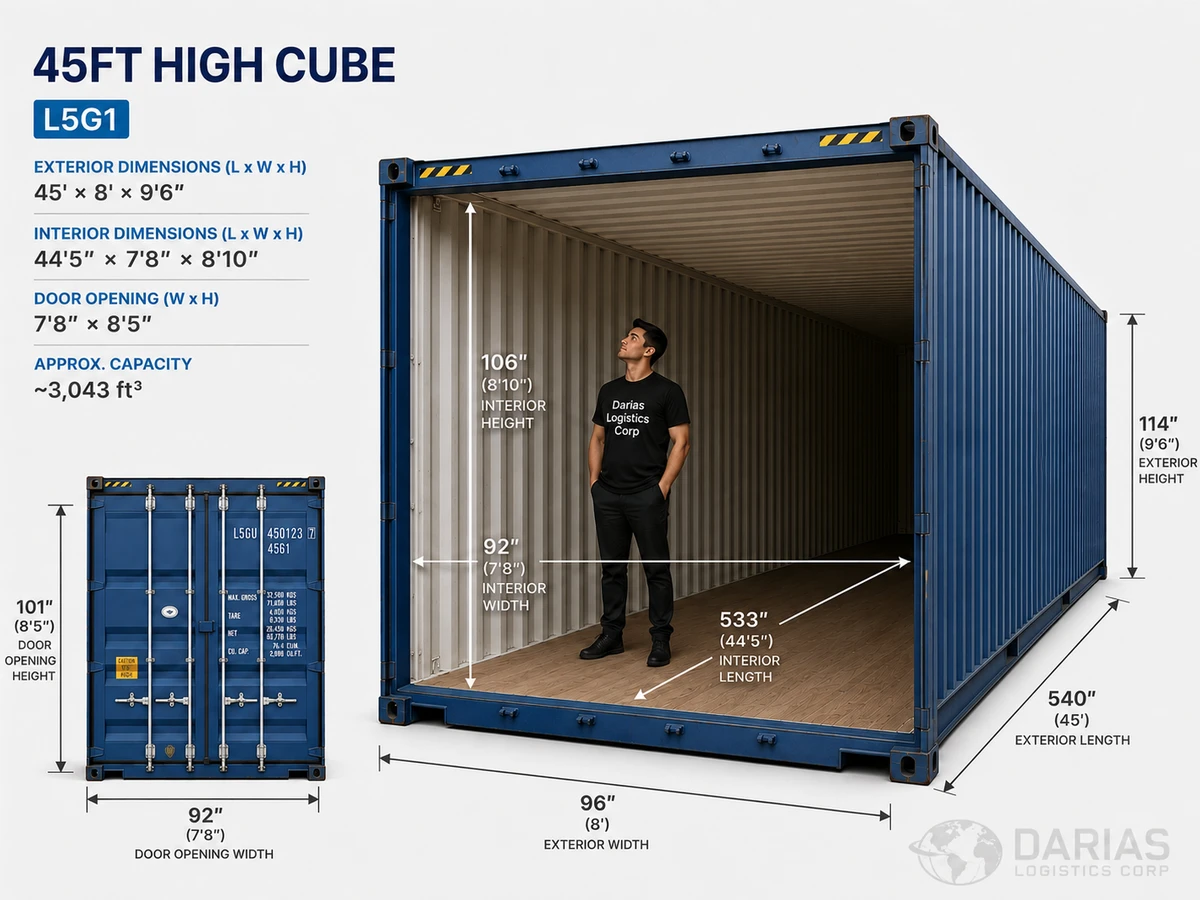
Spécification
| Mesure | Conteneur de 45 pieds high cube |
|---|---|
| Longueur extérieure | 540″ 45′ |
| Largeur extérieure | 96″ 8′ |
| Hauteur extérieure | 114″ 9′ 6″ |
| Longueur intérieure | 533″ 44′ 5″ |
| Largeur intérieure | 92″ 7′ 8″ |
| Hauteur intérieure | 106″ 8′ 10″ |
| Largeur de porte | 92″ 7′ 8″ |
| Hauteur de porte | 101″ 8′ 5″ |
| Tare | 10,580 lb |
| Charge utile max | 56,620 lb |
| Poids légal max sur route | 41,700 lb |
| Poids brut max | 67,200 lb |
| Capacité | 3,043 pi³ |
| Châssis | 45ft or extendable, which is why some carriers decline these |
Ce sont des chiffres nominaux pour ce type de matériel. Les caisses réelles varient selon le fabricant, la compagnie et l'année, et la tare est peinte sur la porte de l'unité que vous recevez. Envoyez le numéro de conteneur et nous vérifions sur le vrai.
What a 45ft container is
A 45 is the long box: five feet more than a 40, and a high cube by default, since there is no standard height version in ordinary service. Outside it runs 45 ft by 8 ft by 9 ft 6 in. Inside, the nominal figures are about 44 ft 5 in by 7 ft 8 in by 8 ft 10 in, giving roughly 3,043 cu ft, with a door opening near 7 ft 8 in wide by 8 ft 5 in tall.
There is a second box that also calls itself a 45. The wide body version is 102 in across rather than 96, and those extra inches change what fits on the floor. On the Caribbean and Central America trades out of PortMiami and Port Everglades the wide body is common enough that a booking marked only 45 is worth checking. The figures on this page are the nominal ones for the 8 ft wide ISO box.
When a 45 is the right box
Volume at ordinary weight, and nothing else. The 45 gives you about 350 cu ft more than a 40ft high cube at the same height, which is two more pallet rows on the deck, and it does it inside one booking rather than two. For light, bulky freight moving on a trade where the size is offered, that is the cheapest cubic foot on the water.
It is the wrong box whenever weight is the binding constraint. It is heavier empty than any 40, at around 10,580 lb, and it rides on a heavier chassis, so the legal road cargo lands at 41,700 lb, below both the standard 40 and the 40ft high cube. Dense freight belongs in a 20 or a 40. And if the cargo is wider than a pallet pair rather than longer, the answer is the 102 in wide body rather than more length.
What people get wrong: the chassis, and where the weight limit comes from
The 45 does not fit the standard 40ft chassis that sits in every yard. It needs a fixed 45 or an extendable, and that is the single practical reason some operations quietly decline the size. It is worth saying the length out loud at the first ask, because the equipment has to be planned rather than found on the morning of the move.
The 41,700 lb road figure is published, not derived here: Crowley lists it for both its 96 in and 102 in wide 45s. It is what remains of the 80,000 lb legal gross once the tractor, a 45 ft chassis and the container's tare come out. The chassis also carries a rating of its own, and on a legal move it is the road gross that binds first. On a permitted overweight move the order can reverse, because a permit raises what the combination may weigh while a pool extendable still caps how much loaded container it is rated to carry. Two different limits, and the lower one always wins.
What to send to get it booked
Say 45 first and say whether it is the 96 in ISO box or the 102 in wide body, because those two answers decide the chassis and the load plan before anything else is discussed. Then the container number, the steamship line and the terminal, which settle the gate requirement and the appointment.
After that the ordinary details: delivery address, last free day, and the cargo weight as it reads on the bill of lading. If the load is close to 41,700 lb, say so, since an overweight 45 is a permit conversation and a different piece of equipment rather than a heavier version of the same move. If the delivery is tight for a 40, it will be tighter for this: forty five feet of box behind a tractor needs room to turn in and room to leave.
Sort de
Va à
More in this section
Questions
Réponses directes
Why do some carriers refuse a 45ft container?
Because of the chassis. A 45 does not ride on the standard 40ft equipment that sits in every yard, so it needs either a fixed 45 or an extendable, and an operation that does not keep those on hand has to go and find one. The refusal is rarely about the box being difficult on the road. It is about whether the equipment under it is available on the day you need it, which is why a 45 is worth naming as a 45 when you first ask.
Is there a standard height 45ft container?
Not in normal service. A 45 is a high cube by default, 9 ft 6 in tall outside, which is why the size is often written as 45 HC even when nobody says the words. So if you have a 45 arriving you can plan on roughly 8 ft 10 in of interior height and a door opening around 8 ft 5 in, and you should plan the travel height the way you would for any high cube rather than the way you would for an 8 ft 6 in box.
How much more does a 45 hold than a 40ft high cube?
About 3,043 cu ft against 2,695 on the nominal figures, so roughly 350 cu ft, which is the extra five feet of floor at the same height. In pallet terms it is usually two more rows on the deck. What it does not give you is more weight: the 45 is heavier empty at around 10,580 lb, and its published legal road cargo is 41,700 lb, which is less than either 40.
Is a 45ft container legal on the highway in Florida?
Yes, on the right chassis. The length is handled by the chassis it rides on rather than by a permit, which is why the equipment question comes first and the legal question rarely comes up at all. Weight is the ordinary constraint: the published road figure for a 45 is 41,700 lb of cargo, which is what is left of the 80,000 lb legal gross once a tractor, a 45 ft chassis and the box's own tare are subtracted.
How do I know if my 45 is the wide body?
Check the width on the booking or measure the box. The ISO 45 is 8 ft wide outside like every other container. The wide body version used heavily on the South Florida trades is 102 in, about 8 ft 6 in, and it is seven inches wider inside. They are not interchangeable at a dock and the pallet pattern is different in each, so it is worth settling before the load plan is drawn rather than when the doors open.
Quelles sont les dimensions intérieures d'un Conteneur de 45 pieds high cube ?
La longueur, la largeur et la hauteur intérieures figurent dans le tableau de spécifications de cette page, à côté des dimensions extérieures et de l'ouverture de porte. C'est l'ouverture de porte qui décide si une machine passe, et elle est plus petite que l'intérieur.
Quel châssis faut-il pour un Conteneur de 45 pieds high cube ?
45ft or extendable, which is why some carriers decline these. Nous apportons le châssis, donc une réservation ne dépend pas de ce que le terminal a de disponible ce matin-là.
Pouvez-vous le traiter en surpoids ?
Oui, sur le bon châssis et avec le bon permis. Le surpoids est une conversation distincte de la taille du conteneur, et les ports ont leurs propres limites en plus de celles de l'État.
D'où sortez-vous un Conteneur de 45 pieds high cube ?
Port of Miami, Port Everglades, Port of Palm Beach, POMTOC, South Florida Container Terminal, Seaboard Marine, Florida International Terminal, Port Everglades Terminal, Crowley, King Ocean, MSC, Tropical Shipping, Antillean Marine, FEC Port Everglades ICTF, FEC Hialeah rail ramp and CSX ramp.
Qu'est-ce que le last free day ?
Le dernier jour où votre conteneur peut rester à l'intérieur du terminal avant que les frais de stockage commencent. Passé ce jour, le demurrage s'accumule chaque jour, et c'est pour ça qu'un pre-pull revient presque toujours moins cher que d'attendre.
Qu'est-ce qu'un pre-pull ?
Nous récupérons le conteneur au terminal avant que vous soyez prêt et nous le gardons sur un parc. Ça arrête le demurrage aux tarifs du terminal et ça enlève la pression sur vos horaires de réception.
Quelle est la différence entre demurrage, per diem et detention ?
Trois frais différents, de parties différentes. Le demurrage, c'est le terminal qui vous facture la marchandise encore à l'intérieur du portail au-delà du temps franc. Le per diem, c'est la compagnie maritime qui vous facture le fait de garder son conteneur dehors au-delà du temps franc. Le detention, c'est le temps du transporteur, facturé quand un chauffeur attend à votre quai au-delà de la fenêtre franche. Ils peuvent courir en même temps, et c'est comme ça qu'une facture devient vite salée.
Comment obtenir un tarif ?
Envoyez la route, l'équipement, la taille du conteneur et le port, et nous revenons avec un chiffre. Tarifs et répartition 24h/24 à quotes@dariaslogistics.com.
Que comprend vraiment un devis de drayage ?
Le déplacement lui-même, plus les accessoires qui surprennent après coup : châssis, pre-pull, per diem, demurrage, detention et stockage. Nous préférons les nommer d'entrée plutôt que les ajouter à une facture.