45' HC / L5G1
45-Fuß-Container high cube
45er sind grundsätzlich high cube; einen 45er in Standardhöhe gibt es nicht. Er braucht ein 45-Fuß- oder ausziehbares Chassis, und genau deshalb lehnen manche Frachtführer ihn stillschweigend ab.
Außen, innen, und die Tür
So sieht es aus
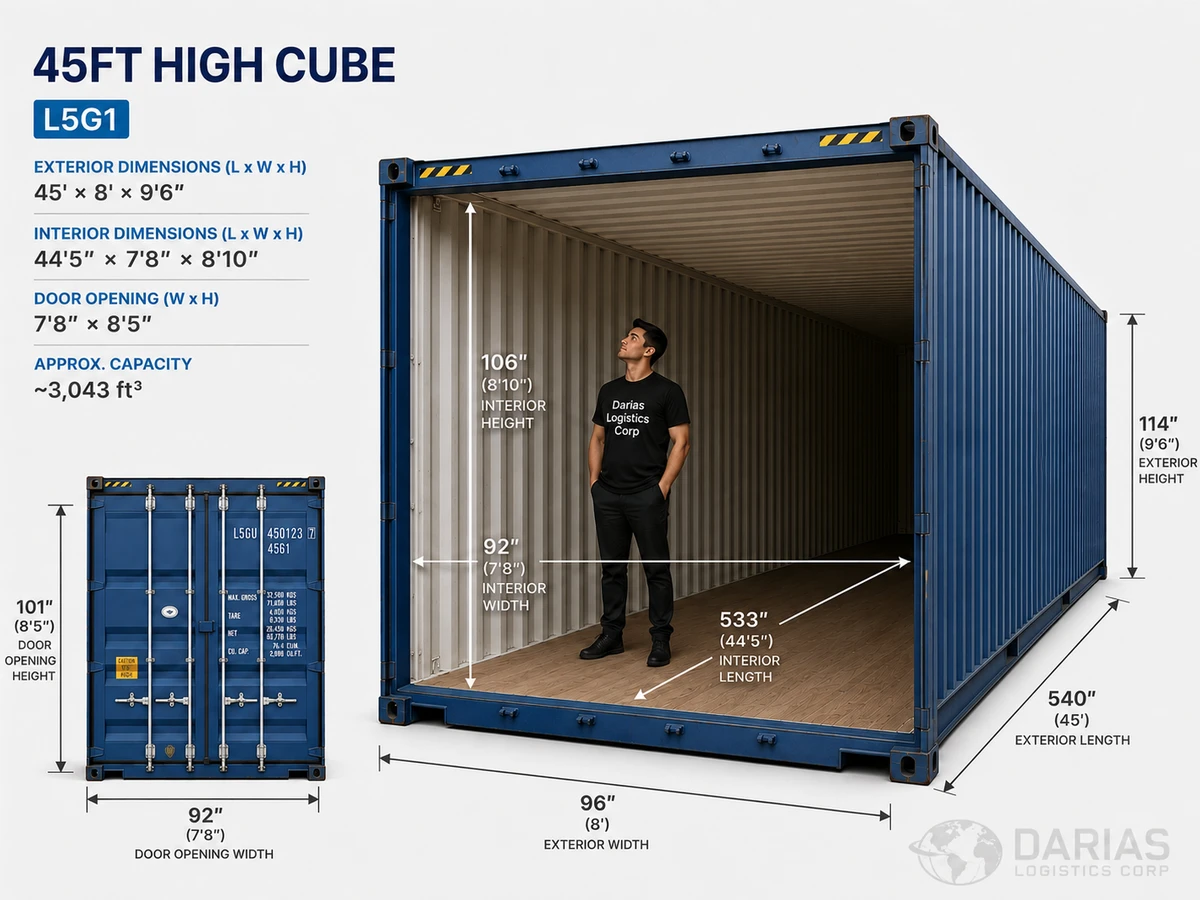
Spezifikation
| Maß | 45-Fuß-Container high cube |
|---|---|
| Außenlänge | 540″ 45′ |
| Außenbreite | 96″ 8′ |
| Außenhöhe | 114″ 9′ 6″ |
| Innenlänge | 533″ 44′ 5″ |
| Innenbreite | 92″ 7′ 8″ |
| Innenhöhe | 106″ 8′ 10″ |
| Türbreite | 92″ 7′ 8″ |
| Türhöhe | 101″ 8′ 5″ |
| Leergewicht | 10,580 lb |
| Max. Zuladung | 56,620 lb |
| Zulässiges Straßengewicht | 41,700 lb |
| Max. Gesamtgewicht | 67,200 lb |
| Volumen | 3,043 ft³ |
| Chassis | 45ft or extendable, which is why some carriers decline these |
Das sind Nennwerte für diesen Ausrüstungstyp. Echte Container schwanken je nach Hersteller, Reederei und Baujahr, und das Leergewicht steht auf der Tür der Einheit, die Sie bekommen. Schicken Sie uns die Containernummer, wir prüfen gegen die echte.
What a 45ft container is
A 45 is the long box: five feet more than a 40, and a high cube by default, since there is no standard height version in ordinary service. Outside it runs 45 ft by 8 ft by 9 ft 6 in. Inside, the nominal figures are about 44 ft 5 in by 7 ft 8 in by 8 ft 10 in, giving roughly 3,043 cu ft, with a door opening near 7 ft 8 in wide by 8 ft 5 in tall.
There is a second box that also calls itself a 45. The wide body version is 102 in across rather than 96, and those extra inches change what fits on the floor. On the Caribbean and Central America trades out of PortMiami and Port Everglades the wide body is common enough that a booking marked only 45 is worth checking. The figures on this page are the nominal ones for the 8 ft wide ISO box.
When a 45 is the right box
Volume at ordinary weight, and nothing else. The 45 gives you about 350 cu ft more than a 40ft high cube at the same height, which is two more pallet rows on the deck, and it does it inside one booking rather than two. For light, bulky freight moving on a trade where the size is offered, that is the cheapest cubic foot on the water.
It is the wrong box whenever weight is the binding constraint. It is heavier empty than any 40, at around 10,580 lb, and it rides on a heavier chassis, so the legal road cargo lands at 41,700 lb, below both the standard 40 and the 40ft high cube. Dense freight belongs in a 20 or a 40. And if the cargo is wider than a pallet pair rather than longer, the answer is the 102 in wide body rather than more length.
What people get wrong: the chassis, and where the weight limit comes from
The 45 does not fit the standard 40ft chassis that sits in every yard. It needs a fixed 45 or an extendable, and that is the single practical reason some operations quietly decline the size. It is worth saying the length out loud at the first ask, because the equipment has to be planned rather than found on the morning of the move.
The 41,700 lb road figure is published, not derived here: Crowley lists it for both its 96 in and 102 in wide 45s. It is what remains of the 80,000 lb legal gross once the tractor, a 45 ft chassis and the container's tare come out. The chassis also carries a rating of its own, and on a legal move it is the road gross that binds first. On a permitted overweight move the order can reverse, because a permit raises what the combination may weigh while a pool extendable still caps how much loaded container it is rated to carry. Two different limits, and the lower one always wins.
What to send to get it booked
Say 45 first and say whether it is the 96 in ISO box or the 102 in wide body, because those two answers decide the chassis and the load plan before anything else is discussed. Then the container number, the steamship line and the terminal, which settle the gate requirement and the appointment.
After that the ordinary details: delivery address, last free day, and the cargo weight as it reads on the bill of lading. If the load is close to 41,700 lb, say so, since an overweight 45 is a permit conversation and a different piece of equipment rather than a heavier version of the same move. If the delivery is tight for a 40, it will be tighter for this: forty five feet of box behind a tractor needs room to turn in and room to leave.
Kommt von
Geht nach
Fragen
Klare Antworten
Why do some carriers refuse a 45ft container?
Because of the chassis. A 45 does not ride on the standard 40ft equipment that sits in every yard, so it needs either a fixed 45 or an extendable, and an operation that does not keep those on hand has to go and find one. The refusal is rarely about the box being difficult on the road. It is about whether the equipment under it is available on the day you need it, which is why a 45 is worth naming as a 45 when you first ask.
Is there a standard height 45ft container?
Not in normal service. A 45 is a high cube by default, 9 ft 6 in tall outside, which is why the size is often written as 45 HC even when nobody says the words. So if you have a 45 arriving you can plan on roughly 8 ft 10 in of interior height and a door opening around 8 ft 5 in, and you should plan the travel height the way you would for any high cube rather than the way you would for an 8 ft 6 in box.
How much more does a 45 hold than a 40ft high cube?
About 3,043 cu ft against 2,695 on the nominal figures, so roughly 350 cu ft, which is the extra five feet of floor at the same height. In pallet terms it is usually two more rows on the deck. What it does not give you is more weight: the 45 is heavier empty at around 10,580 lb, and its published legal road cargo is 41,700 lb, which is less than either 40.
Is a 45ft container legal on the highway in Florida?
Yes, on the right chassis. The length is handled by the chassis it rides on rather than by a permit, which is why the equipment question comes first and the legal question rarely comes up at all. Weight is the ordinary constraint: the published road figure for a 45 is 41,700 lb of cargo, which is what is left of the 80,000 lb legal gross once a tractor, a 45 ft chassis and the box's own tare are subtracted.
How do I know if my 45 is the wide body?
Check the width on the booking or measure the box. The ISO 45 is 8 ft wide outside like every other container. The wide body version used heavily on the South Florida trades is 102 in, about 8 ft 6 in, and it is seven inches wider inside. They are not interchangeable at a dock and the pallet pattern is different in each, so it is worth settling before the load plan is drawn rather than when the doors open.
Welche Innenmaße hat ein 45-Fuß-Container high cube?
Innenlänge, -breite und -höhe stehen in der Spezifikationstabelle auf dieser Seite, neben den Außenmaßen und der Türöffnung. Die Türöffnung ist das Maß, das entscheidet, ob eine Maschine hineinpasst, und sie ist kleiner als der Innenraum.
Welches Chassis braucht ein 45-Fuß-Container high cube?
45ft or extendable, which is why some carriers decline these. Wir bringen das Chassis mit, eine Buchung hängt also nicht davon ab, was das Terminal an dem Morgen verfügbar hat.
Geht das auch mit Übergewicht?
Ja, auf dem richtigen Chassis und mit der richtigen Genehmigung. Übergewicht ist eine eigene Frage, unabhängig von der Containergröße, und die Häfen haben zusätzlich zu den Grenzen des Bundesstaats ihre eigenen.
Woher ziehen Sie 45-Fuß-Container high cube?
Port of Miami, Port Everglades, Port of Palm Beach, POMTOC, South Florida Container Terminal, Seaboard Marine, Florida International Terminal, Port Everglades Terminal, Crowley, King Ocean, MSC, Tropical Shipping, Antillean Marine, FEC Port Everglades ICTF, FEC Hialeah rail ramp and CSX ramp.
Was ist der last free day?
Der letzte Tag, an dem Ihr Container im Terminal stehen darf, bevor Lagerkosten anfallen. Wird er verpasst, läuft das demurrage täglich weiter, und deshalb ist ein pre-pull fast immer günstiger als Warten.
Was ist ein pre-pull?
Wir holen den Container aus dem Terminal, bevor Sie so weit sind, und stellen ihn auf einem Hof ab. Das stoppt das demurrage zu Terminalsätzen und nimmt den Druck von Ihren Annahmezeiten.
Was ist der Unterschied zwischen demurrage, per diem und detention?
Drei verschiedene Kosten von verschiedenen Parteien. Demurrage berechnet Ihnen das Terminal, weil die Ladung nach Ablauf der Freizeit noch hinter dem Tor steht. Per diem berechnet Ihnen die Reederei, weil ihr Container über die Freizeit hinaus draußen ist. Detention ist die Zeit des Frachtführers, berechnet, wenn ein Fahrer an Ihrer Rampe über das freie Zeitfenster hinaus wartet. Sie können gleichzeitig laufen, und so wird eine Rechnung schnell unschön.
Wie bekomme ich einen Preis?
Schicken Sie Strecke, Equipment, Containergröße und Hafen, dann kommt eine Zahl zurück. Angebote und Disposition laufen rund um die Uhr unter quotes@dariaslogistics.com.
Was ist in einem drayage-Angebot wirklich enthalten?
Der Transport selbst, dazu die Nebenkosten, die später überraschen: Chassis, pre-pull, per diem, demurrage, detention und Lagerung. Wir nennen sie lieber vorher, als sie später auf eine Rechnung zu setzen.