Open deck
RGN, abnehmbarer Schwanenhals
Der Schwanenhals wird abgenommen, die Ladefläche wird zur Rampe und die Maschine fährt auf. Die ausziehbaren und mehrachsigen Varianten fahren das Schwerste und Längste, was wir bewegen.
So sieht es aus
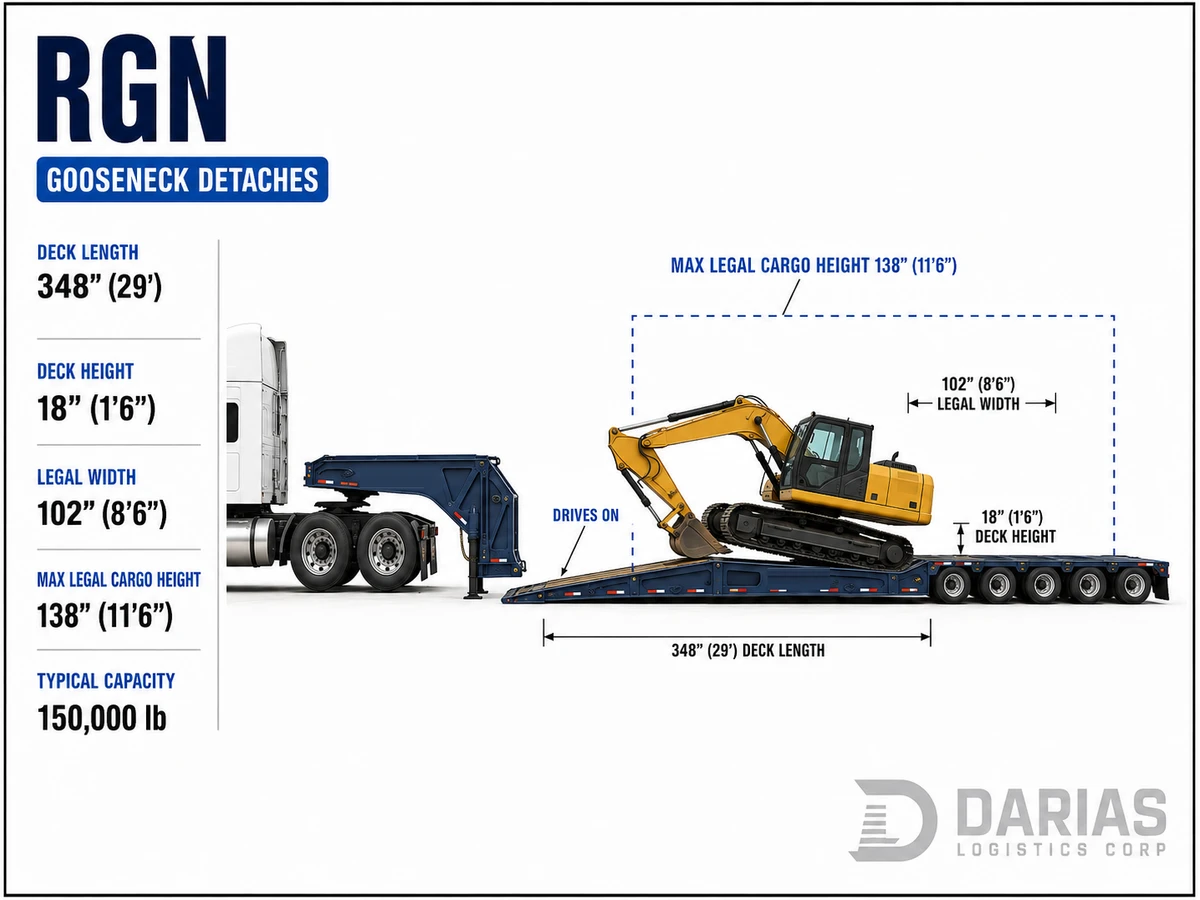
Spezifikation
| Maß | RGN, abnehmbarer Schwanenhals |
|---|---|
| Ladeflächenlänge | 29′ |
| Ladeflächenhöhe | 1′ 6″ |
| Zulässige Breite | 8′ 6″ |
| Zulässige Ladehöhe | 11′ 6″ |
| Übliche Tragfähigkeit | 150,000 lb |
Das sind Nennwerte für diesen Ausrüstungstyp. Echte Container schwanken je nach Hersteller, Reederei und Baujahr, und das Leergewicht steht auf der Tür der Einheit, die Sie bekommen. Schicken Sie uns die Containernummer, wir prüfen gegen die echte.
What an RGN is
An RGN is a lowboy whose front section detaches. The gooseneck carries the trailer's nose and connects it to the tractor, and on this design it comes off hydraulically, letting the deck drop to the ground so the well itself becomes a ramp. The well runs around 29 ft, sits about 1 ft 6 in off the road, and is 8 ft 6 in wide. Heavier units carry figures around 150,000 lb.
That combination is what makes it the heavy haul default. Tall freight travels legally at up to something like 11 ft 6 in under Florida's 13 ft 6 in limit, heavy freight has a trailer built to take it, and self propelled machines load themselves. Extendable and multi-axle versions carry the longest and heaviest pieces of all. These are typical figures for the type rather than one trailer's specification.
When the removable gooseneck earns its cost
When the cargo drives on. A tracked excavator, a dozer, a paver, a crane carrier: machines with low ground clearance and poor breakover angles that would scrape or hang up climbing rear ramps. A deck that lies on the ground gives them a shallow, continuous climb into the well, and it does it without a crane, which is often the difference between a one truck job and a job with a lift at each end.
If the piece has to be lifted anyway, a fixed gooseneck lowboy or a double drop does the same work for less. If the load is tall but light, a double drop is the cheaper trailer. If it is long rather than heavy, a stretch deck spreads it properly. And where the weight passes what any single trailer and its axles can permit, the answer becomes a multi-axle heavy haul unit, which is the same idea with more axles underneath.
What people get wrong: detaching needs a site, and capacity needs a permit
Loading an RGN is a manoeuvre, not a moment. The tractor has to pull the gooseneck clear, which needs room in front of the trailer, and the nose of the deck has to rest on ground that is firm and reasonably level, which a soft yard or a slope will not provide. Sites that look fine to a driver arriving with a flatbed can be unworkable here, and that is worth settling by description before a truck is dispatched rather than by discovery on arrival.
The capacity figure carries the same caution as any heavy haul trailer. An ordinary combination may weigh 80,000 lb in total, so a load anywhere near a trailer's rating is being moved under permit with additional axles and a route written for it. Height, width and length limits apply at the same time, and escorts enter the picture as they are exceeded. None of that is unusual work: it is simply planned in advance, and the planning is the part that takes the days.
What to send to get it booked
Make and model of the machine first, because the manufacturer's figures follow from it and they settle most of the argument. Then its real travelling dimensions: length, width, height and weight with attachments on or off, stated clearly, since a bucket or a boom left fitted changes every one of them.
Say whether it drives on under its own power, whether it runs, and whether anyone at the site can operate it. Describe the loading and unloading ground: surface, slope, and the space ahead of the trailer for the gooseneck to come off. Then the route ends. If the load is over width, over height, or over the legal axle weights, say so at the start, because that is what the permits and the routing are built from.
Kommt von
Geht nach
Fragen
Klare Antworten
What does RGN stand for?
Removable gooseneck. The gooseneck is the raised front section that connects the trailer to the tractor, and on this design it detaches. Once it is off, the front of the deck rests on the ground and becomes a ramp, so a machine can drive straight into the well instead of being lifted in. Everything else about the trailer behaves like a lowboy: a low well, tall cargo clearance and heavy capacity.
How does a removable gooseneck actually come off?
Hydraulically. The system lifts the load off the gooseneck, the gooseneck is disconnected and the tractor pulls it clear, and the nose of the deck is lowered to the ground. Loading happens, then the sequence runs backwards. It takes time and it takes space: room ahead of the trailer for the tractor and the gooseneck, and ground firm and level enough to take the nose of the deck without it sinking.
What is the difference between an RGN and a lowboy?
An RGN is a lowboy whose gooseneck detaches. Fixed gooseneck lowboys exist and they load by ramps at the rear or by crane, which is fine for some machines and awkward for others. The removable version costs more and is worth it when the cargo drives on: tracked equipment, machines with poor breakover angles, anything that would rather climb a shallow deck than a steep ramp. The well, the height and the capacity are much the same.
How much can an RGN carry?
Typical figures run to about 150,000 lb on the heavier units, and every bit of that is permitted territory, since an ordinary combination is capped at 80,000 lb gross. Carrying it legally means axles: more of them, spread far enough that no group is over what it may hold, with a permit written for that configuration and that route. The trailer's capacity is the start of the conversation, not the end of it.
Can an RGN be extended for a longer machine?
Extendable versions exist, and they are how a long machine gets a long well rather than hanging off the ends of a short one. Stretching the trailer also spreads the axles further apart, which helps the weight side of the problem as well as the length side. It is equipment that is planned rather than swapped in on the day, so the machine's real overall length is worth sending before anything is committed.
Was fährt auf einem Auflieger vom Typ RGN, abnehmbarer Schwanenhals?
Der Schwanenhals wird abgenommen, die Ladefläche wird zur Rampe und die Maschine fährt auf. Die ausziehbaren und mehrachsigen Varianten fahren das Schwerste und Längste, was wir bewegen.
Kümmern Sie sich um die Genehmigungen?
Ja. Alles über der zulässigen Breite, Höhe oder dem zulässigen Gewicht wird genehmigt und die Strecke geplant, bevor es sich bewegt, einschließlich Begleitfahrzeugen, wo die Route sie verlangt.
Können Sie Reefer fahren?
Ja, mit genset, damit die Box zwischen Terminal und Tür weiterläuft. Ein Reefer fasst deutlich weniger als ein Trockencontainer mit denselben Außenmaßen, weil Isolierung und Maschinenseite echten Platz kosten.
Und Ladung, die überhaupt nicht in einen Container passt?
Flat rack und open top für Übermaß, oder offene Ladeflächen: Pritsche, step deck, lowboy, RGN und double drop. Messen Sie vor der Buchung, denn alles über dem Lademaß ändert die Genehmigungslage.
Wie bekomme ich einen Preis?
Schicken Sie Strecke, Equipment, Containergröße und Hafen, dann kommt eine Zahl zurück. Angebote und Disposition laufen rund um die Uhr unter quotes@dariaslogistics.com.
Was ist in einem drayage-Angebot wirklich enthalten?
Der Transport selbst, dazu die Nebenkosten, die später überraschen: Chassis, pre-pull, per diem, demurrage, detention und Lagerung. Wir nennen sie lieber vorher, als sie später auf eine Rechnung zu setzen.