20' GP / 22G1
20-Fuß-Container
What a 20ft container measures inside and at the door, and why the tandems stop it near 38,000 lb of cargo on a Miami road, well short of the gross limit.
Außen, innen, und die Tür
So sieht es aus
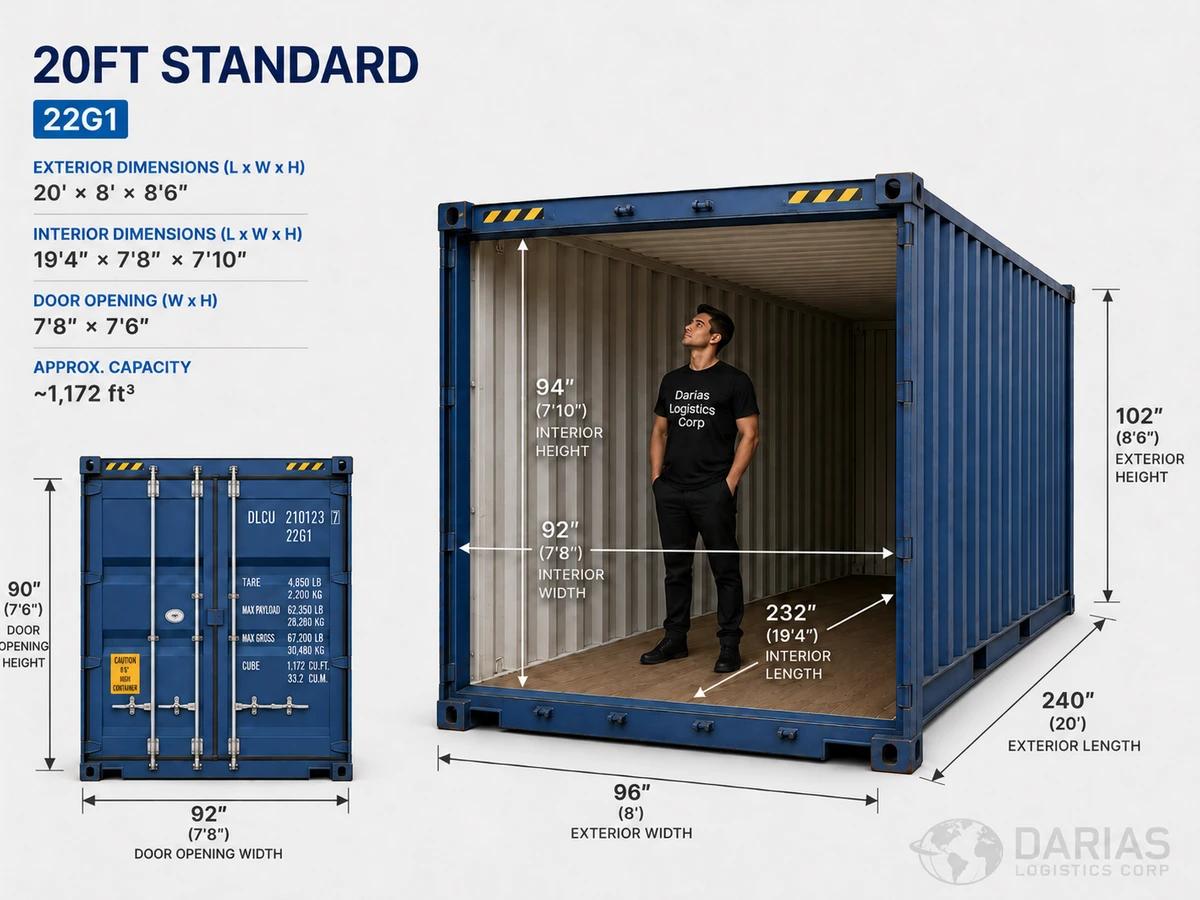
Spezifikation
| Maß | 20-Fuß-Container |
|---|---|
| Außenlänge | 238.5″ 19′ 10.5″ |
| Außenbreite | 96″ 8′ |
| Außenhöhe | 102″ 8′ 6″ |
| Innenlänge | 232″ 19′ 4″ |
| Innenbreite | 92″ 7′ 8″ |
| Innenhöhe | 94″ 7′ 10″ |
| Türbreite | 92″ 7′ 8″ |
| Türhöhe | 90″ 7′ 6″ |
| Leergewicht | 4,850 lb |
| Max. Zuladung | 62,350 lb |
| Zulässiges Straßengewicht | 38,000 lb |
| Max. Gesamtgewicht | 67,200 lb |
| Volumen | 1,172 ft³ |
| Chassis | Standard, or tri-axle if it is overweight |
Das sind Nennwerte für diesen Ausrüstungstyp. Echte Container schwanken je nach Hersteller, Reederei und Baujahr, und das Leergewicht steht auf der Tür der Einheit, die Sie bekommen. Schicken Sie uns die Containernummer, wir prüfen gegen die echte.
What a 20ft container is
A 20ft standard is the shorter of the two ordinary dry boxes: steel walls, a hard roof, and a pair of doors at one end. The outside is close to universal, because the box has to stack and lock like every other box, at about 19 ft 10.5 in long, 8 ft wide and 8 ft 6 in tall. Inside it opens out to roughly 19 ft 4 in by 7 ft 8 in by 7 ft 10 in, which is about 1,172 cu ft of usable space.
The door is the number worth writing down, because it is smaller than the interior: 7 ft 8 in wide by 7 ft 6 in tall. Four inches of height disappear at the header and the sill, and a crate that measured fine against the interior can still stop at the opening. These are nominal figures for the type. Tare on a typical 20 is around 4,850 lb, and the real one is stencilled on the door.
When a 20 beats a 40
Volume picks the 40, weight picks the 20. A 40ft standard gives you 2,389 cu ft against 1,172, so anything light and bulky costs less per cubic foot in the longer box, and two 20s rarely beat one 40 on a lane where both fit. Density flips the answer. Stone, tile, drums, castings, machinery, anything that hits a weight ceiling with the box half empty belongs in a 20, where the space you are not using is space you are not paying for.
Access is the other reason people choose the short box. A 20 on a chassis is a shorter combination and turns into places a 40 cannot: narrow yards, tight residential approaches, older South Florida industrial streets laid out before the 40 became the default. If what you are short of is height rather than weight, the 20ft high cube keeps the same footprint and adds about a foot inside.
The weight trap, and why a 20 stops near 38,000 lb
The commonest mistake on a 20 is arithmetic. Take 80,000 lb of legal highway gross, subtract the tractor, the chassis and the container, and you land somewhere near 50,000 lb of cargo. That number is wrong by about ten thousand pounds and it is how loads end up turned around at a scale. The published highway figure is roughly 38,000 lb of cargo on a standard chassis, and about 44,000 lb if the box rides on a tri-axle.
The reason is where the weight sits. A 20 is short and rides forward, so the whole load lands over one set of tandems instead of spreading down a 40 ft frame. The 34,000 lb tandem limit and the bridge formula, which ties allowable weight to how far the axles are spread, both bite long before the combination approaches 80,000 lb. That is why the 20 is the one size with a tri-axle figure published separately, and why a 38,500 lb box can need a permit for a delivery of a few miles.
What to send to get it booked
The container number and the steamship line come first. Those two decide the terminal, the gate requirement and the appointment, and they are worth more at the start than a description of the cargo. Add the delivery address, the last free day if you know it, and the weight as it reads on the bill of lading rather than an estimate, because 38,000 lb is the line between an ordinary move and a permitted one.
Say whether you want live unload or drop and pick, since it changes both the price and the day. Live means the driver waits while you strip the box. Drop means it is left with you and collected later, which is usually cheaper if you have room to hold a chassis. If the box is heavy enough to need a tri-axle, say so early, because that is equipment to plan around rather than a box to tick on the morning of the move.
Kommt von
Geht nach
Fragen
Klare Antworten
Can a 20ft container be overweight on the highway?
Easily, and it is the commonest surprise on this box. About 38,000 lb of cargo is the published legal figure on a standard chassis, and roughly 44,000 lb on a tri-axle. Past that the load is perfectly legal at sea and overweight on the road, so it needs the right chassis and a permit, and the ports apply limits of their own on top of the state's. Send the weight off the bill of lading before the truck is booked rather than after.
Why does a 20ft container carry less on the road than a 40ft?
Because the load lands in one place. A short box rides forward and concentrates everything over a single set of tandems, and the 34,000 lb tandem cap and the bridge formula stop it there. A 40 spreads the same weight down a longer frame, so it gets much closer to the 80,000 lb gross limit before anything binds. The structural rating does not change: a 20 is built to hold far more than it can ever legally weigh on a Florida road.
How much does an empty 20ft container weigh?
Around 4,850 lb for a typical dry 20, though tare moves by a few hundred pounds with the maker and the build year, and the real figure is stencilled on the door of the box you are given. It matters because tare comes straight out of what you can load: every pound of steel is a pound of cargo you do not get. Work from the stencil and the published road figure rather than from a number you derived yourself.
How many pallets fit in a 20ft container?
Ten standard 40 by 48 in pallets on the floor is the usual plan: two across with the 40 in edge facing out, four rows deep, and a couple more turned in what is left. Two 48 in edges will not sit side by side, because the interior is about 7 ft 8 in wide and that would need a full 8 ft. Whether anything stacks on top is decided by your freight and by the 7 ft 10 in of interior height.
Do I need a tri-axle chassis for a 20ft container?
Only if it is heavy. A standard chassis handles a 20 up to roughly 38,000 lb of cargo, and a tri-axle spreads the load over an extra axle to take it to about 44,000 lb. That extra axle is neither free nor always available at short notice, which is why the weight is worth confirming when the move is booked rather than at the gate. Below 38,000 lb the standard chassis is the simpler and cheaper answer.
Welche Innenmaße hat ein 20-Fuß-Container?
Innenlänge, -breite und -höhe stehen in der Spezifikationstabelle auf dieser Seite, neben den Außenmaßen und der Türöffnung. Die Türöffnung ist das Maß, das entscheidet, ob eine Maschine hineinpasst, und sie ist kleiner als der Innenraum.
Welches Chassis braucht ein 20-Fuß-Container?
Standard, or tri-axle if it is overweight. Wir bringen das Chassis mit, eine Buchung hängt also nicht davon ab, was das Terminal an dem Morgen verfügbar hat.
Geht das auch mit Übergewicht?
Ja, auf dem richtigen Chassis und mit der richtigen Genehmigung. Übergewicht ist eine eigene Frage, unabhängig von der Containergröße, und die Häfen haben zusätzlich zu den Grenzen des Bundesstaats ihre eigenen.
Woher ziehen Sie 20-Fuß-Container?
Port of Miami, Port Everglades, Port of Palm Beach, POMTOC, South Florida Container Terminal, Seaboard Marine, Florida International Terminal, Port Everglades Terminal, Crowley, King Ocean, MSC, Tropical Shipping, Antillean Marine, FEC Port Everglades ICTF, FEC Hialeah rail ramp and CSX ramp.
Was ist der last free day?
Der letzte Tag, an dem Ihr Container im Terminal stehen darf, bevor Lagerkosten anfallen. Wird er verpasst, läuft das demurrage täglich weiter, und deshalb ist ein pre-pull fast immer günstiger als Warten.
Was ist ein pre-pull?
Wir holen den Container aus dem Terminal, bevor Sie so weit sind, und stellen ihn auf einem Hof ab. Das stoppt das demurrage zu Terminalsätzen und nimmt den Druck von Ihren Annahmezeiten.
Was ist der Unterschied zwischen demurrage, per diem und detention?
Drei verschiedene Kosten von verschiedenen Parteien. Demurrage berechnet Ihnen das Terminal, weil die Ladung nach Ablauf der Freizeit noch hinter dem Tor steht. Per diem berechnet Ihnen die Reederei, weil ihr Container über die Freizeit hinaus draußen ist. Detention ist die Zeit des Frachtführers, berechnet, wenn ein Fahrer an Ihrer Rampe über das freie Zeitfenster hinaus wartet. Sie können gleichzeitig laufen, und so wird eine Rechnung schnell unschön.
Wie bekomme ich einen Preis?
Schicken Sie Strecke, Equipment, Containergröße und Hafen, dann kommt eine Zahl zurück. Angebote und Disposition laufen rund um die Uhr unter quotes@dariaslogistics.com.
Was ist in einem drayage-Angebot wirklich enthalten?
Der Transport selbst, dazu die Nebenkosten, die später überraschen: Chassis, pre-pull, per diem, demurrage, detention und Lagerung. Wir nennen sie lieber vorher, als sie später auf eine Rechnung zu setzen.