40' RF / 42R1
40-Fuß-Reefer
Die Isolierung und die Maschinenseite kosten echten Innenraum, deshalb fasst ein Reefer deutlich weniger als ein Trockencontainer mit denselben Außenmaßen.
Außen, innen, und die Tür
So sieht es aus
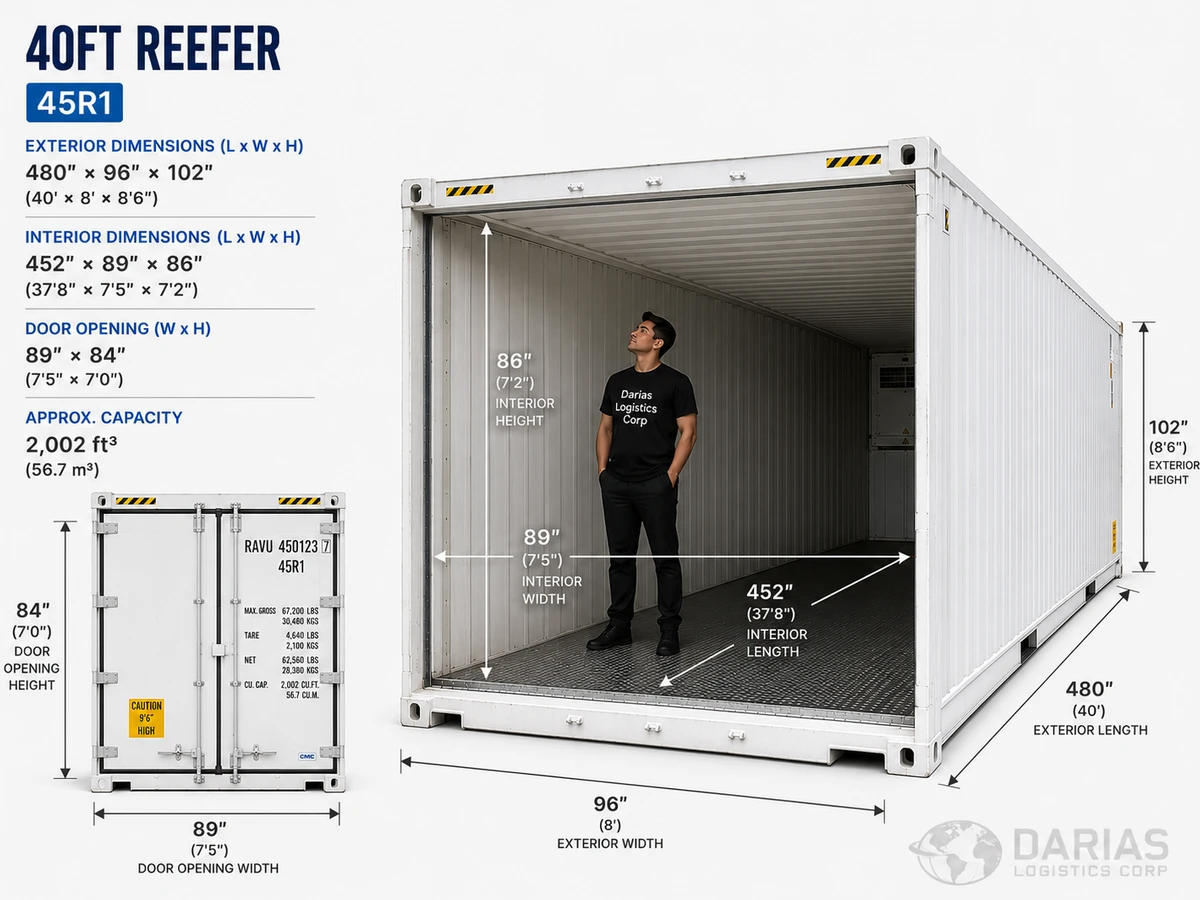
Spezifikation
| Maß | 40-Fuß-Reefer |
|---|---|
| Außenlänge | 480″ 40′ |
| Außenbreite | 96″ 8′ |
| Außenhöhe | 102″ 8′ 6″ |
| Innenlänge | 452″ 37′ 8″ |
| Innenbreite | 89″ 7′ 5″ |
| Innenhöhe | 86″ 7′ 2″ |
| Türbreite | 89″ 7′ 5″ |
| Türhöhe | 84″ 7′ |
| Leergewicht | 10,500 lb |
| Max. Zuladung | 56,700 lb |
| Zulässiges Straßengewicht | 40,000 lb |
| Max. Gesamtgewicht | 67,200 lb |
| Volumen | 2,002 ft³ |
| Chassis | Standard 40ft, plus a genset |
Das sind Nennwerte für diesen Ausrüstungstyp. Echte Container schwanken je nach Hersteller, Reederei und Baujahr, und das Leergewicht steht auf der Tür der Einheit, die Sie bekommen. Schicken Sie uns die Containernummer, wir prüfen gegen die echte.
What a 40ft reefer is
A 40ft reefer is a refrigerated container in the standard 40 ft shell: insulated walls, a T section floor that delivers air along the deck, and a refrigeration unit built into the front end. Outside it is 40 ft by 8 ft by 8 ft 6 in, exactly like a dry 40. Inside, the nominal figures are about 37 ft 8 in by 7 ft 5 in by 7 ft 2 in, roughly 2,002 cu ft, with a door opening near 7 ft 5 in wide by 7 ft tall.
The gap between those two sets of numbers is the whole story of the box. A dry 40 gives about 2,389 cu ft and this gives 2,002, because insulation takes width and height everywhere and the machinery takes length at one end. Tare runs near 10,500 lb against a dry 40's 8,380, and the figure that governs your load is stencilled on the door of the unit you actually get.
Choosing between the reefer sizes, and a reefer trailer
Against a 20ft reefer, this is simply more of everything: 2,002 cu ft rather than 939, and enough floor for around eighteen pallets rather than eight or nine. The short box only wins where the volume is genuinely small or the delivery cannot take a 40. Against a 40ft high cube reefer, the difference is a foot of interior height and roughly 280 cu ft, which matters for tall pallets and for anything stacked two high.
A reefer trailer is a different decision, not a different size. It is the right equipment when the run is domestic: the freight comes out of the container at a dock near the port and goes up the state in a trailer, which releases the line's box and stops the per diem clock instead of driving it inland and back. Keep the container when the cold chain has to stay in one sealed box from the ship to the receiver.
What people get wrong: the genset, the payload and the door
The road cargo figure of 40,000 lb is the published one, from Crowley's equipment specifications and within a few hundred pounds of the OCEMA guideline, and it assumes nothing else is hanging off the unit. A clip on genset with fuel generally runs 2,500 to 3,300 lb, and every pound of it comes out of that same figure. A reefer planned to its paper payload and then fitted with a genset is planned wrong by about three thousand pounds.
Two loading traps follow. The door opening is only about 7 ft tall, which is low enough that a forklift with a raised mast can fail to enter a box its own cargo would fit inside. And the load line inside the container is not decoration: stack past it and the air returning to the machinery end has nowhere to go, so the unit reads its own cold delivery air, believes it is holding, and lets the door end of the load drift warm.
What to send to get it booked
Container number, steamship line and terminal, which decide the gate requirement and the appointment. Then the reefer details: the set point with its units, what the commodity is, and whether the freight is already at temperature. A unit holds a temperature rather than creating one, and saying so at booking is cheaper than discovering it at the receiver.
Say whether a genset is needed and for how long, since it has to be on the equipment before the truck reaches the gate. Send the cargo weight from the bill of lading and remember the genset shares the same legal gross. And say whether the delivery has a plug, because a box that arrives before the receiver is ready either keeps burning diesel or starts burning through the cold chain.
Kommt von
Geht nach
Fragen
Klare Antworten
How many pallets fit in a 40ft reefer?
About eighteen standard 40 by 48 in pallets on the floor, two across with the 40 in edge facing out and nine rows deep, which uses most of the 37 ft 8 in of interior length. A dry 40 takes twenty in the same pattern. The reefer loses those two rows to the machinery end rather than to anything you can load around, and the narrower 7 ft 5 in interior leaves less room to square a pallet up on the way in.
Why does a 40ft reefer weigh so much empty?
Around 10,500 lb of tare against roughly 8,380 for a dry 40, and all of the difference is insulation and machinery. Two thousand pounds of steel and foam that exist to keep a temperature are two thousand pounds of cargo you cannot load. It is why the published legal road cargo is 40,000 lb before a genset is fitted, and why a dense refrigerated load runs out of weight sooner than shippers expect.
Can a reefer container be used as a dry container?
Yes, and the trade calls it a non operating reefer. The unit is simply not run, and the box travels as an insulated dry container. It is a normal thing to do when a line has reefers to reposition and it can be a cheap way to move ordinary freight. What you give up is space and payload: you are carrying insulation and a refrigeration unit that are doing nothing for you on that trip.
What temperature range does a reefer container hold?
Container refrigeration units cover deep frozen through chilled and up into mild settings, and the exact range belongs to the unit rather than to the container, so it is printed on the machinery's own data plate. What matters more for planning is that the unit holds a set point rather than creating one. Freight should go in at temperature, and the set point should be right before the doors close rather than after.
Should a reefer container be pre-cooled before loading?
The box should be at its set point before the freight goes in, and the freight should already be at temperature when it arrives. Loading warm product into a cold box and expecting the unit to pull it down is the classic error: container units are built to hold a temperature against ambient heat, not to remove field heat from a full load. On a Miami dock in August that gap is measured in hours of lost cold chain.
Welche Innenmaße hat ein 40-Fuß-Reefer?
Innenlänge, -breite und -höhe stehen in der Spezifikationstabelle auf dieser Seite, neben den Außenmaßen und der Türöffnung. Die Türöffnung ist das Maß, das entscheidet, ob eine Maschine hineinpasst, und sie ist kleiner als der Innenraum.
Welches Chassis braucht ein 40-Fuß-Reefer?
Standard 40ft, plus a genset. Wir bringen das Chassis mit, eine Buchung hängt also nicht davon ab, was das Terminal an dem Morgen verfügbar hat.
Geht das auch mit Übergewicht?
Ja, auf dem richtigen Chassis und mit der richtigen Genehmigung. Übergewicht ist eine eigene Frage, unabhängig von der Containergröße, und die Häfen haben zusätzlich zu den Grenzen des Bundesstaats ihre eigenen.
Woher ziehen Sie 40-Fuß-Reefer?
Port of Miami, Port Everglades, Port of Palm Beach, POMTOC, South Florida Container Terminal, Seaboard Marine, Florida International Terminal, Port Everglades Terminal, Crowley, King Ocean, MSC, Tropical Shipping, Antillean Marine, FEC Port Everglades ICTF, FEC Hialeah rail ramp and CSX ramp.
Was ist der last free day?
Der letzte Tag, an dem Ihr Container im Terminal stehen darf, bevor Lagerkosten anfallen. Wird er verpasst, läuft das demurrage täglich weiter, und deshalb ist ein pre-pull fast immer günstiger als Warten.
Was ist ein pre-pull?
Wir holen den Container aus dem Terminal, bevor Sie so weit sind, und stellen ihn auf einem Hof ab. Das stoppt das demurrage zu Terminalsätzen und nimmt den Druck von Ihren Annahmezeiten.
Was ist der Unterschied zwischen demurrage, per diem und detention?
Drei verschiedene Kosten von verschiedenen Parteien. Demurrage berechnet Ihnen das Terminal, weil die Ladung nach Ablauf der Freizeit noch hinter dem Tor steht. Per diem berechnet Ihnen die Reederei, weil ihr Container über die Freizeit hinaus draußen ist. Detention ist die Zeit des Frachtführers, berechnet, wenn ein Fahrer an Ihrer Rampe über das freie Zeitfenster hinaus wartet. Sie können gleichzeitig laufen, und so wird eine Rechnung schnell unschön.
Wie bekomme ich einen Preis?
Schicken Sie Strecke, Equipment, Containergröße und Hafen, dann kommt eine Zahl zurück. Angebote und Disposition laufen rund um die Uhr unter quotes@dariaslogistics.com.
Was ist in einem drayage-Angebot wirklich enthalten?
Der Transport selbst, dazu die Nebenkosten, die später überraschen: Chassis, pre-pull, per diem, demurrage, detention und Lagerung. Wir nennen sie lieber vorher, als sie später auf eine Rechnung zu setzen.