any, under customs bond
In-bond und Zoll
Ladung, die noch nicht verzollt ist und in-bond zwischen einem Terminal, einer CFS-Anlage oder einem Zolllager läuft.
So sieht es aus
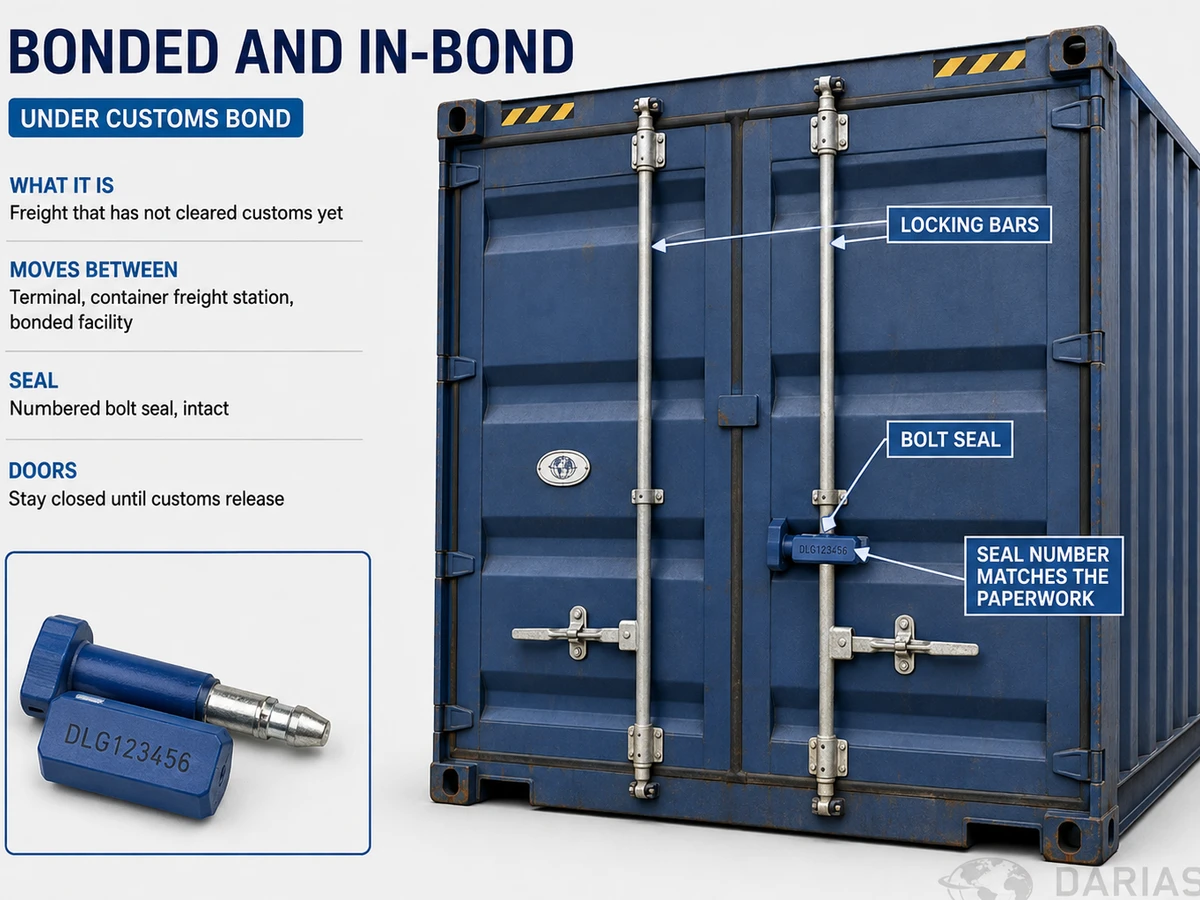
Spezifikation
| Maß | In-bond und Zoll |
|---|---|
| Chassis | any |
Das sind Nennwerte für diesen Ausrüstungstyp. Echte Container schwanken je nach Hersteller, Reederei und Baujahr, und das Leergewicht steht auf der Tür der Einheit, die Sie bekommen. Schicken Sie uns die Containernummer, wir prüfen gegen die echte.
What a bonded move is
A bonded, or in-bond, container is one that has landed in the United States but has not been entered and released yet. Duty has not been paid and customs has not let the goods into commerce, so the freight cannot simply be delivered. It can still be moved, under a bond that guarantees it will arrive where it is supposed to, sealed, on time, and reported.
Practically, that turns an ordinary drayage run into a documented one. The movement is authorized before it starts, the container travels sealed, the destination is named rather than chosen, and the arrival is reported. Nothing about the truck or the chassis changes. What changes is that the paperwork governs the move instead of describing it.
When freight moves under bond
Most often because the entry is going to be made somewhere other than where the ship landed. That is the immediate transportation case: the box leaves PortMiami or Port Everglades and travels to another port or an authorized facility inland, where it is entered. It also covers freight heading to a container freight station for deconsolidation, or to a place where an examination is going to happen.
The other two cases are exports in disguise. A transportation and exportation move carries freight that arrived here across the country to leave from somewhere else. An immediate exportation move sends it straight back out from the port it arrived at. In all three the freight is passing through rather than staying, which is why the bond exists: it is the guarantee that goods which never paid duty never quietly entered the market.
What people get wrong: the bond is not a clearance, and the seal is the proof
A bonded move does not clear anything. It moves uncleared freight legally from one authorized place to another, and the entry still has to be filed and released before the goods can be delivered to a buyer or sold. Shippers who expect a bonded pull to be the end of the customs process are usually surprised by a second step that was always going to be there, and by the storage clock running while they arrange it.
The seal is the other thing people underestimate. It is the evidence that the container reached its destination in the condition it left, and its number belongs on the file at the gate and is checked again at the door. A broken seal, or a seal whose number does not match, converts a routine delivery into an examination and a set of questions. Transit time matters for the same reason: a bonded movement carries a deadline, and arrival has to be reported rather than assumed.
What to send to get it booked
Say the word bonded at the first ask, because it changes how the move is planned rather than how it is priced. Then the in-bond number, the container number, the steamship line and the terminal, which together settle the gate requirement and the appointment.
Add the exact destination as it appears on the paperwork, not a street address that resembles it, and the name of the party who is filing. Send the seal number you expect and the deadline on the movement. If an examination is part of the plan, say so, since exam sites work on their own schedules and that changes what a realistic delivery day looks like. Nothing here is unusual: it is simply a move where the file and the freight have to stay together.
Kommt von
Geht nach
Fragen
Klare Antworten
What does in-bond mean?
It means the freight has arrived in the United States but has not been entered for consumption yet, so duty has not been paid and customs has not released it into commerce. It moves under a bond that guarantees it will turn up where it is supposed to, sealed and intact. Until that entry is filed and released, the cargo is in the custody of the system rather than in the hands of its owner, and every movement has to be authorized.
What is the difference between an IT, a T&E and an IE?
They are the three purposes a bonded move can have. An immediate transportation entry carries freight to another port inside the country so it can be entered there. A transportation and exportation entry carries it across the country to leave again. An immediate exportation entry takes freight that has arrived and sends it straight back out from the same port. Same idea, different destinations, and the paperwork type follows the plan rather than the truck.
How long can freight stay in-bond?
Not indefinitely. Customs sets a maximum transit time for a bonded movement, which for most inland moves is measured in weeks rather than months, and the arrival has to be reported promptly once the freight reaches its destination. Missing either is not a paperwork nuisance: it puts the bond at risk and it draws attention to every subsequent shipment. The dates belong on the file at the start rather than being reconstructed afterwards.
Who is responsible for freight moving under bond?
The party whose bond covers the movement, which is why a bonded move cannot simply be handed to whichever truck is free. The obligation is to deliver the cargo intact to the named destination, with the seal unbroken and the arrival reported. That is why the container number, the seal number and the in-bond number are treated as the load's identity on this kind of move rather than as reference data.
Can a bonded container be opened during the move?
No, not without authority. The seal is the evidence that nothing happened between the terminal and the destination, and a broken or mismatched seal turns a routine delivery into an investigation. If customs wants the box opened, that happens at an authorized place with the examination on record. Everywhere else, the seal number recorded at the gate should be the seal number read at the door on arrival.
Where do bonded containers get pulled from in South Florida?
PortMiami and Port Everglades for most ocean boxes, the Port of Palm Beach and the FEC and CSX ramps where the freight arrived that way. The pull itself is an ordinary container move on a chassis. What makes it a bonded one is the in-bond on file, the seal, the named destination and the arrival that has to be reported.
Does a bonded container have to go to a bonded warehouse?
It goes wherever the in-bond names, and that can be a bonded warehouse, a container freight station, a foreign-trade zone, an exam site, or another port for export. A bonded warehouse is a facility CBP has authorized to hold uncleared goods, so it is not interchangeable with ordinary storage. We handle the move and the bonded storage at the far end as one job.
Welches Chassis braucht ein In-bond und Zoll?
any. Wir bringen das Chassis mit, eine Buchung hängt also nicht davon ab, was das Terminal an dem Morgen verfügbar hat.
Geht das auch mit Übergewicht?
Ja, auf dem richtigen Chassis und mit der richtigen Genehmigung. Übergewicht ist eine eigene Frage, unabhängig von der Containergröße, und die Häfen haben zusätzlich zu den Grenzen des Bundesstaats ihre eigenen.
Woher ziehen Sie In-bond und Zoll?
Port of Miami, Port Everglades, Port of Palm Beach, POMTOC, South Florida Container Terminal, Seaboard Marine, Florida International Terminal, Port Everglades Terminal, Crowley, King Ocean, MSC, Tropical Shipping, Antillean Marine, FEC Port Everglades ICTF, FEC Hialeah rail ramp and CSX ramp.
Was ist der last free day?
Der letzte Tag, an dem Ihr Container im Terminal stehen darf, bevor Lagerkosten anfallen. Wird er verpasst, läuft das demurrage täglich weiter, und deshalb ist ein pre-pull fast immer günstiger als Warten.
Was ist ein pre-pull?
Wir holen den Container aus dem Terminal, bevor Sie so weit sind, und stellen ihn auf einem Hof ab. Das stoppt das demurrage zu Terminalsätzen und nimmt den Druck von Ihren Annahmezeiten.
Was ist der Unterschied zwischen demurrage, per diem und detention?
Drei verschiedene Kosten von verschiedenen Parteien. Demurrage berechnet Ihnen das Terminal, weil die Ladung nach Ablauf der Freizeit noch hinter dem Tor steht. Per diem berechnet Ihnen die Reederei, weil ihr Container über die Freizeit hinaus draußen ist. Detention ist die Zeit des Frachtführers, berechnet, wenn ein Fahrer an Ihrer Rampe über das freie Zeitfenster hinaus wartet. Sie können gleichzeitig laufen, und so wird eine Rechnung schnell unschön.
Wie bekomme ich einen Preis?
Schicken Sie Strecke, Equipment, Containergröße und Hafen, dann kommt eine Zahl zurück. Angebote und Disposition laufen rund um die Uhr unter quotes@dariaslogistics.com.
Was ist in einem drayage-Angebot wirklich enthalten?
Der Transport selbst, dazu die Nebenkosten, die später überraschen: Chassis, pre-pull, per diem, demurrage, detention und Lagerung. Wir nennen sie lieber vorher, als sie später auf eine Rechnung zu setzen.