Leistung
Container unloading
Getting the freight out of the box. Palletized cargo comes off quickly; a floor-loaded 40 is a day's work for a crew, and the difference in effort is the difference in price. The reason to do it here rather than at your door is usually the same one: the empty goes back the same day.
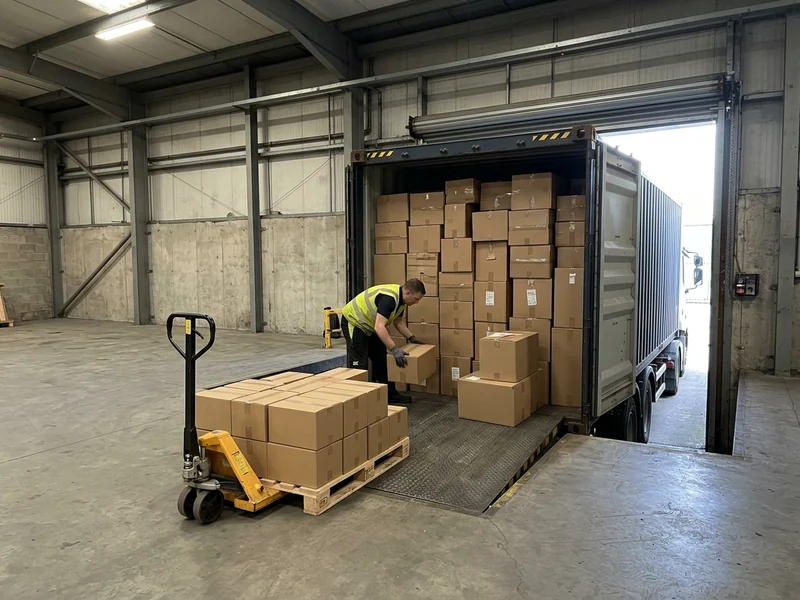
Palletized and floor-loaded are two different jobs
If the container was stuffed onto pallets, unloading it is a forklift job and it is quick. The pallets come off, they are counted, and they go to a rack or onto a trailer.
Floor-loaded is different. The cargo was stacked in by hand at origin, usually to get every cubic foot out of the box, and it comes out the same way it went in. That is a crew, by hand, for hours. A floor-loaded 40ft or high cube is roughly double the work of a 20, because it is roughly double the box, and that is why you will see it priced separately rather than as one devanning rate.
Worth knowing before you book: nobody can tell from the paperwork which one you have. If the packing list says cartons and gives no pallet count, assume floor-loaded and say so when you ask for a price, because discovering it at the dock costs an afternoon.
What a lumper crew is, and when you need one
A lumper is the crew that does the physical unloading. On palletized freight our own people handle it. On a heavy floor-loaded container, or anything that needs sorting as it comes off, it is a dedicated crew and it is a separate line on the quote.
It is not an upsell. It is the honest answer to a floor-loaded 40: somebody is moving every carton by hand, and the only question is whether that is planned for or discovered.
The reason to unload here rather than at your door
Per diem. While the container is out of the terminal it belongs to the shipping line and the clock runs the whole time, including the days it sits at your warehouse waiting for a crew and the trip back empty.
Devanning a short run from the port means the box is emptied and returned the same day, and the freight waits on your schedule instead of the line's. On a slow unload that difference is usually larger than the unloading itself.
It is also the moment to catch a problem. Freight comes out under a count, and anything short, wet or crushed is documented then, with photographs, while the container it came out of is still in front of us. Discover it a week later at your own dock and the conversation with the line is much harder.
What happens to the freight after it comes out
Three doors, and you pick before it moves. Straight onto a trailer for the inland run, which is transload. Onto a rack for storage. Or off one trailer and onto another the same day without touching a rack, which is cross-dock.
It can also be palletized on the way out, which is its own line: cargo that arrived floor-loaded leaves on pallets, wrapped and labelled, ready for a receiver who will not take loose cartons.
Tell us which of those you want when you book, because it changes where the freight is staged as it comes off, and restaging a container's worth of cartons is the one avoidable cost in this whole operation.
Equipment
Häfen
Fragen
Klare Antworten
What does it cost to unload a container?
It depends on one thing more than any other: whether the freight is on pallets or stacked loose on the floor. Palletized is a forklift job. Floor-loaded is a crew by hand, and a floor-loaded 40ft is roughly double a 20ft because it is roughly double the box. The published rates are on the warehousing cost page, and they are separated exactly that way rather than hidden behind one devanning number.
Do you unload floor-loaded containers?
Yes, and it is worth telling us before you book rather than after. Nobody can tell from a packing list whether a container is floor-loaded; if it lists cartons with no pallet count, assume it is, because discovering it at the dock costs an afternoon and a crew.
Can you restack or rework a damaged pallet load?
Yes. Pallet restacking and rework is ordinary work here: a load that shifted, a pallet built too high for the receiver, cartons that need re-squaring and re-wrapping before anyone will take them. It is also the moment to photograph what arrived, while the container it came out of is still in front of us.
Does unloading here get the container back to the line faster?
That is usually the whole reason to do it here. Per diem runs the entire time the box is out of the terminal, including the days it waits at your dock for a crew. Minutes from the port, the container is emptied and returned the same day and the freight waits on your schedule instead of the line's.
Gibt es einen 45-Fuß-Container in Standardhöhe?
In der Praxis nein. 20- und 40-Fuß-Container gibt es in 8 Fuß 6 Standard und 9 Fuß 6 High Cube, der 45 hat sich aber nur als High Cube durchgesetzt, daher der ISO-Code L5G1: die 5 steht für die Höhe von 9 Fuß 6. Wenn Ihnen jemand einen 45 anbietet, ist es ein High Cube. Beim 45 ist die eigentliche Frage die Breite, denn der 102 Zoll breite Wide Body ist auf den Südflorida-Trades verbreitet und innen 7 Zoll breiter als der ISO-Container.
Wie bekomme ich einen Preis?
Schicken Sie Strecke, Equipment, Containergröße und Hafen, dann kommt eine Zahl zurück. Angebote und Disposition laufen rund um die Uhr unter quotes@dariaslogistics.com.