20' GP / 22G1
حاوية 20 قدماً
What a 20ft container measures inside and at the door, and why the tandems stop it near 38,000 lb of cargo on a Miami road, well short of the gross limit.
من الخارج ومن الداخل والباب
شكلها
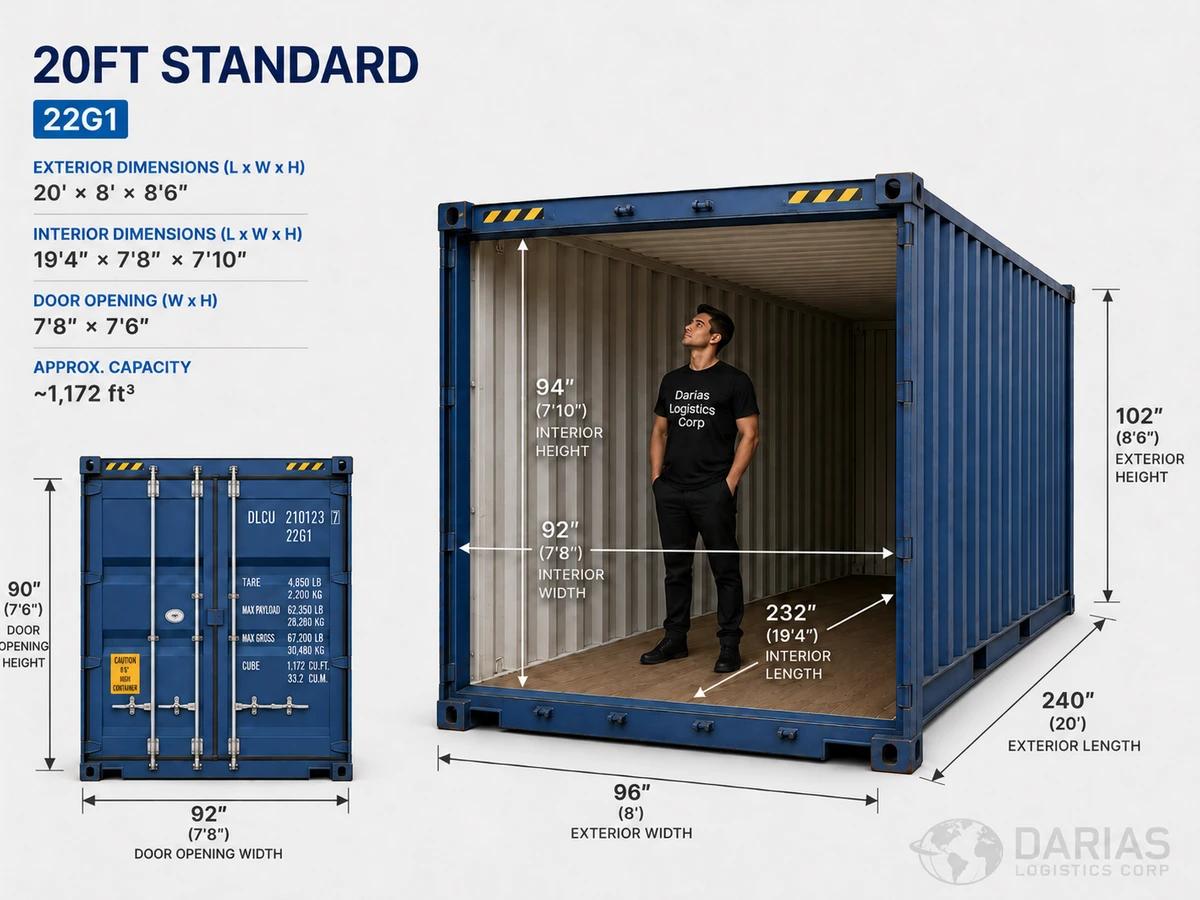
المواصفات
| القياس | حاوية 20 قدماً |
|---|---|
| الطول الخارجي | 238.5″ 19′ 10.5″ |
| العرض الخارجي | 96″ 8′ |
| الارتفاع الخارجي | 102″ 8′ 6″ |
| الطول الداخلي | 232″ 19′ 4″ |
| العرض الداخلي | 92″ 7′ 8″ |
| الارتفاع الداخلي | 94″ 7′ 10″ |
| عرض الباب | 92″ 7′ 8″ |
| ارتفاع الباب | 90″ 7′ 6″ |
| الوزن الفارغ | 4,850 lb |
| أقصى حمولة | 62,350 lb |
| الوزن القانوني على الطريق | 38,000 lb |
| أقصى وزن إجمالي | 67,200 lb |
| السعة | 1,172 قدم³ |
| الشاسيه | Standard, or tri-axle if it is overweight |
هذه أرقام اسمية لهذا النوع من المعدات. الحاويات الفعلية تختلف حسب المصنّع والخط الملاحي وسنة الصنع، والوزن الفارغ مطبوع على باب الوحدة التي تصلك. أرسل لنا رقم الحاوية ونتحقق من الوحدة الفعلية.
What a 20ft container is
A 20ft standard is the shorter of the two ordinary dry boxes: steel walls, a hard roof, and a pair of doors at one end. The outside is close to universal, because the box has to stack and lock like every other box, at about 19 ft 10.5 in long, 8 ft wide and 8 ft 6 in tall. Inside it opens out to roughly 19 ft 4 in by 7 ft 8 in by 7 ft 10 in, which is about 1,172 cu ft of usable space.
The door is the number worth writing down, because it is smaller than the interior: 7 ft 8 in wide by 7 ft 6 in tall. Four inches of height disappear at the header and the sill, and a crate that measured fine against the interior can still stop at the opening. These are nominal figures for the type. Tare on a typical 20 is around 4,850 lb, and the real one is stencilled on the door.
When a 20 beats a 40
Volume picks the 40, weight picks the 20. A 40ft standard gives you 2,389 cu ft against 1,172, so anything light and bulky costs less per cubic foot in the longer box, and two 20s rarely beat one 40 on a lane where both fit. Density flips the answer. Stone, tile, drums, castings, machinery, anything that hits a weight ceiling with the box half empty belongs in a 20, where the space you are not using is space you are not paying for.
Access is the other reason people choose the short box. A 20 on a chassis is a shorter combination and turns into places a 40 cannot: narrow yards, tight residential approaches, older South Florida industrial streets laid out before the 40 became the default. If what you are short of is height rather than weight, the 20ft high cube keeps the same footprint and adds about a foot inside.
The weight trap, and why a 20 stops near 38,000 lb
The commonest mistake on a 20 is arithmetic. Take 80,000 lb of legal highway gross, subtract the tractor, the chassis and the container, and you land somewhere near 50,000 lb of cargo. That number is wrong by about ten thousand pounds and it is how loads end up turned around at a scale. The published highway figure is roughly 38,000 lb of cargo on a standard chassis, and about 44,000 lb if the box rides on a tri-axle.
The reason is where the weight sits. A 20 is short and rides forward, so the whole load lands over one set of tandems instead of spreading down a 40 ft frame. The 34,000 lb tandem limit and the bridge formula, which ties allowable weight to how far the axles are spread, both bite long before the combination approaches 80,000 lb. That is why the 20 is the one size with a tri-axle figure published separately, and why a 38,500 lb box can need a permit for a delivery of a few miles.
What to send to get it booked
The container number and the steamship line come first. Those two decide the terminal, the gate requirement and the appointment, and they are worth more at the start than a description of the cargo. Add the delivery address, the last free day if you know it, and the weight as it reads on the bill of lading rather than an estimate, because 38,000 lb is the line between an ordinary move and a permitted one.
Say whether you want live unload or drop and pick, since it changes both the price and the day. Live means the driver waits while you strip the box. Drop means it is left with you and collected later, which is usually cheaper if you have room to hold a chassis. If the box is heavy enough to need a tri-axle, say so early, because that is equipment to plan around rather than a box to tick on the morning of the move.
تخرج من
تذهب إلى
أسئلة
إجابات مباشرة
Can a 20ft container be overweight on the highway?
Easily, and it is the commonest surprise on this box. About 38,000 lb of cargo is the published legal figure on a standard chassis, and roughly 44,000 lb on a tri-axle. Past that the load is perfectly legal at sea and overweight on the road, so it needs the right chassis and a permit, and the ports apply limits of their own on top of the state's. Send the weight off the bill of lading before the truck is booked rather than after.
Why does a 20ft container carry less on the road than a 40ft?
Because the load lands in one place. A short box rides forward and concentrates everything over a single set of tandems, and the 34,000 lb tandem cap and the bridge formula stop it there. A 40 spreads the same weight down a longer frame, so it gets much closer to the 80,000 lb gross limit before anything binds. The structural rating does not change: a 20 is built to hold far more than it can ever legally weigh on a Florida road.
How much does an empty 20ft container weigh?
Around 4,850 lb for a typical dry 20, though tare moves by a few hundred pounds with the maker and the build year, and the real figure is stencilled on the door of the box you are given. It matters because tare comes straight out of what you can load: every pound of steel is a pound of cargo you do not get. Work from the stencil and the published road figure rather than from a number you derived yourself.
How many pallets fit in a 20ft container?
Ten standard 40 by 48 in pallets on the floor is the usual plan: two across with the 40 in edge facing out, four rows deep, and a couple more turned in what is left. Two 48 in edges will not sit side by side, because the interior is about 7 ft 8 in wide and that would need a full 8 ft. Whether anything stacks on top is decided by your freight and by the 7 ft 10 in of interior height.
Do I need a tri-axle chassis for a 20ft container?
Only if it is heavy. A standard chassis handles a 20 up to roughly 38,000 lb of cargo, and a tri-axle spreads the load over an extra axle to take it to about 44,000 lb. That extra axle is neither free nor always available at short notice, which is why the weight is worth confirming when the move is booked rather than at the gate. Below 38,000 lb the standard chassis is the simpler and cheaper answer.
ما القياسات الداخلية لـ حاوية 20 قدماً؟
الطول والعرض والارتفاع من الداخل مذكورة في جدول المواصفات في هذه الصفحة، إلى جانب القياسات الخارجية وقياس فتحة الباب. وفتحة الباب هي التي تقرر إن كانت الآلة تدخل أم لا، وهي أصغر من الحيز الداخلي.
ما الشاسيه الذي يحتاجه حاوية 20 قدماً؟
Standard, or tri-axle if it is overweight. نحن نحضر الشاسيه معنا، فلا يتوقف الحجز على ما هو متوفر في المحطة ذلك الصباح.
هل تنقلونه بوزن زائد؟
نعم، على الشاسيه الصحيح وبالتصريح الصحيح. الوزن الزائد حديث منفصل عن مقاس الحاوية، وللموانئ حدودها الخاصة فوق حدود الولاية.
من أين تسحبون حاوية 20 قدماً؟
Port of Miami, Port Everglades, Port of Palm Beach, POMTOC, South Florida Container Terminal, Seaboard Marine, Florida International Terminal, Port Everglades Terminal, Crowley, King Ocean, MSC, Tropical Shipping, Antillean Marine, FEC Port Everglades ICTF, FEC Hialeah rail ramp and CSX ramp.
ما هو الـ last free day؟
آخر يوم يمكن أن تبقى فيه حاويتك داخل المحطة قبل أن تبدأ رسوم التخزين. إذا تجاوزته، يبدأ الـ demurrage بالتراكم يومياً، ولهذا فإن الـ pre-pull أرخص من الانتظار في أغلب الحالات.
ما هو الـ pre-pull؟
نسحب الحاوية من المحطة قبل أن تكون جاهزاً لها ونحفظها في ساحة. هذا يوقف الـ demurrage بأسعار المحطة، ويرفع الضغط عن جدول الاستلام عندك.
ما الفرق بين الـ demurrage والـ per diem والـ detention؟
ثلاثة رسوم مختلفة من جهات مختلفة. الـ demurrage هو المحطة تحاسبك على بقاء البضاعة داخل البوابة بعد المدة المجانية. الـ per diem هو الخط الملاحي يحاسبك على بقاء حاويته خارج المحطة بعد المدة المجانية. الـ detention هو وقت الناقل، ويُحتسب حين ينتظر السائق عند رصيفك بعد انتهاء النافذة المجانية. وقد تجري كلها في وقت واحد، وهكذا تصبح الفاتورة سيئة بسرعة.
كيف أحصل على سعر؟
أرسل الخط، والمعدة، ومقاس الحاوية، والميناء، ونرد عليك برقم. التسعير والتشغيل على مدار 24 ساعة على quotes@dariaslogistics.com.
ما الذي يشمله عرض سعر الـ drayage فعلاً؟
النقلة نفسها، إضافة إلى الرسوم الإضافية التي يفاجأ بها الناس لاحقاً: الشاسيه، والـ pre-pull، والـ per diem، والـ demurrage، والـ detention، والتخزين. نفضّل تسميتها من البداية على إضافتها إلى فاتورة.