Open deck
Lowboy
أخفض سطح موجود، للآلات العالية والثقيلة. الحوض قصير، فيكون القيد عادةً هو الطول لا الوزن.
شكلها
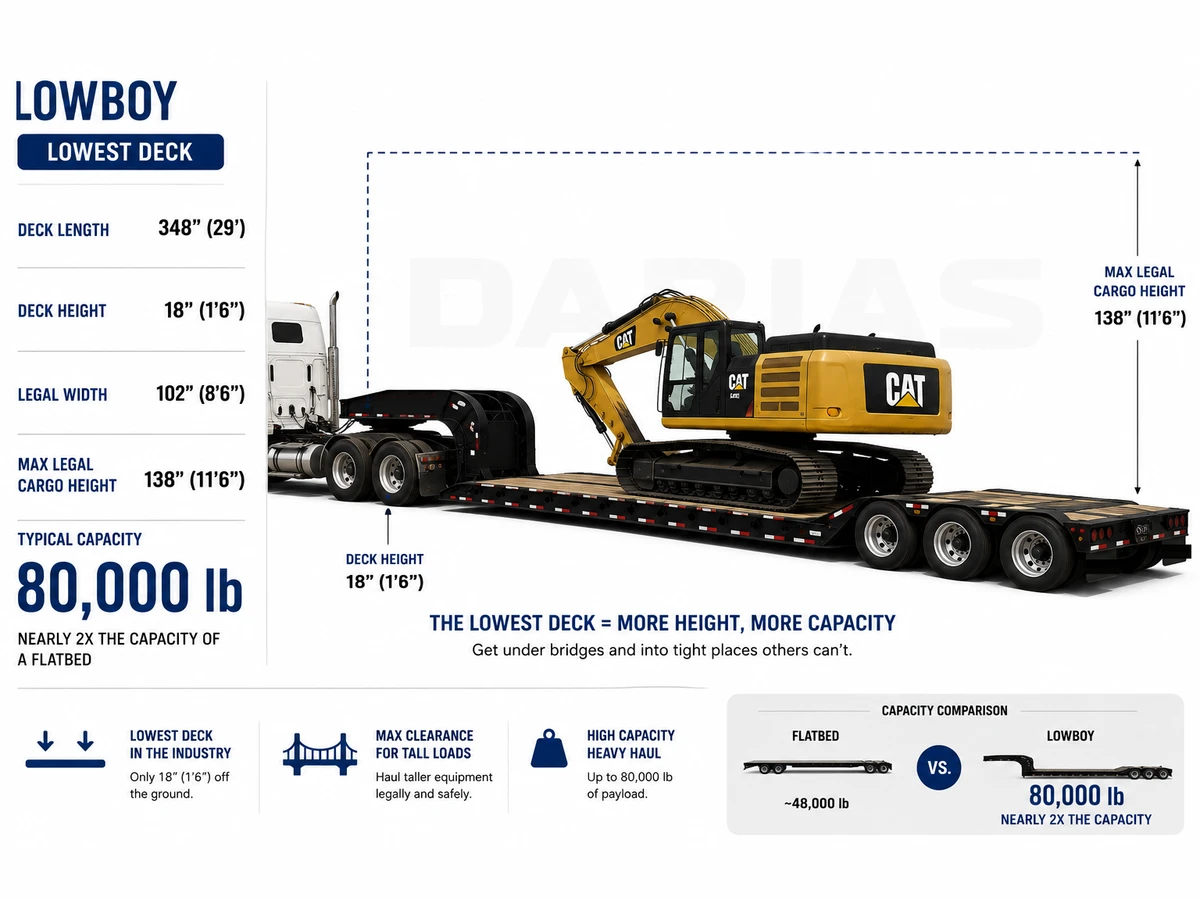
المواصفات
| القياس | Lowboy |
|---|---|
| طول السطح | 29′ |
| ارتفاع السطح | 1′ 6″ |
| العرض القانوني | 8′ 6″ |
| أقصى ارتفاع قانوني للحمولة | 11′ 6″ |
| السعة المعتادة | 80,000 lb |
هذه أرقام اسمية لهذا النوع من المعدات. الحاويات الفعلية تختلف حسب المصنّع والخط الملاحي وسنة الصنع، والوزن الفارغ مطبوع على باب الوحدة التي تصلك. أرسل لنا رقم الحاوية ونتحقق من الوحدة الفعلية.
What a lowboy is
A lowboy is the heavy machine trailer: a short well slung as close to the road as the design allows, with a gooseneck at the front and the axles behind. The well floor sits about 1 ft 6 in up, runs around 29 ft, and is 8 ft 6 in wide. Typical capacity is in the region of 80,000 lb, which puts it in a different class from the other open decks.
Two things follow from that low deck. Tall freight travels legally, with something like 11 ft 6 in of usable cargo height under Florida's 13 ft 6 in limit. And on the removable gooseneck versions, the front of the trailer detaches so the deck becomes a ramp and the machine drives into the well under its own power. These are typical figures for the type rather than one trailer's specification.
Choosing between a lowboy and its neighbours
Against a double drop, the difference is weight and loading. Both put the cargo in a low well and both carry tall freight, but a double drop typically carries around 45,000 lb and has a fixed gooseneck, so the load has to be lifted in. A lowboy is built heavy and, in its removable gooseneck form, lets the machine drive itself on. Excavators, dozers, cranes, presses and transformers end up here for both reasons at once.
Against a step deck, the lowboy wins on height and weight and loses on length and simplicity. A step deck gives 53 ft of deck and around 10 ft of cargo height, which suits anything that is merely large. When the load outgrows even a lowboy, the answer is more axles rather than a different shape: a multi-axle heavy haul trailer spreads the same deck over enough axles to make the weight permittable.
What people get wrong: capacity is not permission, and length runs out first
The 80,000 lb capacity is what the trailer is built to hold. It is not what a truck may weigh. A combination is capped at 80,000 lb gross in total on ordinary roads, so a lowboy carrying anywhere near its rating is by definition a permitted move, usually with extra axles underneath to spread the load. Reading the capacity as a green light is the commonest misunderstanding on this trailer, and it is the one that produces a machine sitting loaded with nowhere legal to go.
The other surprise is length. The well is about 29 ft because that is what fits between the gooseneck and the axles, so a long machine runs out of floor while the trailer still has weight to spare. Booms, counterweights and attachments often travel separately for this reason. And because the deck rides so low, ground clearance becomes a site question: a steep apron, a curb cut or a rutted yard can stop a lowboy that the road never would.
What to send to get it booked
The machine's make and model is worth more than any other single line, because the published figures follow from it. Then the numbers as it will travel: length, width, height and weight, with attachments on or off stated plainly, since a boom left on changes all four.
Say how it loads. Does it drive on, and if so what is its ground clearance and how does it behave on a ramp. Does it need to be craned. Then describe both sites: the approach, the surface, the room to turn, and anything low overhead. If the load is over width, over height or over the legal axle weight, say so at the start, because permits, routes and escorts are arranged in advance and are the part of a heavy haul that takes the time.
تخرج من
تذهب إلى
أسئلة
إجابات مباشرة
How much can a lowboy carry?
A typical figure is 80,000 lb of freight, and that number needs context, because 80,000 lb is also the legal gross weight of an entire combination. A trailer rated to carry that much is built for loads that will be moved under permit with extra axles underneath, not for loads that slip through unnoticed. The structural capacity of the trailer and what a given move is allowed to weigh are two separate questions.
How low is a lowboy deck?
The well floor sits about 1 ft 6 in off the road, which is the lowest deck in ordinary use and a few inches below a double drop. Those inches are the reason the trailer exists: they turn into cargo height under Florida's 13 ft 6 in limit, and they are what lets a tall machine travel without a height permit. The same low ride is what makes ground clearance a real consideration on rough sites.
How does a machine get onto a lowboy?
Usually it drives on. On a removable gooseneck version the front of the trailer detaches and the deck itself becomes the ramp, so a tracked or wheeled machine climbs straight into the well. On a fixed gooseneck lowboy it is ramps at the rear or a crane. Either way the machine's ground clearance and its breakover angle decide whether the loading works, which is why those come up early on plant moves.
Why is a lowboy well so short?
Because the well has to fit between the gooseneck and the rear axles, and both of those are fixed points on a legal trailer. That leaves around 29 ft of low floor. It is why length rather than weight is usually what stops a lowboy job: the machine is heavy enough and the trailer will take it, but the piece will not sit inside the well. Extendable and multi-axle versions exist for exactly that reason.
When does a load on a lowboy need a permit?
Whenever it breaks a legal limit, and heavy plant tends to break more than one at a time. Over 8 ft 6 in wide, over 13 ft 6 in tall measured from the road, or over the weight the axles may legally carry, and the move is permitted and routed rather than simply dispatched. Escorts come in as width and length grow. That is normal work for this trailer and it is planned before the machine is loaded.
ما الذي يُنقل على Lowboy؟
أخفض سطح موجود، للآلات العالية والثقيلة. الحوض قصير، فيكون القيد عادةً هو الطول لا الوزن.
هل تتولون التصاريح؟
نعم. كل ما يتجاوز العرض أو الارتفاع أو الوزن القانوني يُستخرج له تصريح ويُدرس مساره قبل أن يتحرك، مع المرافقة حيث يقتضيها الطريق.
هل تتعاملون مع الـ reefer؟
نعم، مع genset حتى تبقى الحاوية تعمل بين المحطة والباب. حاوية الـ reefer تحمل أقل بوضوح من حاوية جافة بنفس المقاس الخارجي، لأن العزل وجهة المكينة تأخذان مساحة حقيقية.
وماذا عن البضاعة التي لا تدخل في حاوية أصلاً؟
flat rack وopen top لما يخرج عن الأبعاد، أو مسطحة مكشوفة: flatbed، وstep deck، وlowboy، وRGN، وdouble drop. قِس البضاعة قبل الحجز، لأن كل ما يخرج عن الأبعاد يغيّر مسألة التصاريح.
كيف أحصل على سعر؟
أرسل الخط، والمعدة، ومقاس الحاوية، والميناء، ونرد عليك برقم. التسعير والتشغيل على مدار 24 ساعة على quotes@dariaslogistics.com.
ما الذي يشمله عرض سعر الـ drayage فعلاً؟
النقلة نفسها، إضافة إلى الرسوم الإضافية التي يفاجأ بها الناس لاحقاً: الشاسيه، والـ pre-pull، والـ per diem، والـ demurrage، والـ detention، والتخزين. نفضّل تسميتها من البداية على إضافتها إلى فاتورة.