Open deck
مسطحة
المسطحة المكشوفة الافتراضية، مقاس 48 و53 قدماً. تُحمّل من الجانب أو من الأعلى أو من الخلف، وكل ما يتجاوز 8 أقدام و6 بوصات من ارتفاع الحمولة يبدأ في الحاجة إلى تصريح.
شكلها
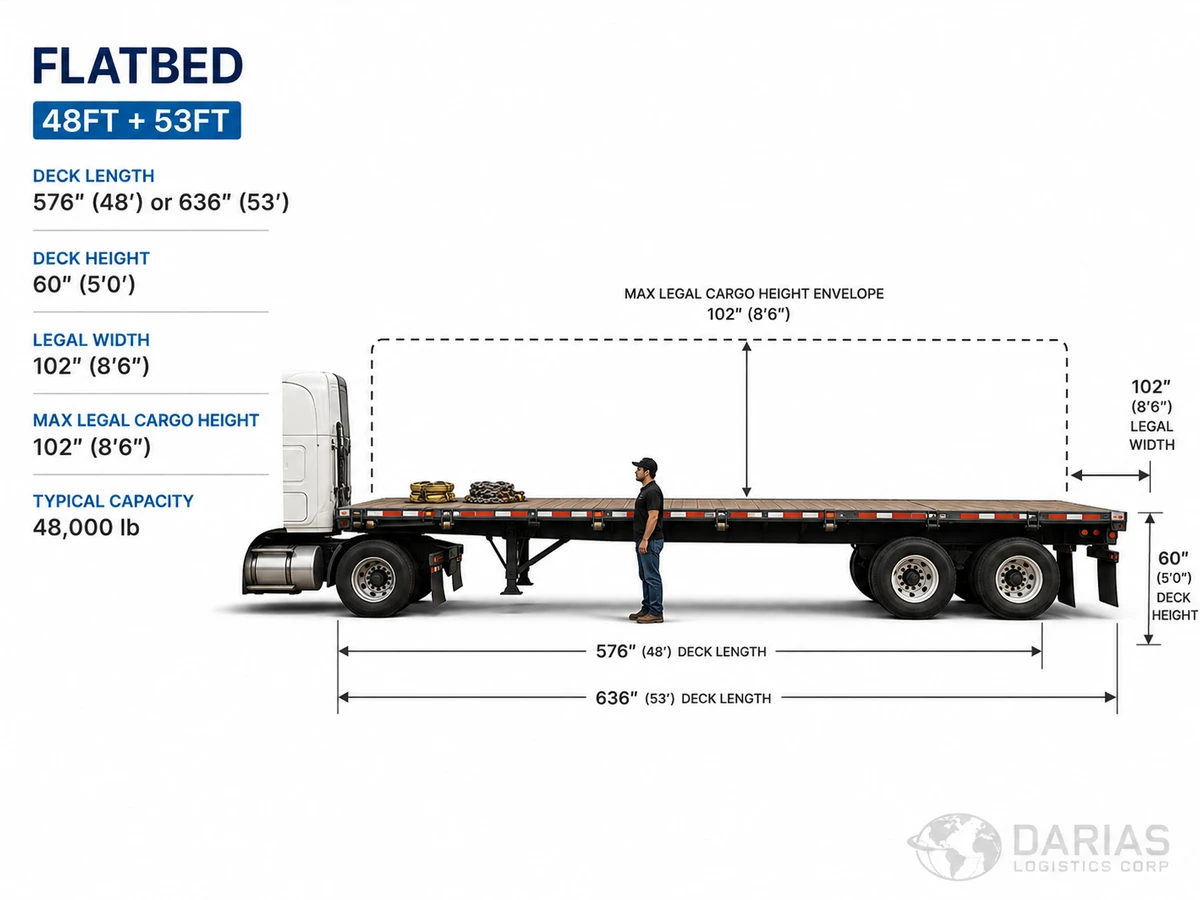
المواصفات
| القياس | مسطحة |
|---|---|
| طول السطح | 48′ أو 53′ |
| ارتفاع السطح | 5′ |
| العرض القانوني | 8′ 6″ |
| أقصى ارتفاع قانوني للحمولة | 8′ 6″ |
| السعة المعتادة | 48,000 lb |
هذه أرقام اسمية لهذا النوع من المعدات. الحاويات الفعلية تختلف حسب المصنّع والخط الملاحي وسنة الصنع، والوزن الفارغ مطبوع على باب الوحدة التي تصلك. أرسل لنا رقم الحاوية ونتحقق من الوحدة الفعلية.
What a flatbed is
A flatbed is the plainest open deck there is: a level platform with no sides, no roof and nothing in the way, in 48 ft and 53 ft lengths. The deck sits around 5 ft off the road, legal width is 8 ft 6 in, and a typical trailer carries something like 48,000 lb of freight. Because there is nothing around it, the load can come on from the side with a forklift, from above with a crane, or in from the back.
That openness is the whole argument for it. Any piece that will not go through a door, any bundle too long to turn inside a van, anything that has to be lifted rather than rolled: a flatbed takes it without an argument. These are typical figures for the type rather than the specification of one trailer, and the real deck height moves a little with suspension and tires.
Choosing between a flatbed and its neighbours
The first question is height. A flatbed gives about 8 ft 6 in of legal cargo height, and a step deck gives about 10 ft because its main deck sits roughly 18 in lower. If the freight is taller than 8 ft 6 in, stepping down is cheaper and simpler than permitting a flatbed. Taller again, and the answer becomes a double drop or a lowboy, both of which put the cargo in a well between the axles.
The second question is weather and handling. A conestoga is a flatbed with a rolling tarp on a frame, so the load still comes on from the side but travels covered and nobody climbs on the deck to sheet it. A dry van is the right call when the freight is palletized and fits through a door, because enclosed freight needs no tarping, no strapping to a deck and no securement inspection along the way.
What people get wrong: the height sum, and where the weight sits
Cargo height is measured from the road, not from the deck. Florida's limit is 13 ft 6 in, the deck is about 5 ft of that, and so the freight gets 8 ft 6 in. People measure the piece on the ground, compare it to the limit and conclude they are fine, then discover that five feet of trailer went underneath it. Anything over that line moves as a permitted load with a planned route, which is a normal thing to arrange and a bad thing to discover on the morning of the pick up.
Weight distribution catches the other half. The 48,000 lb figure is what the trailer typically carries in total, but the rules bind by axle group, so a dense piece sitting in the wrong place can put a load over on the drives or the tandems while the gross is fine. Say what the piece weighs and how long it is, and the placement is worked out before it is loaded rather than corrected at a scale.
What to send to get it booked
Four numbers and one sentence. Length, width, height and weight of the cargo, measured on whatever it is sitting on, plus a sentence on how it will be loaded and unloaded: forklift, crane, or driven on somewhere else. That is enough to know whether this is a flatbed job or belongs on a lower deck.
Then the pick up and delivery, and anything unusual about either site: a tight gate, soft ground, no equipment at one end. Say whether the load has to be tarped, since that is time and labor at both ends rather than a box to tick, and say whether it has lifting points or has to be forked from the side. If the freight is over 8 ft 6 in tall or over 8 ft 6 in wide, say that first, because permits and routing are planned before the trailer is assigned.
Lanes this trailer runs
تخرج من
تذهب إلى
أسئلة
إجابات مباشرة
How tall can cargo be on a flatbed in Florida?
About 8 ft 6 in, and the arithmetic is simple enough to do on the phone. Florida's legal travel height is 13 ft 6 in measured from the road, and a flatbed deck stands roughly 5 ft off it, so what is left for the freight is 8 ft 6 in. Go above that and the load needs a permit and a planned route, or it moves on a drop deck instead, which starts the same sum from a lower deck.
What is the deck height of a flatbed trailer?
Around 5 ft loaded, which is the figure to plan against, though it varies a little with the suspension, the tires and how much weight is on the deck. It matters for two reasons: it decides how much cargo height is left under the 13 ft 6 in limit, and it decides how the freight gets up there. Anything that cannot be craned or forked to 5 ft has to be able to be rolled up a ramp somewhere else.
Does a flatbed load have to be tarped?
Only if the freight needs it, and the shipper usually decides. Tarping protects against weather and road spray and it is normal for lumber, drywall, machinery and anything with a finish. It is also labor: a crew, time at both ends, and straps or bungees that have to be checked en route. If the load must be covered every time, a conestoga does the same job with a rolling tarp and no tarping crew.
When should I use a 53 ft flatbed instead of a 48?
When the freight is long enough that the extra five feet stops it overhanging, or when the load has to be spread out to keep axle weights legal. Otherwise the 48 is the easier trailer to place and the more common one to find. Length is rarely free: a longer trailer is harder to get into a tight site, and a 53 ft deck carrying weight at the back can run into axle limits before it runs out of deck.
How much weight can a flatbed carry?
Around 48,000 lb of freight as a typical figure, with the real limit set by the 80,000 lb legal gross of the combination and by what each axle group may carry. Where the weight sits on the deck matters as much as how much of it there is: a dense piece parked over one axle group can put a load out of legal even when the total is comfortably inside the gross limit.
ما الذي يُنقل على مسطحة؟
المسطحة المكشوفة الافتراضية، مقاس 48 و53 قدماً. تُحمّل من الجانب أو من الأعلى أو من الخلف، وكل ما يتجاوز 8 أقدام و6 بوصات من ارتفاع الحمولة يبدأ في الحاجة إلى تصريح.
هل تتولون التصاريح؟
نعم. كل ما يتجاوز العرض أو الارتفاع أو الوزن القانوني يُستخرج له تصريح ويُدرس مساره قبل أن يتحرك، مع المرافقة حيث يقتضيها الطريق.
هل تتعاملون مع الـ reefer؟
نعم، مع genset حتى تبقى الحاوية تعمل بين المحطة والباب. حاوية الـ reefer تحمل أقل بوضوح من حاوية جافة بنفس المقاس الخارجي، لأن العزل وجهة المكينة تأخذان مساحة حقيقية.
وماذا عن البضاعة التي لا تدخل في حاوية أصلاً؟
flat rack وopen top لما يخرج عن الأبعاد، أو مسطحة مكشوفة: flatbed، وstep deck، وlowboy، وRGN، وdouble drop. قِس البضاعة قبل الحجز، لأن كل ما يخرج عن الأبعاد يغيّر مسألة التصاريح.
كيف أحصل على سعر؟
أرسل الخط، والمعدة، ومقاس الحاوية، والميناء، ونرد عليك برقم. التسعير والتشغيل على مدار 24 ساعة على quotes@dariaslogistics.com.
ما الذي يشمله عرض سعر الـ drayage فعلاً؟
النقلة نفسها، إضافة إلى الرسوم الإضافية التي يفاجأ بها الناس لاحقاً: الشاسيه، والـ pre-pull، والـ per diem، والـ demurrage، والـ detention، والتخزين. نفضّل تسميتها من البداية على إضافتها إلى فاتورة.