Open deck
مقطورة reefer
مقطورة بدرجة حرارة مضبوطة، مقاس 48 و53 قدماً. وهي ما تتحول إليه حاوية الـ reefer حين تمر البضاعة بـ transload لتكمل إلى الداخل.
شكلها
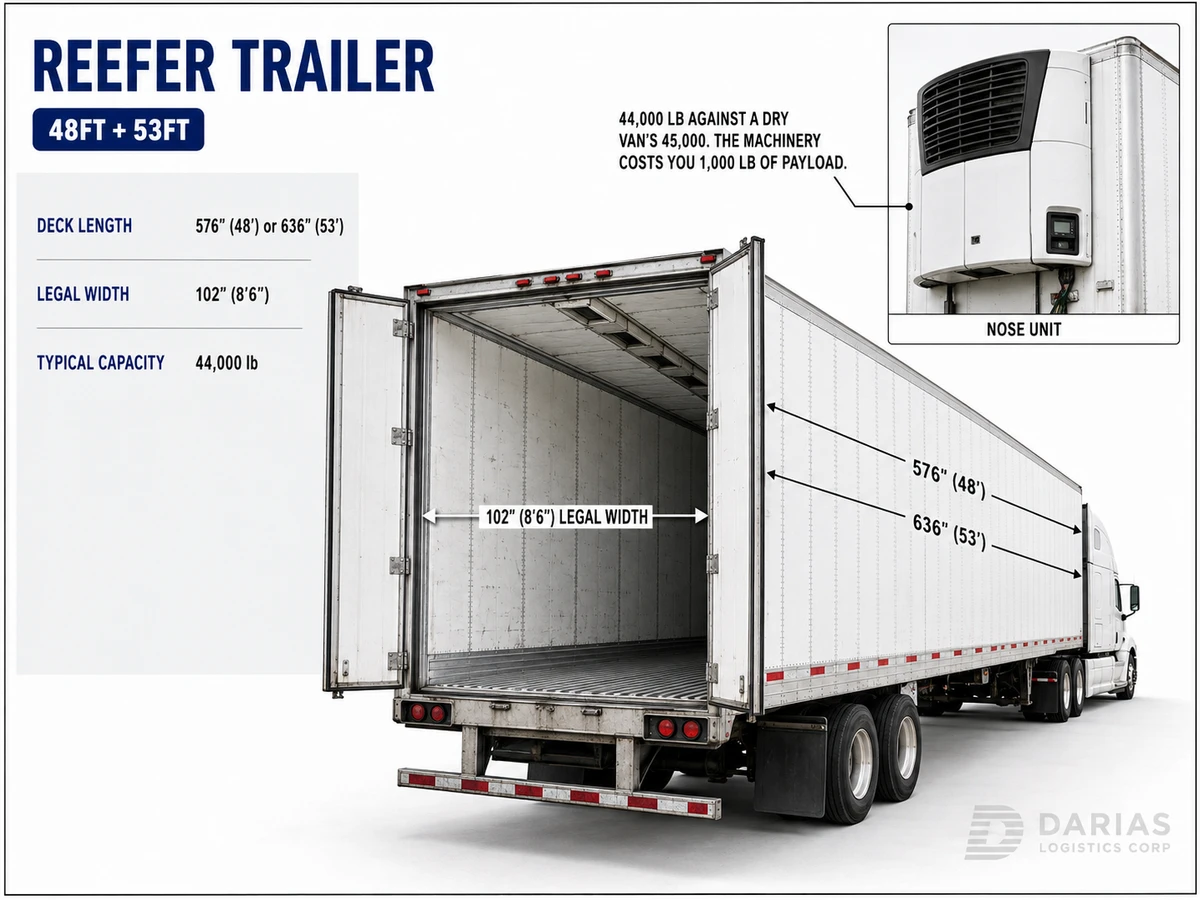
المواصفات
| القياس | مقطورة reefer |
|---|---|
| طول السطح | 48′ أو 53′ |
| العرض القانوني | 8′ 6″ |
| السعة المعتادة | 44,000 lb |
هذه أرقام اسمية لهذا النوع من المعدات. الحاويات الفعلية تختلف حسب المصنّع والخط الملاحي وسنة الصنع، والوزن الفارغ مطبوع على باب الوحدة التي تصلك. أرسل لنا رقم الحاوية ونتحقق من الوحدة الفعلية.
What a reefer trailer is
A reefer trailer is an insulated highway van with a refrigeration unit built into the front wall and its own diesel tank to run it. It comes in 48 ft and 53 ft lengths, is 8 ft 6 in wide like any legal trailer, and typically carries around 44,000 lb of freight. Inside, a duct or chute along the ceiling carries cold air to the back of the load and the air returns along the floor to the unit.
Because the unit carries its own fuel, the trailer can be dropped at a dock and left running, which is why so much refrigerated distribution works on drop trailers. These are typical figures for the type rather than one trailer's specification, and both interior size and payload vary with the insulation and the unit fitted.
When a reefer trailer is the right equipment
Whenever freight has to hold a temperature over the road. Produce, seafood, dairy, meat, flowers, pharmaceuticals, chocolate in a Florida summer, and a long list of goods that are not obviously perishable but have a temperature on the specification sheet. It is also used as a plain insulated van for freight that simply must not get hot, with the unit set accordingly.
Against a reefer container, the choice is about what the trip is. A container makes sense when the cold chain has to stay in one sealed box from the ship to the receiver. A trailer makes sense for the domestic leg, and transloading a container into one at a dock near the port often costs less overall, because the empty container goes straight back and the line's per diem clock stops instead of running to the destination and back.
What people get wrong: holding is not cooling, and the air has to move
A refrigeration unit is sized to hold a temperature against the heat coming through the walls. It is not sized to remove heat from a full load of warm product, and on a Miami dock in summer the difference is measured in hours the freight does not have. Pre cool the trailer to the set point, load freight that is already at temperature, and keep the doors closed while it happens. Loading warm and expecting the unit to catch up is the single most expensive habit in refrigerated freight.
The second thing is airflow. Cold air is delivered along the ceiling chute to the back of the trailer and has to return along the floor, so the load needs a gap above it and grooved floor channels kept clear. Stacking to the roof or blocking the chute at the nose closes that circuit, and a unit that cannot circulate will read a perfect temperature at the front while the rear of the load drifts. Weight is the quieter limit: around 44,000 lb of typical capacity means dense refrigerated loads run out of pounds before pallets.
What to send to get it booked
The set point with its units, the commodity, and whether the freight will be at temperature when it is loaded. Say whether the unit should run continuously or on a cycle, since that follows the cargo rather than the driver, and say whether a temperature record is required at delivery.
Then the ordinary load details: pallet count and size, total weight, and the tallest piece on its pallet. Describe both sites, including whether the receiver expects a drop trailer or a live unload and whether appointments apply. If this is coming out of a refrigerated container, send the container number and the terminal as well, because transloading near the port and returning the empty early is frequently the cheaper way to run the same freight inland.
Lanes this trailer runs
تخرج من
تذهب إلى
أسئلة
إجابات مباشرة
How is a reefer trailer different from a reefer container?
The refrigeration works the same way, the shape does not. A trailer has wheels, landing gear and a fuel tank, so it can be dropped at a dock and left running without a tractor, and it needs no genset because the unit carries its own engine. A container has to sit on a chassis, belongs to a shipping line and needs a clip on genset off the terminal plug. One is built for highways, the other for ships.
Does a reefer trailer need to run the whole trip?
It needs to hold the set point the whole trip, which for most loads means running. The unit burns its own diesel and the tank is sized for days rather than hours, so a long run is normal. What it cannot do is recover a cold chain that was already lost: a trailer holds a temperature against outside heat, so the freight should arrive cold and the box should be at temperature before the doors open.
Why does a reefer trailer hold less than a dry van?
Insulation and machinery. Every wall, the roof and the floor carry insulation, and the refrigeration unit occupies the front wall along with its fuel, so both the interior space and the payload come down. Typical capacity is around 44,000 lb against a dry van's 45,000, and the usable interior is smaller in every direction. On a dense refrigerated load that difference shows up as a pallet or two left behind.
Can one reefer trailer carry frozen and chilled freight together?
Only if it is set up for it. Multi temperature trailers exist, with movable bulkheads and separate evaporators so two compartments hold different set points, and they are common on distribution work. An ordinary single temperature trailer holds one set point for the whole box, and mixing commodities that want different temperatures in it means one of them is being carried wrong for the entire trip.
Should a reefer unit run continuously or start and stop?
It depends on the commodity. Continuous running holds a steadier temperature and keeps air moving, which matters for fresh produce that needs constant circulation. A start and stop cycle saves fuel and suits frozen freight, which is far more forgiving of small swings. It is a decision that belongs to the shipper and the cargo rather than to the driver, so it is worth stating with the set point at booking.
ما الذي يُنقل على مقطورة reefer؟
مقطورة بدرجة حرارة مضبوطة، مقاس 48 و53 قدماً. وهي ما تتحول إليه حاوية الـ reefer حين تمر البضاعة بـ transload لتكمل إلى الداخل.
هل تتولون التصاريح؟
نعم. كل ما يتجاوز العرض أو الارتفاع أو الوزن القانوني يُستخرج له تصريح ويُدرس مساره قبل أن يتحرك، مع المرافقة حيث يقتضيها الطريق.
هل تتعاملون مع الـ reefer؟
نعم، مع genset حتى تبقى الحاوية تعمل بين المحطة والباب. حاوية الـ reefer تحمل أقل بوضوح من حاوية جافة بنفس المقاس الخارجي، لأن العزل وجهة المكينة تأخذان مساحة حقيقية.
وماذا عن البضاعة التي لا تدخل في حاوية أصلاً؟
flat rack وopen top لما يخرج عن الأبعاد، أو مسطحة مكشوفة: flatbed، وstep deck، وlowboy، وRGN، وdouble drop. قِس البضاعة قبل الحجز، لأن كل ما يخرج عن الأبعاد يغيّر مسألة التصاريح.
كيف أحصل على سعر؟
أرسل الخط، والمعدة، ومقاس الحاوية، والميناء، ونرد عليك برقم. التسعير والتشغيل على مدار 24 ساعة على quotes@dariaslogistics.com.
ما الذي يشمله عرض سعر الـ drayage فعلاً؟
النقلة نفسها، إضافة إلى الرسوم الإضافية التي يفاجأ بها الناس لاحقاً: الشاسيه، والـ pre-pull، والـ per diem، والـ demurrage، والـ detention، والتخزين. نفضّل تسميتها من البداية على إضافتها إلى فاتورة.