Open deck
Conestoga
شادر منزلق على هيكل، فتُحمّل البضاعة من الجانب كما في المسطحة لكنها تسافر مغطاة كما في المقطورة المغلقة. بلا طاقم تغطية وبلا مخاطرة من المطر.
شكلها
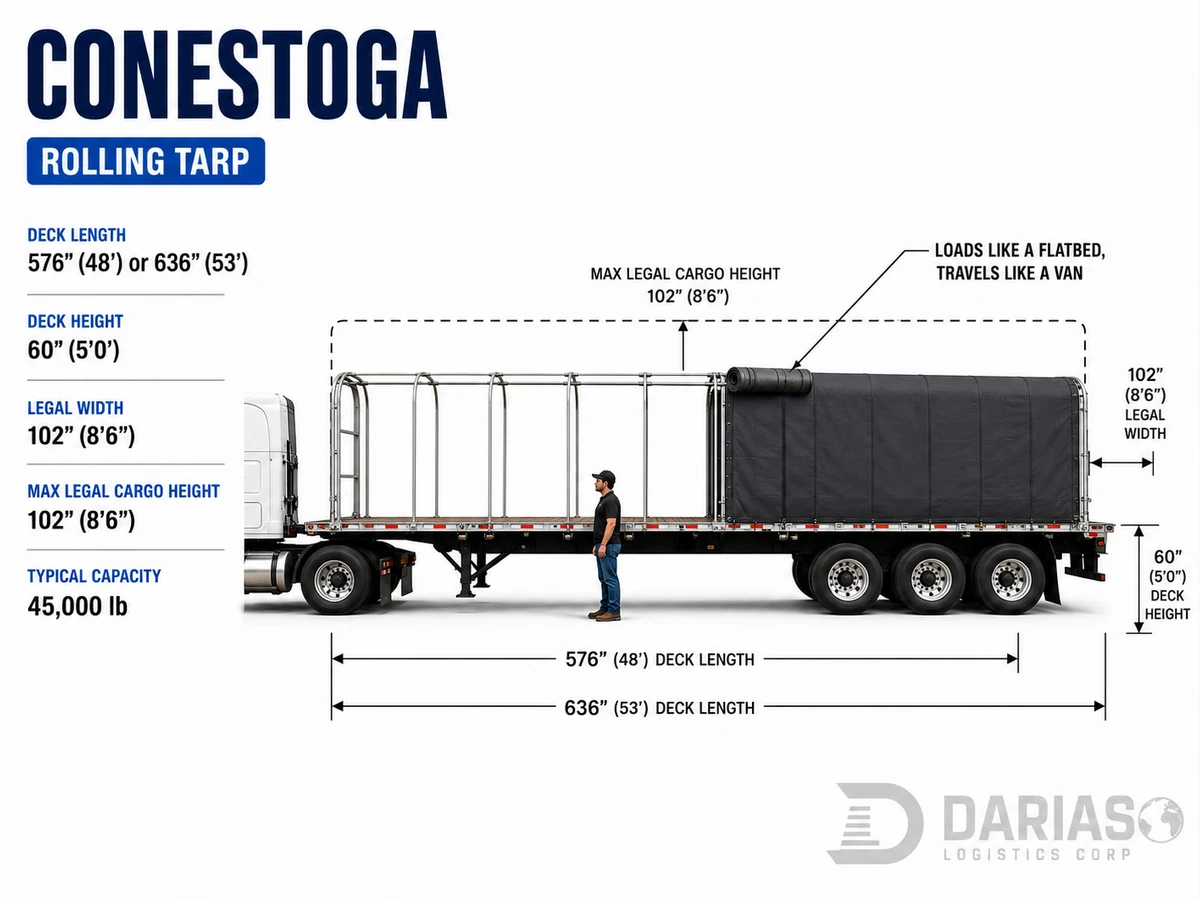
المواصفات
| القياس | Conestoga |
|---|---|
| طول السطح | 48′ أو 53′ |
| ارتفاع السطح | 5′ |
| العرض القانوني | 8′ 6″ |
| أقصى ارتفاع قانوني للحمولة | 8′ 6″ |
| السعة المعتادة | 45,000 lb |
هذه أرقام اسمية لهذا النوع من المعدات. الحاويات الفعلية تختلف حسب المصنّع والخط الملاحي وسنة الصنع، والوزن الفارغ مطبوع على باب الوحدة التي تصلك. أرسل لنا رقم الحاوية ونتحقق من الوحدة الفعلية.
What a conestoga is
A conestoga is an open deck trailer with a tarpaulin carried on a rolling frame. Rolled back, it is a flatbed: 48 ft or 53 ft of deck about 5 ft off the road, 8 ft 6 in wide, open at the sides and open above. Rolled forward, it is a covered load. Typical capacity is around 45,000 lb, and cargo height works out near 8 ft 6 in against Florida's 13 ft 6 in limit, exactly as it does on a flatbed.
The point of the design is loading. Freight goes on from the side with a forklift or from above with a crane, then travels protected from weather and road spray without anyone climbing onto the cargo to sheet it. These are typical figures for the type rather than one trailer's specification, and the usable space under the closed cover is slightly less than the bare deck because the frame takes its share.
When a conestoga beats the alternatives
Against a tarped flatbed, it wins on time, safety and consistency. Hand tarping is a crew, a delay at both ends and a real fall risk, and the result depends on how carefully it was done. A rolling cover is one person at ground level in a few minutes, and it closes the same way every time. On freight that must be covered on every trip, like machinery with a finish, packaged building products or anything that marks, that adds up quickly.
Against a dry van, the question is how the freight loads. If it goes through a door on a pallet, the van is simpler, drier and carries more, since no frame is eating into the payload. The conestoga is for freight that has to come on from the side or from above and still must not get wet. If it does not need covering at all, take the plain flatbed and the extra three thousand pounds.
What people get wrong: it is a tarp, and the frame takes its share
A closed conestoga looks like a van and is not one. It is a tarpaulin on a frame, it is not sealed, and cargo that would be ruined by any moisture belongs in something with steel walls and doors. It also does not make freight secure the way a locked van does. What it does reliably is keep weather and road spray off a load that would otherwise be tarped by hand, which is a real and specific job.
The second thing is the arithmetic of the frame. It weighs something, which is why typical capacity sits around 45,000 lb rather than a flatbed's 48,000, and it takes a little of the usable height and width when it is closed. So a piece that sits happily on an open deck can still foul the cover. Measure the load against what the trailer looks like closed, not against the deck it was loaded on, and remember the height limit is measured from the road.
What to send to get it booked
Length, width, height and weight of the freight as it will sit on the deck, and the piece count. Then how it is loading: forklift from the side, crane from above, or both, since that is what decides whether a conestoga is the right trailer rather than a van.
Say plainly whether the load must stay dry and how dry, because that is the line between this trailer and an enclosed one. If the freight is close to 45,000 lb, say so, as the cover system is weight that does not come off. And describe both sites: a rolling frame needs room alongside the trailer to be worked, and a bay that only allows access from the rear takes away the thing you are paying for.
Lanes this trailer runs
تخرج من
تذهب إلى
أسئلة
إجابات مباشرة
What is a conestoga trailer?
A flatbed with a tarpaulin stretched over a rolling frame. The frame slides back along the deck like a concertina, so the whole trailer opens for side or overhead loading and then closes over the freight for the road. It gives you the access of an open deck and the weather protection of a covered load, without a crew climbing on top of the cargo to sheet it by hand.
How long does it take to open a conestoga?
Minutes rather than the better part of an hour, which is the honest comparison, because the alternative is hand tarping. The frame is rolled back, the load comes on or off, and the frame is rolled forward and secured. It is one person's job and it happens at ground level. On a load that has to be covered at both ends, the time saved twice over is most of the reason the trailer exists.
Is a conestoga as weatherproof as a dry van?
No, and it is worth being plain about it. A conestoga is a very good tarp on a good frame: it keeps rain and road spray off freight that would otherwise be sheeted by hand, and it does that far more reliably than a crew with straps. A dry van is a sealed box with doors. For cargo that cannot tolerate any moisture at all, and that fits through a door, the van is the right answer.
Does a conestoga lose payload to the tarp system?
Yes, a few thousand pounds, which is why a typical conestoga figure sits nearer 45,000 lb where a plain flatbed is around 48,000. The frame and the tarp are permanently part of the trailer, so their weight comes out of the freight allowance on every trip whether the cover is needed or not. On a dense load close to the limit that difference is the deciding factor.
Can a conestoga be loaded from the top?
Yes, with the frame rolled back the deck is open above as well as at the sides, so a crane can lower a piece straight in. That is one of the real advantages over a curtain sider, which only opens at the sides. The thing to check is height: the frame has to roll forward over the load afterwards, so freight that fits the deck does not automatically fit under the closed cover.
ما الذي يُنقل على Conestoga؟
شادر منزلق على هيكل، فتُحمّل البضاعة من الجانب كما في المسطحة لكنها تسافر مغطاة كما في المقطورة المغلقة. بلا طاقم تغطية وبلا مخاطرة من المطر.
هل تتولون التصاريح؟
نعم. كل ما يتجاوز العرض أو الارتفاع أو الوزن القانوني يُستخرج له تصريح ويُدرس مساره قبل أن يتحرك، مع المرافقة حيث يقتضيها الطريق.
هل تتعاملون مع الـ reefer؟
نعم، مع genset حتى تبقى الحاوية تعمل بين المحطة والباب. حاوية الـ reefer تحمل أقل بوضوح من حاوية جافة بنفس المقاس الخارجي، لأن العزل وجهة المكينة تأخذان مساحة حقيقية.
وماذا عن البضاعة التي لا تدخل في حاوية أصلاً؟
flat rack وopen top لما يخرج عن الأبعاد، أو مسطحة مكشوفة: flatbed، وstep deck، وlowboy، وRGN، وdouble drop. قِس البضاعة قبل الحجز، لأن كل ما يخرج عن الأبعاد يغيّر مسألة التصاريح.
كيف أحصل على سعر؟
أرسل الخط، والمعدة، ومقاس الحاوية، والميناء، ونرد عليك برقم. التسعير والتشغيل على مدار 24 ساعة على quotes@dariaslogistics.com.
ما الذي يشمله عرض سعر الـ drayage فعلاً؟
النقلة نفسها، إضافة إلى الرسوم الإضافية التي يفاجأ بها الناس لاحقاً: الشاسيه، والـ pre-pull، والـ per diem، والـ demurrage، والـ detention، والتخزين. نفضّل تسميتها من البداية على إضافتها إلى فاتورة.