Open deck
Conestoga
Un telone scorrevole su un telaio, così la merce si carica dal lato come su un pianale ma viaggia coperta come in una cassa. Niente squadra di intelonatura e nessun rischio pioggia.
Come si presenta
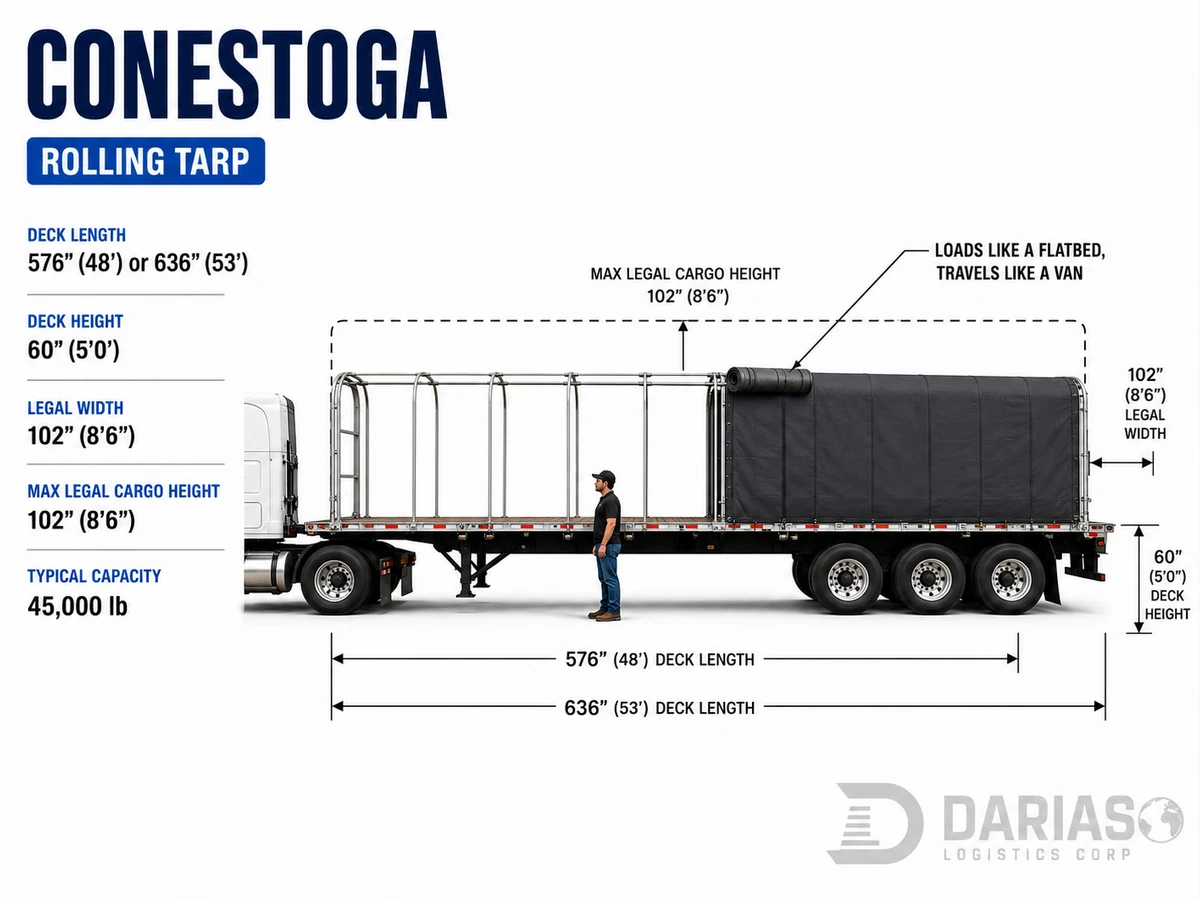
Specifiche
| Misura | Conestoga |
|---|---|
| Lunghezza pianale | 48′ o 53′ |
| Altezza pianale | 5′ |
| Larghezza legale | 8′ 6″ |
| Altezza legale max del carico | 8′ 6″ |
| Capacità tipica | 45,000 lb |
Questi sono valori nominali per questo tipo di attrezzatura. I container reali variano per costruttore, compagnia e anno, e la tara è stampigliata sulla porta dell'unità che le arriva. Ci mandi il numero del container e lo verifichiamo su quello vero.
What a conestoga is
A conestoga is an open deck trailer with a tarpaulin carried on a rolling frame. Rolled back, it is a flatbed: 48 ft or 53 ft of deck about 5 ft off the road, 8 ft 6 in wide, open at the sides and open above. Rolled forward, it is a covered load. Typical capacity is around 45,000 lb, and cargo height works out near 8 ft 6 in against Florida's 13 ft 6 in limit, exactly as it does on a flatbed.
The point of the design is loading. Freight goes on from the side with a forklift or from above with a crane, then travels protected from weather and road spray without anyone climbing onto the cargo to sheet it. These are typical figures for the type rather than one trailer's specification, and the usable space under the closed cover is slightly less than the bare deck because the frame takes its share.
When a conestoga beats the alternatives
Against a tarped flatbed, it wins on time, safety and consistency. Hand tarping is a crew, a delay at both ends and a real fall risk, and the result depends on how carefully it was done. A rolling cover is one person at ground level in a few minutes, and it closes the same way every time. On freight that must be covered on every trip, like machinery with a finish, packaged building products or anything that marks, that adds up quickly.
Against a dry van, the question is how the freight loads. If it goes through a door on a pallet, the van is simpler, drier and carries more, since no frame is eating into the payload. The conestoga is for freight that has to come on from the side or from above and still must not get wet. If it does not need covering at all, take the plain flatbed and the extra three thousand pounds.
What people get wrong: it is a tarp, and the frame takes its share
A closed conestoga looks like a van and is not one. It is a tarpaulin on a frame, it is not sealed, and cargo that would be ruined by any moisture belongs in something with steel walls and doors. It also does not make freight secure the way a locked van does. What it does reliably is keep weather and road spray off a load that would otherwise be tarped by hand, which is a real and specific job.
The second thing is the arithmetic of the frame. It weighs something, which is why typical capacity sits around 45,000 lb rather than a flatbed's 48,000, and it takes a little of the usable height and width when it is closed. So a piece that sits happily on an open deck can still foul the cover. Measure the load against what the trailer looks like closed, not against the deck it was loaded on, and remember the height limit is measured from the road.
What to send to get it booked
Length, width, height and weight of the freight as it will sit on the deck, and the piece count. Then how it is loading: forklift from the side, crane from above, or both, since that is what decides whether a conestoga is the right trailer rather than a van.
Say plainly whether the load must stay dry and how dry, because that is the line between this trailer and an enclosed one. If the freight is close to 45,000 lb, say so, as the cover system is weight that does not come off. And describe both sites: a rolling frame needs room alongside the trailer to be worked, and a bay that only allows access from the rear takes away the thing you are paying for.
Lanes this trailer runs
Esce da
Va a
Domande
Risposte dirette
What is a conestoga trailer?
A flatbed with a tarpaulin stretched over a rolling frame. The frame slides back along the deck like a concertina, so the whole trailer opens for side or overhead loading and then closes over the freight for the road. It gives you the access of an open deck and the weather protection of a covered load, without a crew climbing on top of the cargo to sheet it by hand.
How long does it take to open a conestoga?
Minutes rather than the better part of an hour, which is the honest comparison, because the alternative is hand tarping. The frame is rolled back, the load comes on or off, and the frame is rolled forward and secured. It is one person's job and it happens at ground level. On a load that has to be covered at both ends, the time saved twice over is most of the reason the trailer exists.
Is a conestoga as weatherproof as a dry van?
No, and it is worth being plain about it. A conestoga is a very good tarp on a good frame: it keeps rain and road spray off freight that would otherwise be sheeted by hand, and it does that far more reliably than a crew with straps. A dry van is a sealed box with doors. For cargo that cannot tolerate any moisture at all, and that fits through a door, the van is the right answer.
Does a conestoga lose payload to the tarp system?
Yes, a few thousand pounds, which is why a typical conestoga figure sits nearer 45,000 lb where a plain flatbed is around 48,000. The frame and the tarp are permanently part of the trailer, so their weight comes out of the freight allowance on every trip whether the cover is needed or not. On a dense load close to the limit that difference is the deciding factor.
Can a conestoga be loaded from the top?
Yes, with the frame rolled back the deck is open above as well as at the sides, so a crane can lower a piece straight in. That is one of the real advantages over a curtain sider, which only opens at the sides. The thing to check is height: the frame has to roll forward over the load afterwards, so freight that fits the deck does not automatically fit under the closed cover.
Cosa carica un Conestoga?
Un telone scorrevole su un telaio, così la merce si carica dal lato come su un pianale ma viaggia coperta come in una cassa. Niente squadra di intelonatura e nessun rischio pioggia.
Vi occupate voi dei permessi?
Sì. Tutto ciò che supera larghezza, altezza o peso di legge viene autorizzato e instradato prima di muoversi, scorte comprese dove il percorso le richiede.
Gestite i reefer?
Sì, con genset, così il container continua a funzionare tra il terminal e la porta. Un reefer carica sensibilmente meno di un container secco delle stesse misure esterne, perché l'isolamento e il lato macchina occupano spazio reale.
E la merce che in un container non ci sta?
Flat rack e open top per il fuori sagoma, oppure pianale aperto: flatbed, step deck, lowboy, RGN e double drop. La misuri prima di prenotare, perché tutto ciò che esce dalla sagoma cambia il discorso permessi.
Come ottengo una tariffa?
Ci mandi la tratta, il mezzo, la dimensione del container e il porto, e le rispondiamo con un numero. Preventivi e dispatch 24 ore su 24 a quotes@dariaslogistics.com.
Cosa comprende davvero un preventivo di drayage?
Il trasporto in sé, più gli accessori che poi sorprendono: chassis, pre-pull, per diem, demurrage, detention e stoccaggio. Preferiamo indicarli subito piuttosto che aggiungerli a una fattura.