40' RH / 45R1
Reefer da 40 piedi high cube
Il cavallo di battaglia del deperibile nel sud della Florida. Un piede di altezza interna in più rispetto a un reefer standard, con lo stesso requisito di genset.
Fuori, dentro, e la porta
Come si presenta
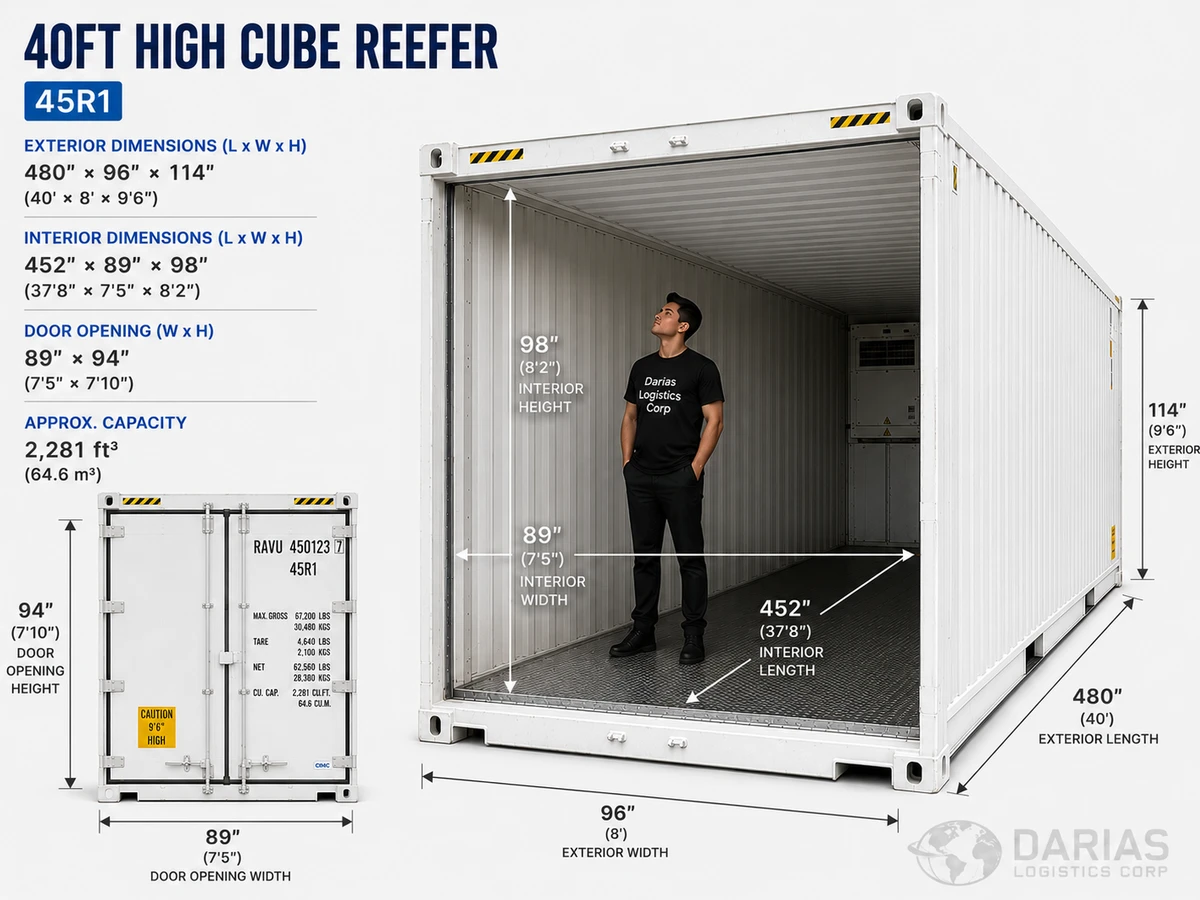
Specifiche
| Misura | Reefer da 40 piedi high cube |
|---|---|
| Lunghezza esterna | 480″ 40′ |
| Larghezza esterna | 96″ 8′ |
| Altezza esterna | 114″ 9′ 6″ |
| Lunghezza interna | 452″ 37′ 8″ |
| Larghezza interna | 89″ 7′ 5″ |
| Altezza interna | 98″ 8′ 2″ |
| Larghezza porta | 89″ 7′ 5″ |
| Altezza porta | 94″ 7′ 10″ |
| Tara | 10,580 lb |
| Portata max | 56,620 lb |
| Peso legale max su strada | 40,000 lb |
| Peso lordo max | 67,200 lb |
| Capacità | 2,281 piedi³ |
| Chassis | Standard 40ft, plus a genset |
Questi sono valori nominali per questo tipo di attrezzatura. I container reali variano per costruttore, compagnia e anno, e la tara è stampigliata sulla porta dell'unità che le arriva. Ci mandi il numero del container e lo verifichiamo su quello vero.
What a 40ft high cube reefer is
A high cube reefer is the refrigerated 40 with an extra foot of height. Outside it runs 40 ft by 8 ft by 9 ft 6 in. Inside, the nominal figures are about 37 ft 8 in by 7 ft 5 in by 8 ft 2 in, which is roughly 2,281 cu ft, with a door opening near 7 ft 5 in wide by 7 ft 10 in tall. Tare sits around 10,580 lb, near enough identical to a standard reefer.
It is the ordinary box of the perishable trades through South Florida, so a refrigerated 40 arriving from the Caribbean or Central America is more often this than the standard height version. The interior figures are nominal for the type; the tare on the door of the unit you receive is the one your load plan should use.
When the extra foot is the right call
Refrigerated freight is usually bulky rather than heavy. Flowers, produce, boxed seafood and most palletized chilled goods fill a container on volume long before they approach the road weight limit, so height is the dimension that converts into money. About 280 cu ft more than a standard reefer, and enough interior height at 8 ft 2 in to make a second tier of pallets realistic where 7 ft 2 in does not.
If the load is dense rather than bulky, none of that helps and the standard reefer is just as good, or a 20ft reefer if the volume is small. If the cold chain ends at a domestic run rather than at a receiver, the freight is often better transloaded into a reefer trailer near the port, which releases the line's box and stops the per diem clock instead of sending it up the state and back.
What people get wrong: travel height, and the genset arithmetic
This is a high cube, so the height that has to clear Florida's 13 ft 6 in limit is the chassis deck plus 9 ft 6 in of container, not the box on its own. On ordinary routes a standard chassis carries it legally with little margin, and the places that catch people are local: a canopy over the receiving apron, an older overpass on the last mile, a dock with something built above the door. A gooseneck chassis sits the box lower and is worth asking for when a clearance is known to be tight.
The weight arithmetic has the same shape as every reefer. About 40,000 lb of legal road cargo is the published figure for a high cube reefer, what is left of the 80,000 lb gross after the tractor, the chassis and 10,580 lb of tare, and it assumes nothing is hanging off the box. A clip on genset with fuel generally runs 2,500 to 3,300 lb, and all of it comes out of the same number. Plan the payload with the genset in it, not beside it.
What to send to get it booked
The container number, the steamship line and the terminal come first, since they settle the gate requirement and the appointment. Then the refrigerated details: set point and units, the commodity, and whether the freight is already at temperature, because the unit holds a temperature rather than pulling one down.
Say whether a genset is needed and for how long. Send the cargo weight as it reads on the bill of lading, with the genset counted against the same legal gross. And because this box is tall, mention anything tight on the route or at the delivery: a canopy, a gate bar, a low dock. That one line is what decides between a standard chassis and a gooseneck before a driver is committed.
Esce da
Va a
More in this section
Domande
Risposte dirette
What is the difference between a 40ft reefer and a 40ft high cube reefer?
Height, and only height. Both are 40 ft long and 8 ft wide outside, both lose the same length to the machinery end, and both need a genset off the plug. The high cube stands 9 ft 6 in tall outside instead of 8 ft 6 in, which gives about 8 ft 2 in of interior height against 7 ft 2 in, and lifts capacity from roughly 2,002 to 2,281 cu ft. Payload is within a hundred pounds either way.
How much interior height does a high cube reefer have?
About 8 ft 2 in on the nominal figures, with a door opening near 7 ft 10 in. Both are lower than the equivalent dry box, because an insulated ceiling and a raised T section floor take their share before anything is loaded. The extra foot over a standard reefer is what makes a second tier of pallets realistic, and the door opening is still the number that decides whether a loaded pallet actually gets through the end.
Does a high cube reefer need a gooseneck chassis?
Not usually, but it is the box where the question is worth asking. At 9 ft 6 in tall it is a high cube like any other, so the travel height is the chassis deck plus the container against Florida's 13 ft 6 in limit, and on a standard chassis that leaves little to spare. A gooseneck drops the box and buys the margin back. Whether it is needed depends on the route and the delivery rather than on the container.
Why is the high cube reefer so common on the South Florida perishable trades?
Because most refrigerated cargo through PortMiami and Port Everglades is bulky rather than dense: flowers, fruit, vegetables, seafood in boxes on pallets. That freight fills the box on volume long before it reaches 40,000 lb, so the extra foot of height is worth more than any extra payload would be. Once a trade standardises on a size, the boxes and the plugs and the load plans all follow it.
Can I stack two tiers of pallets in a high cube reefer?
Often yes, and that is the reason to choose it, but the load line inside the box still governs. Air is delivered along the floor and has to return over the top of the cargo to the machinery end, so the gap above the load is not wasted space, it is the return path. Stack into it and the unit will hold a perfect temperature at the front while the door end of the load quietly drifts.
Quali sono le misure interne di un Reefer da 40 piedi high cube?
Lunghezza, larghezza e altezza interne sono nella tabella delle specifiche di questa pagina, accanto alle misure esterne e all'apertura della porta. È l'apertura della porta a decidere se una macchina ci passa, ed è più piccola dell'interno.
Che chassis serve per un Reefer da 40 piedi high cube?
Standard 40ft, plus a genset. Lo chassis lo portiamo noi, così la prenotazione non dipende da cosa il terminal ha disponibile quella mattina.
Lo gestite in sovrappeso?
Sì, con lo chassis giusto e il permesso giusto. Il sovrappeso è una questione a parte rispetto alla dimensione del container, e i porti hanno limiti propri oltre a quelli dello stato.
Da dove ritirate un Reefer da 40 piedi high cube?
Port of Miami, Port Everglades, Port of Palm Beach, POMTOC, South Florida Container Terminal, Seaboard Marine, Florida International Terminal, Port Everglades Terminal, Crowley, King Ocean, MSC, Tropical Shipping, Antillean Marine, FEC Port Everglades ICTF, FEC Hialeah rail ramp and CSX ramp.
Cos'è il last free day?
L'ultimo giorno in cui il suo container può restare dentro il terminal prima che partano gli addebiti di stoccaggio. Se lo si supera, il demurrage matura ogni giorno, ed è per questo che un pre-pull costa quasi sempre meno dell'attesa.
Cos'è un pre-pull?
Ritiriamo il container dal terminal prima che lei sia pronto e lo teniamo in un piazzale. Ferma il demurrage a tariffe di terminal e toglie pressione ai suoi orari di ricevimento.
Che differenza c'è tra demurrage, per diem e detention?
Tre addebiti diversi, da soggetti diversi. Il demurrage è il terminal che le addebita la merce ferma dentro il gate oltre il tempo libero. Il per diem è la compagnia di navigazione che le addebita il suo container tenuto fuori oltre il tempo libero. Il detention è il tempo del trasportatore, addebitato quando un autista aspetta alla sua banchina oltre la finestra libera. Possono correre insieme, ed è così che una fattura diventa pesante in fretta.
Come ottengo una tariffa?
Ci mandi la tratta, il mezzo, la dimensione del container e il porto, e le rispondiamo con un numero. Preventivi e dispatch 24 ore su 24 a quotes@dariaslogistics.com.
Cosa comprende davvero un preventivo di drayage?
Il trasporto in sé, più gli accessori che poi sorprendono: chassis, pre-pull, per diem, demurrage, detention e stoccaggio. Preferiamo indicarli subito piuttosto che aggiungerli a una fattura.