20' / 40' FR
Flat rack
Un pianale con testate abbattibili e senza sponde laterali, per carichi troppo larghi o troppo alti per una cassa. Da 20 e da 40 piedi. Misuri prima di prenotare, perché il fuori sagoma è una conversazione sui permessi, non sulla prenotazione.
Fuori, dentro, e la porta
Come si presenta
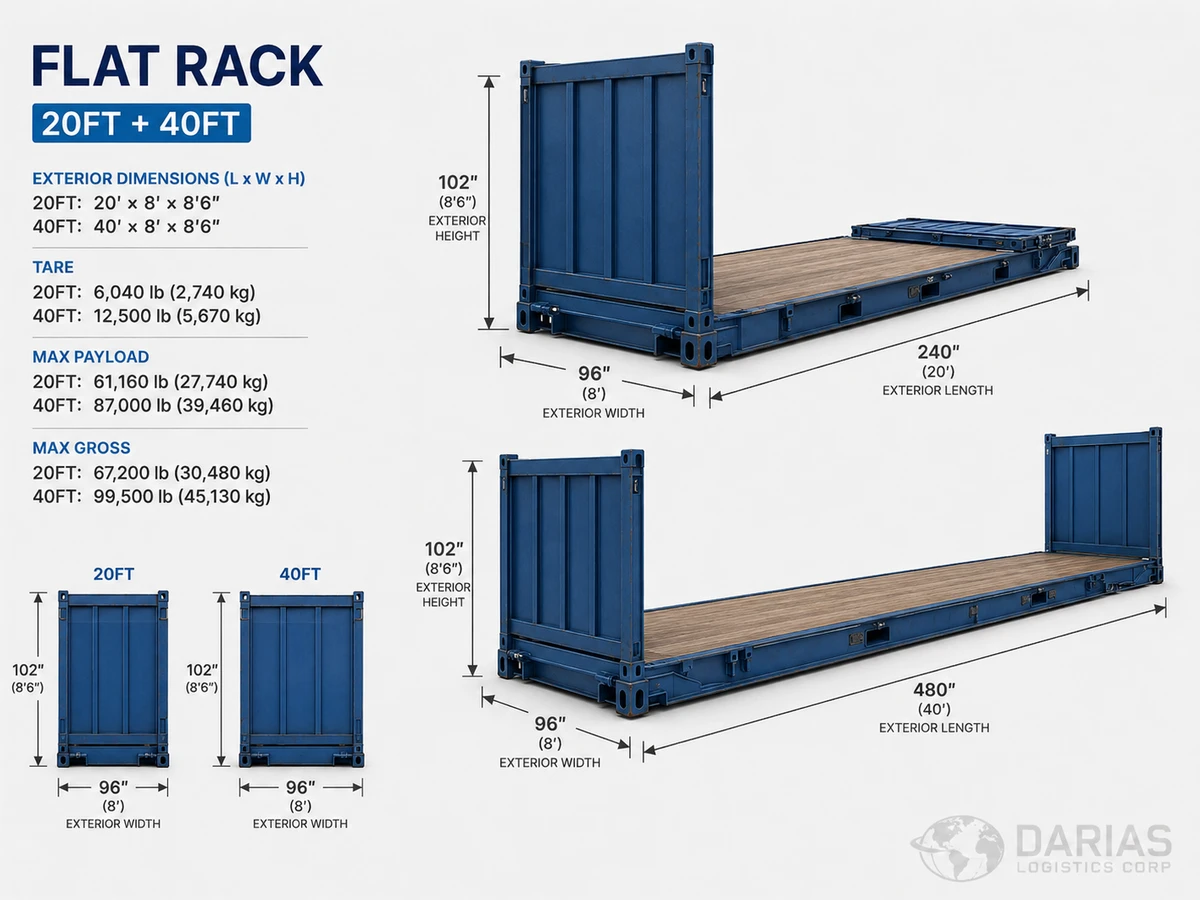
Specifiche
| Misura | Flat rack |
|---|---|
| Lunghezza esterna | 480″ 40′ |
| Larghezza esterna | 96″ 8′ |
| Altezza esterna | 102″ 8′ 6″ |
| Tara | 12,500 lb |
| Portata max | 87,000 lb |
| Peso lordo max | 99,500 lb |
| Chassis | Standard, to the box length |
| Dati riferiti a | 40ft |
| Esiste anche da | 20ft |
Questi sono valori nominali per questo tipo di attrezzatura. I container reali variano per costruttore, compagnia e anno, e la tara è stampigliata sulla porta dell'unità che le arriva. Ci mandi il numero del container e lo verifichiamo su quello vero.
What a flat rack is
A flat rack is a container reduced to its floor: a heavy steel deck the size of a container, with two end walls and nothing along the sides. It handles like a box at a terminal, locks to a chassis at the same four corners, and stacks in a ship's cell guides, but it carries freight that would never go through a door. The figures shown are for the 40 ft version, about 40 ft by 8 ft by 8 ft 6 in with a tare near 12,500 lb, and it also runs as a 20.
There are no interior or door dimensions to quote, which is the point of the type. What matters instead is the deck size, the lashing points, and the shape of the piece going on it. Racks come with fixed or collapsible end walls, and the collapsible ones fold flat so empties can be stacked and repositioned.
When a flat rack beats the alternatives
Use it when the cargo is too wide for a box, or too tall and too heavy for an open top, or when it has to be lifted and lashed rather than rolled or forked in. Transformers, boats, construction plant, long steel, generator sets, anything with an awkward footprint and real weight. An open top is the better answer when the piece fits inside the walls and only the roof is the obstacle, because an open top still encloses and protects the load.
If the freight is never going to sea, a flat rack is usually the wrong tool. A step deck, a double drop or a lowboy sits the cargo much lower, which matters on a road where the limit is 13 ft 6 in, and it is easier to load. The flat rack earns its place when the same piece has to cross water as a container sized unit and then continue on a chassis.
What people get wrong: the rating, and how fast the height disappears
The 87,000 lb payload and the 99,500 lb gross on the specification are structural ratings for the rack itself. They describe the steel. They do not describe a truck. On a Florida road the limit is the 80,000 lb legal gross of the whole combination, so a legally loaded flat rack carries a small fraction of its rating unless the move is permitted, and permitted moves come with their own routes, times and equipment.
Height is the other one. A flat rack on a chassis puts its deck at container floor level, so the cargo starts high before it starts at all, and Florida's 13 ft 6 in is measured from the road. A piece that looks modest on the ground can be over height the moment it is on the rack. Width behaves the same way: past 8 ft 6 in the move is over dimensional, and an over dimensional box cannot use the PortMiami Tunnel, so it leaves over the bridge and through downtown instead.
What to send to get it booked
Measure the piece before you ask, and send four numbers: length, width, height and weight. Then say how it can be handled, because lifting points, a cradle, skids or a forklift pocket decide what happens at both ends of the trip. If it is already on a rack, the container number and the steamship line give the terminal and the appointment.
Say the rack length, 20 or 40, since the chassis matches the unit. Say whether the end walls are up or folded. And if anything overhangs the deck in any direction, say by how much, because that is the difference between a normal dispatch and a permitted, routed over dimensional move. Over gauge is a measuring conversation first and a booking conversation second.
Work it out first
Esce da
Va a
More in this section
Domande
Risposte dirette
Can a flat rack carry cargo wider than the container itself?
Yes, and that is the reason to use one. With no side walls the cargo can overhang the deck, which is impossible in any enclosed box. What the overhang buys you at sea it costs you on land: anything wider than 8 ft 6 in is an over dimensional load on a Florida road, so it is measured, permitted and routed before it moves, and escorts come into the conversation as the width grows.
Why is a flat rack's payload so much higher than a container's?
Because the 87,000 lb figure is the rack's structural rating, which is about how much steel and how many lashing points the deck has, not about what a truck may weigh. On a Florida road the binding number is the 80,000 lb legal gross of the whole combination, so the cargo a flat rack can actually carry on the highway is a fraction of its rating unless the move is permitted. Load to the road, not to the plate.
Do the end walls on a flat rack fold down?
On the collapsible type, yes: the two end walls fold flat onto the deck so empty racks can be stacked and repositioned cheaply, which is a large part of why the design exists. Folded down they also let a long piece overhang the ends. Standing up they give you something to brace and lash against, which is usually worth keeping if the cargo does not need the length.
How is cargo secured on a flat rack?
To the rack, with chains, straps or welded stops working against the lashing points built into the deck and the corner posts, and with dunnage under the load to spread it. Securing is part of the shipment rather than an afterthought: the piece has to survive a sea leg and a road leg, and the road leg has its own securement rules. Send the weight, the footprint and where the piece can be lashed or lifted.
Is a flat rack the same as a platform container?
Close, but not identical. A platform is just the deck, with no end walls at all, and it is used for the heaviest and most awkward pieces. A flat rack keeps two end walls, fixed or collapsible, which give you bracing and some containment. Both move through terminals as container sized units and both are measured, permitted and lashed rather than simply booked, so the choice is about the cargo shape.
Che chassis serve per un Flat rack?
Standard, to the box length. Lo chassis lo portiamo noi, così la prenotazione non dipende da cosa il terminal ha disponibile quella mattina.
Lo gestite in sovrappeso?
Sì, con lo chassis giusto e il permesso giusto. Il sovrappeso è una questione a parte rispetto alla dimensione del container, e i porti hanno limiti propri oltre a quelli dello stato.
Da dove ritirate un Flat rack?
Port of Miami, Port Everglades, Port of Palm Beach, POMTOC, South Florida Container Terminal, Seaboard Marine, Florida International Terminal, Port Everglades Terminal, Crowley, King Ocean, MSC, Tropical Shipping, Antillean Marine, FEC Port Everglades ICTF, FEC Hialeah rail ramp and CSX ramp.
Cos'è il last free day?
L'ultimo giorno in cui il suo container può restare dentro il terminal prima che partano gli addebiti di stoccaggio. Se lo si supera, il demurrage matura ogni giorno, ed è per questo che un pre-pull costa quasi sempre meno dell'attesa.
Cos'è un pre-pull?
Ritiriamo il container dal terminal prima che lei sia pronto e lo teniamo in un piazzale. Ferma il demurrage a tariffe di terminal e toglie pressione ai suoi orari di ricevimento.
Che differenza c'è tra demurrage, per diem e detention?
Tre addebiti diversi, da soggetti diversi. Il demurrage è il terminal che le addebita la merce ferma dentro il gate oltre il tempo libero. Il per diem è la compagnia di navigazione che le addebita il suo container tenuto fuori oltre il tempo libero. Il detention è il tempo del trasportatore, addebitato quando un autista aspetta alla sua banchina oltre la finestra libera. Possono correre insieme, ed è così che una fattura diventa pesante in fretta.
Come ottengo una tariffa?
Ci mandi la tratta, il mezzo, la dimensione del container e il porto, e le rispondiamo con un numero. Preventivi e dispatch 24 ore su 24 a quotes@dariaslogistics.com.
Cosa comprende davvero un preventivo di drayage?
Il trasporto in sé, più gli accessori che poi sorprendono: chassis, pre-pull, per diem, demurrage, detention e stoccaggio. Preferiamo indicarli subito piuttosto che aggiungerli a una fattura.