Servizio
Reefer trailer freight
Temperature-controlled truckload, in 48ft and 53ft reefer trailers.
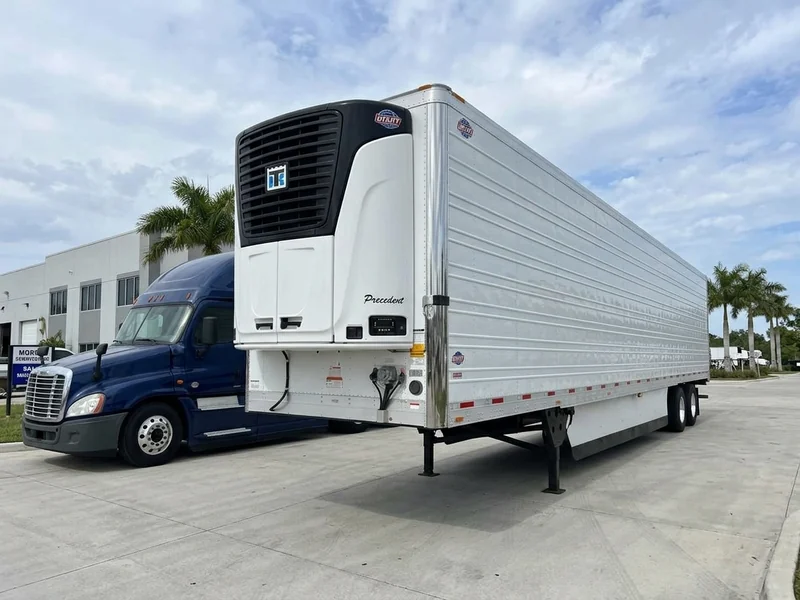
A reefer holds a temperature, it does not create one
The unit on the nose of the trailer maintains a set point. It is not built to pull the heat out of a warm load, and a trailer asked to do that can run the whole trip without ever catching up. Freight goes in at temperature, into a trailer that was pre-cooled before the doors opened.
Tell us the set point when you ask for the rate, and whether it runs continuous or on cycle. Continuous holds a tighter band and burns more fuel, cycle is cheaper and lets the box drift between cut-in and cut-out. For anything with a narrow tolerance that difference decides whether the load arrives in spec.
The cold costs you a thousand pounds
A reefer trailer runs 48ft or 53ft, the same footprint as a dry van, and carries around 44,000 lb against a dry van's 45,000. The refrigeration unit, the fuel it carries and the insulation in the walls account for the difference, and the same insulation costs interior width and height as well.
That matters most on freight that was already heavy. A load that just fits a dry van does not automatically fit a reefer, and finding that out at the dock costs a day. If the load is near the limit, give us the weight and we will say which trailer it actually fits before anything is booked.
Out of the ocean box, or stay in it
Refrigerated freight arriving by sea does not have to finish the trip in the container it landed in. Transloading into a reefer trailer returns the box, ends per diem, and stops the inland leg paying container and chassis rates. It is a temperature-controlled handling job rather than a simple restack, so it needs a dock that can do it without letting the freight warm up.
Sometimes staying in the ocean box is still the right answer, and that is a reefer container move with a genset on the chassis. Which one is cheaper depends on the distance and how long the box would be out, so it is worth asking before choosing.
Long-haul lanes out of Miami
The other half of the cold chain
Mezzi
Porti
Domande
Risposte dirette
Can a reefer trailer cool down a warm load?
No. The unit on the nose of the trailer maintains a set point. It is not built to pull the heat out of a warm load, and a trailer asked to do that can run the whole trip without ever catching up. Freight goes in at temperature, into a trailer that was pre-cooled before the doors opened. If the freight is going to be warm at loading, that has to be solved at your end, because no amount of trailer fixes it once the doors are shut and the truck is moving.
How much weight can a 53ft reefer trailer carry?
Around 44,000 lb, against a dry van's 45,000 in the same 48ft or 53ft footprint. The refrigeration unit, the fuel it carries and the insulation in the walls account for the difference, and that same insulation costs interior width and height as well. It matters most on freight that was already heavy: a load that just fits a dry van does not automatically fit a reefer, and finding that out at the dock costs a day. Send the weight and the trailer question gets settled before booking.
What is the difference between continuous and cycle running?
Continuous keeps the unit running and holds a tighter temperature band, and it burns more fuel for it. Cycle lets the unit stop and start between cut-in and cut-out, which is cheaper and lets the box drift a little. For freight with a narrow tolerance that drift is the whole question; for freight with a wide window it is money saved for nothing lost. Send the set point and which mode the load needs at the rate request rather than at the dock, because it is part of the price.
What does it take to transload refrigerated freight into a trailer?
A dock that can do it without letting the freight warm up, which is the difference between a transload and an ordinary restack. The trailer is pre-cooled before the doors open, the handling window is kept short, and the freight moves at temperature rather than sitting out while a crew works around it. The payoff is that the ocean container goes back early, per diem stops, and the long inland leg stops paying container and chassis rates for freight that no longer needs them.
Do you run reefer truckloads outside Florida?
Yes, out of South Florida to all 48 states in 48ft and 53ft reefer trailers. The Florida corridor shapes the transit time the same way it does for a dry van: almost everything leaving the state runs north through a narrow neck first, so the first several hundred miles are spent getting out of Florida. Send the set point, the mode, the weight and the delivery window along with the lane, because on temperature-controlled freight the appointment at the far end is usually the real constraint.
Come ottengo una tariffa?
Ci mandi la tratta, il mezzo, la dimensione del container e il porto, e le rispondiamo con un numero. Preventivi e dispatch 24 ore su 24 a quotes@dariaslogistics.com.
Cosa comprende davvero un preventivo di drayage?
Il trasporto in sé, più gli accessori che poi sorprendono: chassis, pre-pull, per diem, demurrage, detention e stoccaggio. Preferiamo indicarli subito piuttosto che aggiungerli a una fattura.