45' HC wide body, 102in
45 piedi high cube, 102 pollici di larghezza
Sette pollici più largo dentro di un 45 ISO, ed è lì che sta tutto: 99 pollici prendono due pallet da 48 affiancati, 92 no. Seaboard e Crowley li muovono dal sud della Florida, quindi sui trade dei Caraibi e del Centro America un 45 spesso è questo container. Il payload è il peso legale su strada, non la portata del container.
Fuori, dentro, e la porta
Come si presenta
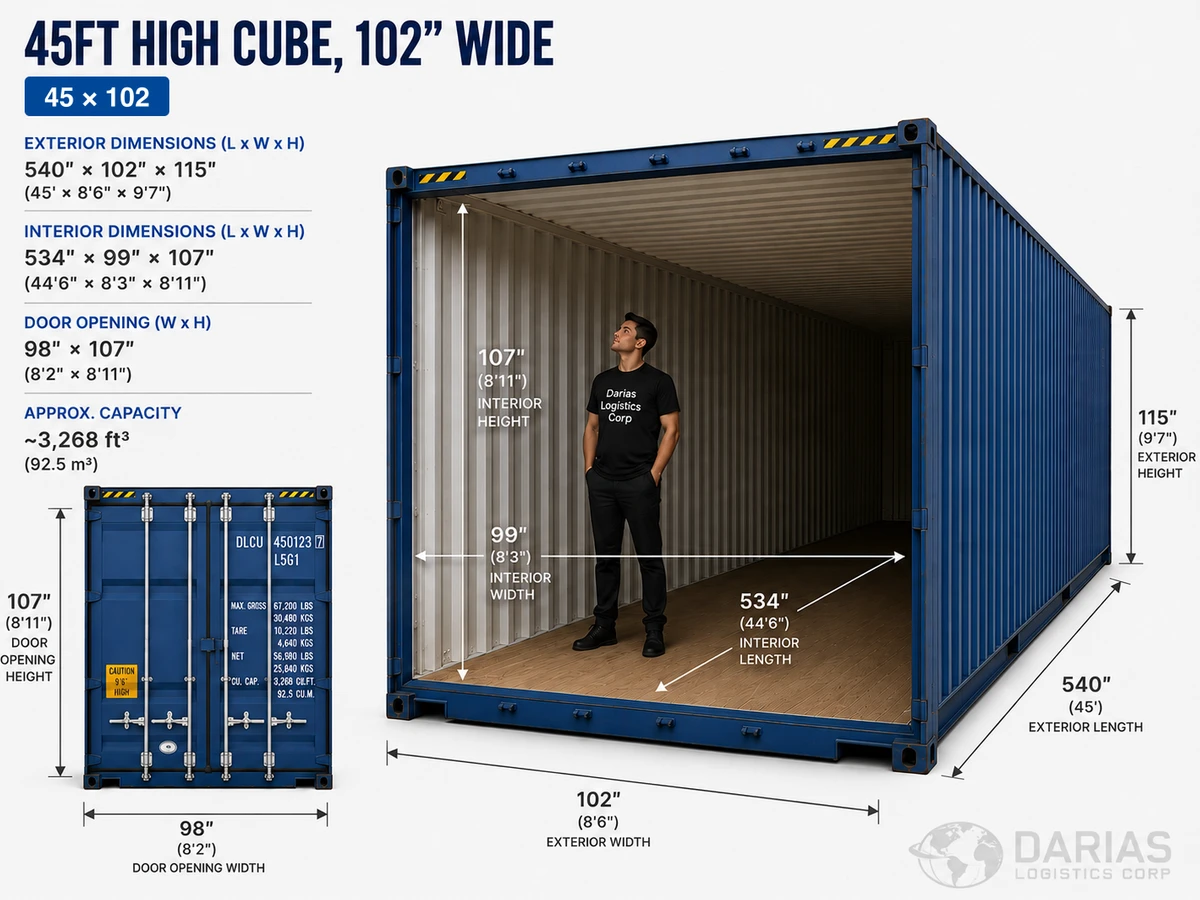
Specifiche
| Misura | 45 piedi high cube, 102 pollici di larghezza |
|---|---|
| Lunghezza esterna | 540″ 45′ |
| Larghezza esterna | 102″ 8′ 6″ |
| Altezza esterna | 115″ 9′ 7″ |
| Lunghezza interna | 534″ 44′ 6″ |
| Larghezza interna | 99″ 8′ 3″ |
| Altezza interna | 107″ 8′ 11″ |
| Larghezza porta | 98″ 8′ 2″ |
| Altezza porta | 107″ 8′ 11″ |
| Tara | 10,220 lb |
| Portata max | 56,730 lb |
| Peso legale max su strada | 41,700 lb |
| Peso lordo max | 67,200 lb |
| Capacità | 3,268 piedi³ |
| Chassis | 45ft or extendable |
Dati pubblicati da Crowley. La tara varia comunque per costruzione ed è stampigliata sulla porta dell'unità che le arriva. Ci mandi il numero del container e lo verifichiamo su quello vero.
What the 102 in wide 45 is
This is a 45 ft high cube built 102 in wide instead of the usual 96. Outside it runs 45 ft long, about 8 ft 6 in wide and 9 ft 7 in tall. Inside, the published figures are roughly 44 ft 6 in by 8 ft 3 in by 8 ft 11 in, giving around 3,268 cu ft, and the door opening is about 8 ft 2 in wide by 8 ft 11 in tall, which is unusually generous on height for a container.
On the Caribbean and Central America trades through PortMiami and Port Everglades it is a common box rather than a curiosity, so a booking that says only 45 may well mean this one. Tare runs around 10,220 lb on the published figures, and as with any container the tare that governs your load is the one stencilled on the door of the unit you actually receive.
Why seven inches changes the load plan
Two standard 48 in pallets need 96 in of width. An ordinary container gives you about 92 in inside, so they do not go side by side and the whole floor plan has to be built around turning pallets and accepting dead space. This box gives you 99 in, so they do, all the way down 44 ft 6 in of floor. That is not a marginal gain: it is a different way of loading the same freight.
Against an 8 ft wide 45 it is about 225 more cu ft on nearly identical outside dimensions, and against a 40ft high cube it is more of everything. The comparison that actually matters is pallets landed rather than cubic feet quoted, and that is where the wide body separates from its neighbours. If your cargo is not palletized, the advantage shrinks to the seven inches themselves and the choice goes back to whichever box is available on the trade.
What people get wrong: width has no margin, and the rating is not the road limit
102 in is the legal highway width, not a width that needs a permit and not a width with anything spare. An ordinary 8 ft container travels with six inches of slack against the limit, and this one travels with none. Nothing about that is a problem on an ordinary route, but it means a box seated slightly off on a chassis, a narrow gate, a construction lane or a tight dock approach has less room to be wrong in than the crew may expect.
The other trap is the weight column. The container is rated at 67,200 lb gross, and that is a sea and stacking figure. The number that decides whether a truck is legal in Florida is the 80,000 lb gross of the whole combination, which leaves about 41,700 lb of cargo after the tractor, a 45 ft chassis and the box's own tare, the figure Crowley publishes for this box. Loading to the rating rather than the road figure is how a legally stuffed container becomes an illegal vehicle at the first scale.
What to send to get it booked
Say 102 in, or say wide body, at the first ask. The chassis question and the load plan both change with that one word, and a 45 assumed to be the ISO box gets planned with the wrong interior width. Then the container number, the steamship line and the terminal, which decide the gate requirement and the appointment.
After that the usual: delivery address, last free day, and the cargo weight as it reads on the bill of lading rather than a guess. If the receiving site is tight, describe it, because this is a 45 ft box at full legal width and the approach matters more than the door. If the freight is palletized, the pallet size and the count are worth sending too, since that is what the extra seven inches is being bought for.
Work it out first
Esce da
Va a
Domande
Risposte dirette
How wide is a 102 in container inside?
About 8 ft 3 in, which is 99 in, against roughly 92 in in an ordinary 8 ft wide box. Seven inches does not sound like much until you put pallets in it. Two 48 in pallet edges need 96 in and they fit here with room to breathe, where in a 96 in wide container they do not fit at all. That single fact is the reason the wide body exists and the reason the two sizes are not interchangeable.
Is a 102 in wide container legal on the road without a permit?
Yes. 102 in is the legal highway width in the United States, so the box travels as an ordinary load and no width permit is involved. What it does not have is margin. An 8 ft wide container has half a foot of slack against the limit and this one has none, so a shifted box on a chassis, a tight gate or a narrow bridge approach is less forgiving than the crew may be used to.
Where do 102 in wide 45ft containers come from?
They run heavily on the Caribbean and Central America services out of PortMiami and Port Everglades, which is why South Florida sees them far more often than most of the country does. If your booking is on one of those trades and says 45, there is a real chance this is the box rather than the 8 ft wide ISO version, and it is worth confirming before a load plan is drawn around the wrong interior width.
Can a 45ft wide body be loaded at a standard dock?
Usually yes, since the door opening is around 8 ft 2 in wide and dock levellers and forklifts are not troubled by the extra few inches of box width. The thing to check is the approach rather than the door: a wider box on a 45 ft chassis needs a straighter run into the bay. As always, the tightest opening on the trip is worth measuring in advance, and it is often the receiver's door and not the container.
Is the payload of a wide body 45 lower than its rating?
Much lower, and the two numbers answer different questions. The box is rated to 67,200 lb gross, which is a sea figure covering how the steel and the corner castings are built. On a Florida road the limit is the 80,000 lb legal gross of the whole combination, which leaves roughly 41,700 lb of cargo once the tractor, a 45 ft chassis and about 10,220 lb of tare are taken out. Load to the road figure.
Quali sono le misure interne di un 45 piedi high cube, 102 pollici di larghezza?
Lunghezza, larghezza e altezza interne sono nella tabella delle specifiche di questa pagina, accanto alle misure esterne e all'apertura della porta. È l'apertura della porta a decidere se una macchina ci passa, ed è più piccola dell'interno.
Che chassis serve per un 45 piedi high cube, 102 pollici di larghezza?
45ft or extendable. Lo chassis lo portiamo noi, così la prenotazione non dipende da cosa il terminal ha disponibile quella mattina.
Lo gestite in sovrappeso?
Sì, con lo chassis giusto e il permesso giusto. Il sovrappeso è una questione a parte rispetto alla dimensione del container, e i porti hanno limiti propri oltre a quelli dello stato.
Da dove ritirate un 45 piedi high cube, 102 pollici di larghezza?
Port of Miami, Port Everglades, Port of Palm Beach, POMTOC, South Florida Container Terminal, Seaboard Marine, Florida International Terminal, Port Everglades Terminal, Crowley, King Ocean, MSC, Tropical Shipping, Antillean Marine, FEC Port Everglades ICTF, FEC Hialeah rail ramp and CSX ramp.
Cos'è il last free day?
L'ultimo giorno in cui il suo container può restare dentro il terminal prima che partano gli addebiti di stoccaggio. Se lo si supera, il demurrage matura ogni giorno, ed è per questo che un pre-pull costa quasi sempre meno dell'attesa.
Cos'è un pre-pull?
Ritiriamo il container dal terminal prima che lei sia pronto e lo teniamo in un piazzale. Ferma il demurrage a tariffe di terminal e toglie pressione ai suoi orari di ricevimento.
Che differenza c'è tra demurrage, per diem e detention?
Tre addebiti diversi, da soggetti diversi. Il demurrage è il terminal che le addebita la merce ferma dentro il gate oltre il tempo libero. Il per diem è la compagnia di navigazione che le addebita il suo container tenuto fuori oltre il tempo libero. Il detention è il tempo del trasportatore, addebitato quando un autista aspetta alla sua banchina oltre la finestra libera. Possono correre insieme, ed è così che una fattura diventa pesante in fretta.
Come ottengo una tariffa?
Ci mandi la tratta, il mezzo, la dimensione del container e il porto, e le rispondiamo con un numero. Preventivi e dispatch 24 ore su 24 a quotes@dariaslogistics.com.
Cosa comprende davvero un preventivo di drayage?
Il trasporto in sé, più gli accessori che poi sorprendono: chassis, pre-pull, per diem, demurrage, detention e stoccaggio. Preferiamo indicarli subito piuttosto che aggiungerli a una fattura.