40' GP / 42G1
Container da 40 piedi
The 40ft standard container explained: nominal inside and door dimensions, 2,389 cu ft of space, and what it can legally weigh on a South Florida road.
Fuori, dentro, e la porta
Come si presenta
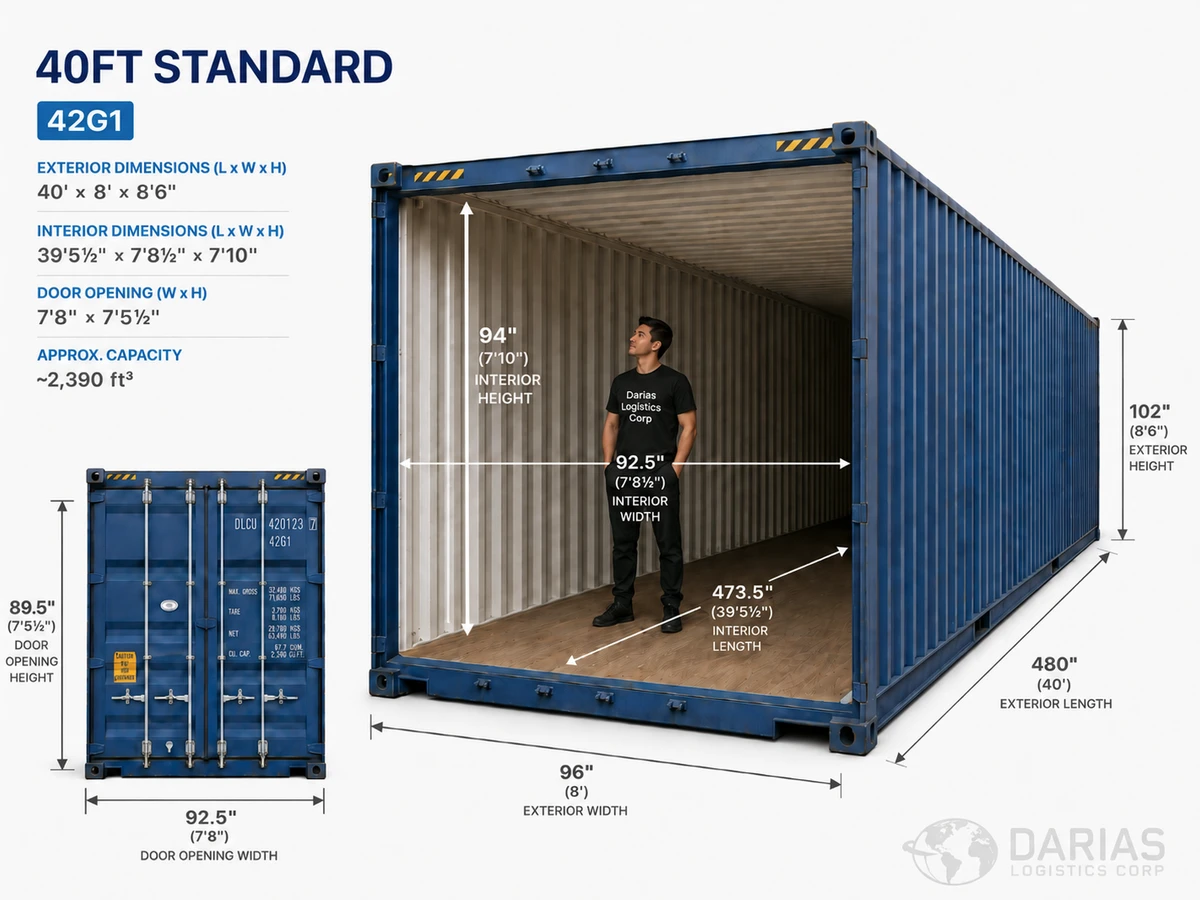
Specifiche
| Misura | Container da 40 piedi |
|---|---|
| Lunghezza esterna | 480″ 40′ |
| Larghezza esterna | 96″ 8′ |
| Altezza esterna | 102″ 8′ 6″ |
| Lunghezza interna | 473.5″ 39′ 5.5″ |
| Larghezza interna | 92.5″ 7′ 8.5″ |
| Altezza interna | 94″ 7′ 10″ |
| Larghezza porta | 92″ 7′ 8″ |
| Altezza porta | 89.5″ 7′ 5.5″ |
| Tara | 8,380 lb |
| Portata max | 58,820 lb |
| Peso legale max su strada | 44,000 lb |
| Peso lordo max | 67,200 lb |
| Capacità | 2,389 piedi³ |
| Chassis | Standard 40ft |
Questi sono valori nominali per questo tipo di attrezzatura. I container reali variano per costruttore, compagnia e anno, e la tara è stampigliata sulla porta dell'unità che le arriva. Ci mandi il numero del container e lo verifichiamo su quello vero.
What a 40ft container is
The 40ft standard is the default dry box of the container trades, and most of what moves through South Florida is either this or its high cube version. Outside it is 40 ft long, 8 ft wide and 8 ft 6 in tall. Inside, the nominal figures are about 39 ft 5.5 in by 7 ft 8.5 in by 7 ft 10 in, which comes to roughly 2,389 cu ft, a little over twice a 20ft standard.
The door opening is about 7 ft 8 in wide by 7 ft 5.5 in tall, and it is smaller than the interior in both directions. That gap is where loading plans go wrong. Tare on a typical 40 is around 8,380 lb, but these are nominal figures for the type and the true tare is stencilled on the door of the unit you are given.
Choosing between a 40, a 20 and a high cube
A 40 is the right box when you have volume and ordinary weight. It gives you 2,389 cu ft for one booking, one chassis and one appointment, where two 20s give you 2,344 cu ft for two of each. The 20 wins on density, because a pair of short boxes can legally carry far more total weight than one 40, and it wins where the delivery simply cannot take 40 ft of box on a chassis.
The high cube is the same 40 with a foot more inside, about 8 ft 10 in of height and 2,695 cu ft, for freight that is tall rather than heavy. On the Caribbean and Central America trades out of PortMiami and Port Everglades you will also meet 45 ft boxes, which add length again but need a 45 ft or extendable chassis. If the cargo is wider or taller than any box, the answer stops being a container and becomes an open top, a flat rack or an open deck trailer.
What people get wrong: the payload figure and the door
The 44,000 lb road figure is published, not derived here: the Florida road table and the ocean carriers' OCEMA guideline both put a 40 ft dry box at 44,000 lb of cargo on a standard chassis, and Crowley lists 44,200 for its high cubes. It is what is left of the 80,000 lb legal gross once the tractor, the chassis and the container's 8,380 lb tare are taken out. The container itself is rated far higher, at 67,200 lb gross, which is a sea figure and not a road one. Confusing the two is how a legally stuffed box becomes an illegal truck.
The other recurring problem is measuring against the interior. Height at the ceiling is about 7 ft 10 in and the door opening is roughly four inches less, so a crate that fits the box does not always fit the way in. Width behaves the same way. Measure the cargo on its pallet, then measure the opening at both ends of the trip, because the customer's dock door is often tighter than anything on the container.
What to send to get it booked
Container number, steamship line and terminal first, because those settle the gate requirement and the appointment. Then the delivery address, the last free day if you know it, and the cargo weight as it reads on the bill of lading rather than an estimate, since that is what decides whether this is an ordinary move or a permitted one.
Say whether the box is being stripped live while the driver waits or dropped and collected later, and say what the receiving site looks like if it is anything other than a dock. Sixty five feet of combination needs room to turn and room to leave. If the freight is coming out of the box for an inland run anyway, mention it, because a transload onto a dry van at the warehouse can be cheaper than driving the container up the state.
Esce da
Va a
More in this section
Domande
Risposte dirette
How much can a 40ft container weigh on the road in Florida?
Around 44,000 lb of cargo on a standard 40ft chassis, the figure the Florida road table and the ocean carriers' own guideline, OCEMA, both publish. Treat it as the planning figure rather than a guarantee, since the real tare of your box and how the load sits on the axles both move it. Anything above it is an overweight move: different chassis, a permit, and port limits on top.
Is one 40ft container cheaper than two 20ft containers?
On a lane where both fit, usually yes. One 40 is one booking, one chassis, one appointment and one delivery, and it gives 2,389 cu ft against 2,344 for a pair of 20s. The pair wins when weight is the problem, because two short boxes can legally carry roughly 76,000 lb of cargo between them against one 40's 44,000, or when the delivery cannot physically take a 40 ft box on a chassis.
How many pallets fit in a 40ft container?
Twenty standard 40 by 48 in pallets on the floor, two across with the 40 in edge facing out and ten rows deep, which uses almost all of the 39 ft 5.5 in of interior length. The width is the constraint on the pattern: at about 7 ft 8.5 in inside there is no room to turn a pallet sideways in the main run. Stacking a second tier depends on your freight and on 7 ft 10 in of height.
Does a 40ft container need a special chassis?
No, a standard 40ft chassis is the normal answer, and it also carries a 40ft high cube. The chassis becomes a question at 45 ft, where a fixed 45 or an extendable is needed, and at heavy weights, where an extra axle is what makes the load legal. For an ordinary 40 the chassis is the least interesting part of the move: the terminal, the appointment and the weight decide the day.
How much room does a truck need to deliver a 40ft container?
More than most people picture. The box alone is 40 ft, the combination with a tractor runs to around 65 ft, and it has to swing in, stop square and pull straight out again. A yard that takes a 53 ft dry van will take a 40ft container on a chassis. A tight residential approach, a narrow gate or a street with parked cars on both sides often will not, and that is a better conversation before the truck is dispatched than at the curb.
Quali sono le misure interne di un Container da 40 piedi?
Lunghezza, larghezza e altezza interne sono nella tabella delle specifiche di questa pagina, accanto alle misure esterne e all'apertura della porta. È l'apertura della porta a decidere se una macchina ci passa, ed è più piccola dell'interno.
Che chassis serve per un Container da 40 piedi?
Standard 40ft. Lo chassis lo portiamo noi, così la prenotazione non dipende da cosa il terminal ha disponibile quella mattina.
Lo gestite in sovrappeso?
Sì, con lo chassis giusto e il permesso giusto. Il sovrappeso è una questione a parte rispetto alla dimensione del container, e i porti hanno limiti propri oltre a quelli dello stato.
Da dove ritirate un Container da 40 piedi?
Port of Miami, Port Everglades, Port of Palm Beach, POMTOC, South Florida Container Terminal, Seaboard Marine, Florida International Terminal, Port Everglades Terminal, Crowley, King Ocean, MSC, Tropical Shipping, Antillean Marine, FEC Port Everglades ICTF, FEC Hialeah rail ramp and CSX ramp.
Cos'è il last free day?
L'ultimo giorno in cui il suo container può restare dentro il terminal prima che partano gli addebiti di stoccaggio. Se lo si supera, il demurrage matura ogni giorno, ed è per questo che un pre-pull costa quasi sempre meno dell'attesa.
Cos'è un pre-pull?
Ritiriamo il container dal terminal prima che lei sia pronto e lo teniamo in un piazzale. Ferma il demurrage a tariffe di terminal e toglie pressione ai suoi orari di ricevimento.
Che differenza c'è tra demurrage, per diem e detention?
Tre addebiti diversi, da soggetti diversi. Il demurrage è il terminal che le addebita la merce ferma dentro il gate oltre il tempo libero. Il per diem è la compagnia di navigazione che le addebita il suo container tenuto fuori oltre il tempo libero. Il detention è il tempo del trasportatore, addebitato quando un autista aspetta alla sua banchina oltre la finestra libera. Possono correre insieme, ed è così che una fattura diventa pesante in fretta.
Come ottengo una tariffa?
Ci mandi la tratta, il mezzo, la dimensione del container e il porto, e le rispondiamo con un numero. Preventivi e dispatch 24 ore su 24 a quotes@dariaslogistics.com.
Cosa comprende davvero un preventivo di drayage?
Il trasporto in sé, più gli accessori che poi sorprendono: chassis, pre-pull, per diem, demurrage, detention e stoccaggio. Preferiamo indicarli subito piuttosto che aggiungerli a una fattura.