20' GP / 22G1
Container da 20 piedi
What a 20ft container measures inside and at the door, and why the tandems stop it near 38,000 lb of cargo on a Miami road, well short of the gross limit.
Fuori, dentro, e la porta
Come si presenta
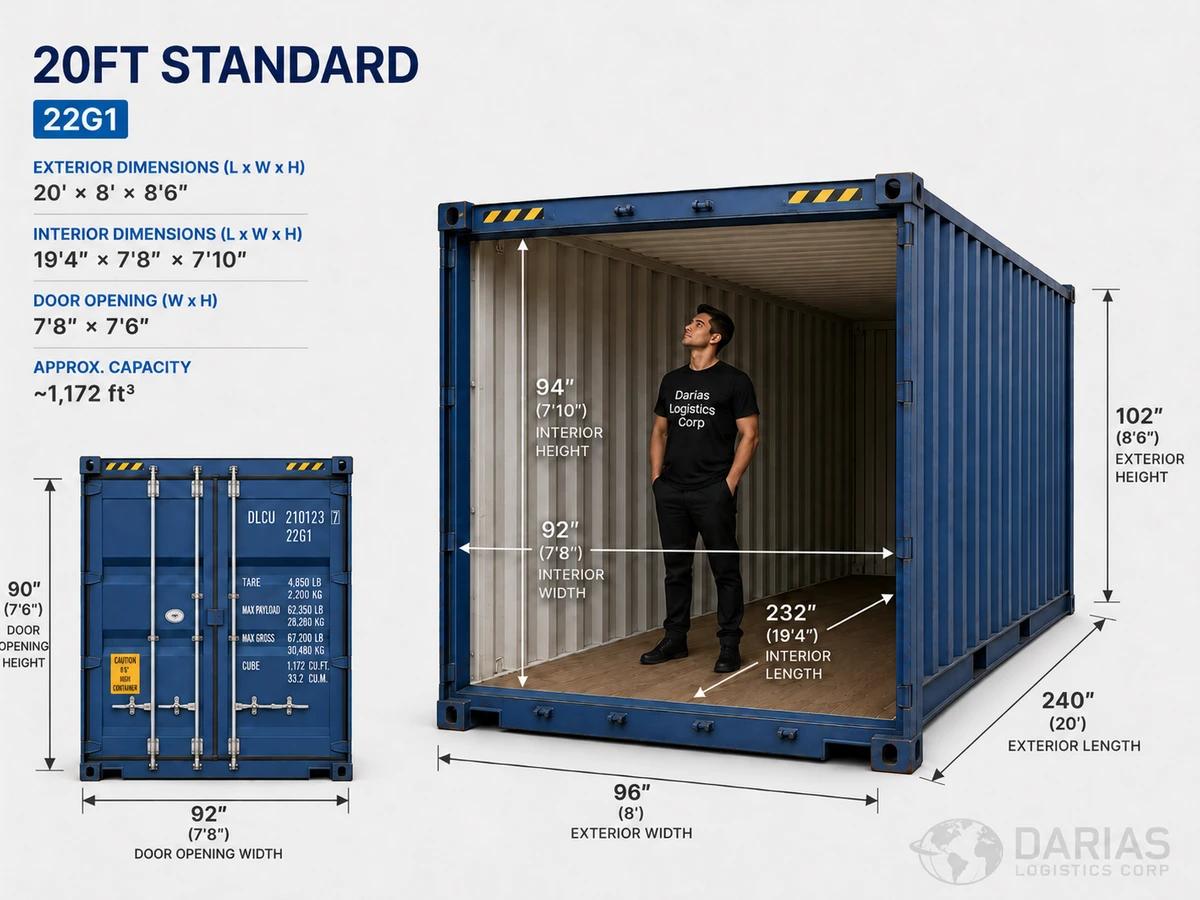
Specifiche
| Misura | Container da 20 piedi |
|---|---|
| Lunghezza esterna | 238.5″ 19′ 10.5″ |
| Larghezza esterna | 96″ 8′ |
| Altezza esterna | 102″ 8′ 6″ |
| Lunghezza interna | 232″ 19′ 4″ |
| Larghezza interna | 92″ 7′ 8″ |
| Altezza interna | 94″ 7′ 10″ |
| Larghezza porta | 92″ 7′ 8″ |
| Altezza porta | 90″ 7′ 6″ |
| Tara | 4,850 lb |
| Portata max | 62,350 lb |
| Peso legale max su strada | 38,000 lb |
| Peso lordo max | 67,200 lb |
| Capacità | 1,172 piedi³ |
| Chassis | Standard, or tri-axle if it is overweight |
Questi sono valori nominali per questo tipo di attrezzatura. I container reali variano per costruttore, compagnia e anno, e la tara è stampigliata sulla porta dell'unità che le arriva. Ci mandi il numero del container e lo verifichiamo su quello vero.
What a 20ft container is
A 20ft standard is the shorter of the two ordinary dry boxes: steel walls, a hard roof, and a pair of doors at one end. The outside is close to universal, because the box has to stack and lock like every other box, at about 19 ft 10.5 in long, 8 ft wide and 8 ft 6 in tall. Inside it opens out to roughly 19 ft 4 in by 7 ft 8 in by 7 ft 10 in, which is about 1,172 cu ft of usable space.
The door is the number worth writing down, because it is smaller than the interior: 7 ft 8 in wide by 7 ft 6 in tall. Four inches of height disappear at the header and the sill, and a crate that measured fine against the interior can still stop at the opening. These are nominal figures for the type. Tare on a typical 20 is around 4,850 lb, and the real one is stencilled on the door.
When a 20 beats a 40
Volume picks the 40, weight picks the 20. A 40ft standard gives you 2,389 cu ft against 1,172, so anything light and bulky costs less per cubic foot in the longer box, and two 20s rarely beat one 40 on a lane where both fit. Density flips the answer. Stone, tile, drums, castings, machinery, anything that hits a weight ceiling with the box half empty belongs in a 20, where the space you are not using is space you are not paying for.
Access is the other reason people choose the short box. A 20 on a chassis is a shorter combination and turns into places a 40 cannot: narrow yards, tight residential approaches, older South Florida industrial streets laid out before the 40 became the default. If what you are short of is height rather than weight, the 20ft high cube keeps the same footprint and adds about a foot inside.
The weight trap, and why a 20 stops near 38,000 lb
The commonest mistake on a 20 is arithmetic. Take 80,000 lb of legal highway gross, subtract the tractor, the chassis and the container, and you land somewhere near 50,000 lb of cargo. That number is wrong by about ten thousand pounds and it is how loads end up turned around at a scale. The published highway figure is roughly 38,000 lb of cargo on a standard chassis, and about 44,000 lb if the box rides on a tri-axle.
The reason is where the weight sits. A 20 is short and rides forward, so the whole load lands over one set of tandems instead of spreading down a 40 ft frame. The 34,000 lb tandem limit and the bridge formula, which ties allowable weight to how far the axles are spread, both bite long before the combination approaches 80,000 lb. That is why the 20 is the one size with a tri-axle figure published separately, and why a 38,500 lb box can need a permit for a delivery of a few miles.
What to send to get it booked
The container number and the steamship line come first. Those two decide the terminal, the gate requirement and the appointment, and they are worth more at the start than a description of the cargo. Add the delivery address, the last free day if you know it, and the weight as it reads on the bill of lading rather than an estimate, because 38,000 lb is the line between an ordinary move and a permitted one.
Say whether you want live unload or drop and pick, since it changes both the price and the day. Live means the driver waits while you strip the box. Drop means it is left with you and collected later, which is usually cheaper if you have room to hold a chassis. If the box is heavy enough to need a tri-axle, say so early, because that is equipment to plan around rather than a box to tick on the morning of the move.
Esce da
Va a
More in this section
Domande
Risposte dirette
Can a 20ft container be overweight on the highway?
Easily, and it is the commonest surprise on this box. About 38,000 lb of cargo is the published legal figure on a standard chassis, and roughly 44,000 lb on a tri-axle. Past that the load is perfectly legal at sea and overweight on the road, so it needs the right chassis and a permit, and the ports apply limits of their own on top of the state's. Send the weight off the bill of lading before the truck is booked rather than after.
Why does a 20ft container carry less on the road than a 40ft?
Because the load lands in one place. A short box rides forward and concentrates everything over a single set of tandems, and the 34,000 lb tandem cap and the bridge formula stop it there. A 40 spreads the same weight down a longer frame, so it gets much closer to the 80,000 lb gross limit before anything binds. The structural rating does not change: a 20 is built to hold far more than it can ever legally weigh on a Florida road.
How much does an empty 20ft container weigh?
Around 4,850 lb for a typical dry 20, though tare moves by a few hundred pounds with the maker and the build year, and the real figure is stencilled on the door of the box you are given. It matters because tare comes straight out of what you can load: every pound of steel is a pound of cargo you do not get. Work from the stencil and the published road figure rather than from a number you derived yourself.
How many pallets fit in a 20ft container?
Ten standard 40 by 48 in pallets on the floor is the usual plan: two across with the 40 in edge facing out, four rows deep, and a couple more turned in what is left. Two 48 in edges will not sit side by side, because the interior is about 7 ft 8 in wide and that would need a full 8 ft. Whether anything stacks on top is decided by your freight and by the 7 ft 10 in of interior height.
Do I need a tri-axle chassis for a 20ft container?
Only if it is heavy. A standard chassis handles a 20 up to roughly 38,000 lb of cargo, and a tri-axle spreads the load over an extra axle to take it to about 44,000 lb. That extra axle is neither free nor always available at short notice, which is why the weight is worth confirming when the move is booked rather than at the gate. Below 38,000 lb the standard chassis is the simpler and cheaper answer.
Quali sono le misure interne di un Container da 20 piedi?
Lunghezza, larghezza e altezza interne sono nella tabella delle specifiche di questa pagina, accanto alle misure esterne e all'apertura della porta. È l'apertura della porta a decidere se una macchina ci passa, ed è più piccola dell'interno.
Che chassis serve per un Container da 20 piedi?
Standard, or tri-axle if it is overweight. Lo chassis lo portiamo noi, così la prenotazione non dipende da cosa il terminal ha disponibile quella mattina.
Lo gestite in sovrappeso?
Sì, con lo chassis giusto e il permesso giusto. Il sovrappeso è una questione a parte rispetto alla dimensione del container, e i porti hanno limiti propri oltre a quelli dello stato.
Da dove ritirate un Container da 20 piedi?
Port of Miami, Port Everglades, Port of Palm Beach, POMTOC, South Florida Container Terminal, Seaboard Marine, Florida International Terminal, Port Everglades Terminal, Crowley, King Ocean, MSC, Tropical Shipping, Antillean Marine, FEC Port Everglades ICTF, FEC Hialeah rail ramp and CSX ramp.
Cos'è il last free day?
L'ultimo giorno in cui il suo container può restare dentro il terminal prima che partano gli addebiti di stoccaggio. Se lo si supera, il demurrage matura ogni giorno, ed è per questo che un pre-pull costa quasi sempre meno dell'attesa.
Cos'è un pre-pull?
Ritiriamo il container dal terminal prima che lei sia pronto e lo teniamo in un piazzale. Ferma il demurrage a tariffe di terminal e toglie pressione ai suoi orari di ricevimento.
Che differenza c'è tra demurrage, per diem e detention?
Tre addebiti diversi, da soggetti diversi. Il demurrage è il terminal che le addebita la merce ferma dentro il gate oltre il tempo libero. Il per diem è la compagnia di navigazione che le addebita il suo container tenuto fuori oltre il tempo libero. Il detention è il tempo del trasportatore, addebitato quando un autista aspetta alla sua banchina oltre la finestra libera. Possono correre insieme, ed è così che una fattura diventa pesante in fretta.
Come ottengo una tariffa?
Ci mandi la tratta, il mezzo, la dimensione del container e il porto, e le rispondiamo con un numero. Preventivi e dispatch 24 ore su 24 a quotes@dariaslogistics.com.
Cosa comprende davvero un preventivo di drayage?
Il trasporto in sé, più gli accessori che poi sorprendono: chassis, pre-pull, per diem, demurrage, detention e stoccaggio. Preferiamo indicarli subito piuttosto che aggiungerli a una fattura.