Open deck
Step deck
Il pianale principale ribassato dà circa 18 pollici in più di altezza di carico di legge rispetto a un pianale normale. Si chiama anche drop deck.
Come si presenta
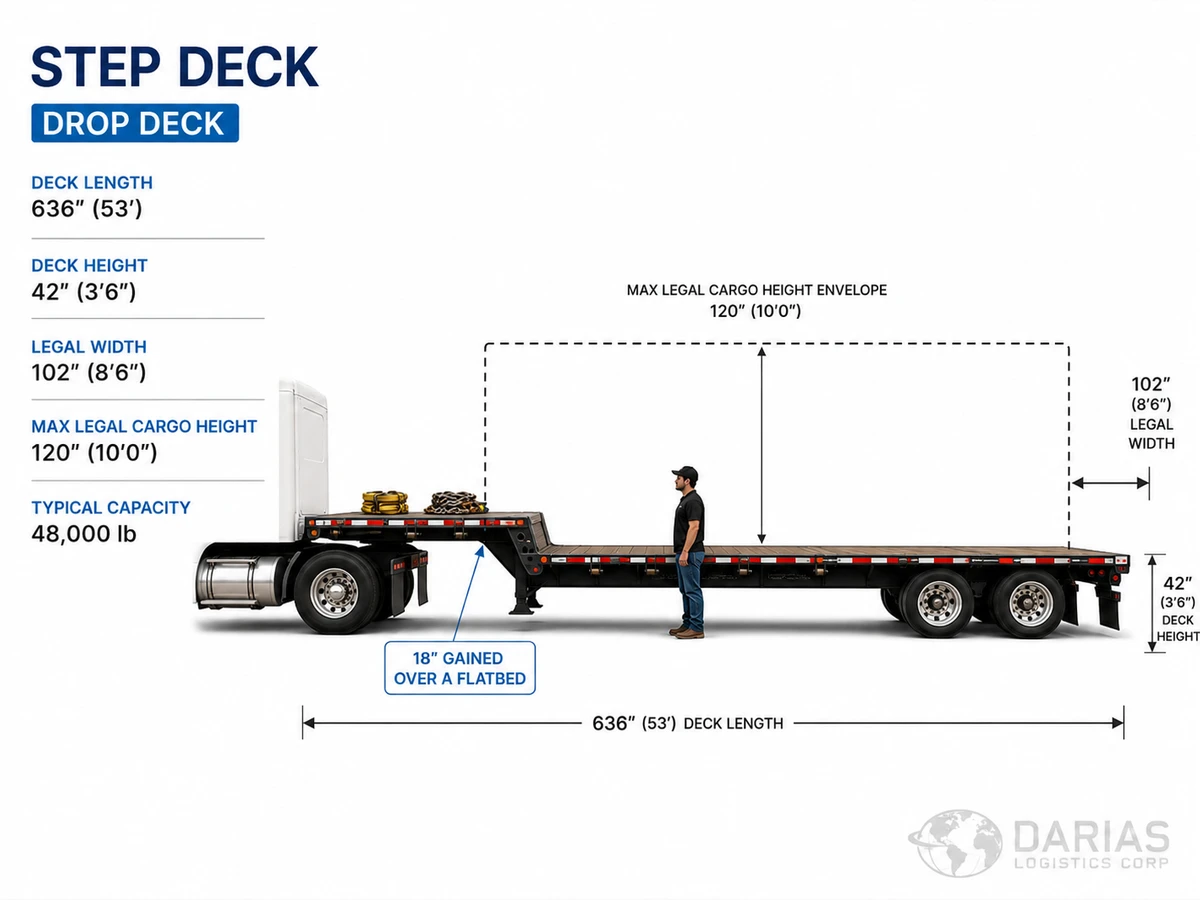
Specifiche
| Misura | Step deck |
|---|---|
| Lunghezza pianale | 53′ |
| Altezza pianale | 3′ 6″ |
| Larghezza legale | 8′ 6″ |
| Altezza legale max del carico | 10′ |
| Capacità tipica | 48,000 lb |
Questi sono valori nominali per questo tipo di attrezzatura. I container reali variano per costruttore, compagnia e anno, e la tara è stampigliata sulla porta dell'unità che le arriva. Ci mandi il numero del container e lo verifichiamo su quello vero.
What a step deck is
A step deck is a flatbed with its main deck lowered. A short upper deck sits over the kingpin at about the height of an ordinary flatbed, then the deck steps down behind the tractor and runs low for the rest of its length. Total deck length is around 53 ft, legal width is 8 ft 6 in, the main deck sits roughly 3 ft 6 in off the road, and a typical trailer carries something like 48,000 lb. It is called a drop deck just as often, and they are the same thing.
Everything else about it behaves like a flatbed. There are no sides and no roof, so the load comes on from the side with a forklift, from above with a crane, or up ramps at the back. These are typical figures for the type rather than one trailer's specification: deck height in particular moves a little with suspension, tires and load.
When a step deck is the right trailer
The answer is almost always height. A flatbed gives about 8 ft 6 in of legal cargo height and a step deck gives about 10 ft, because its deck starts 18 in closer to the road. Freight between those two numbers travels legally on a step deck and needs a permit on a flatbed, and that is the whole decision for most loads: machinery, tanks, crated equipment, anything that measured a little too tall for an open deck.
Above 10 ft the step deck runs out too, and the answer becomes a double drop or a lowboy, which put the cargo in a well between the axles and allow something like 11 ft 6 in. Those have short wells, so they trade length for height. If the freight is not tall at all, a flatbed is easier to load and easier to find, and if it is palletized and weatherproof it should probably be in a dry van.
What people get wrong: measuring from the deck, and the step itself
Cargo height is measured from the road. The limit in Florida is 13 ft 6 in, the deck takes 3 ft 6 in of it, and what is left for the freight is 10 ft. People measure a machine on the workshop floor, see 11 ft, compare it to 13 ft 6 in and assume there is room. There is not, and the correction happens either at a permit office or at the first low structure on the route.
The second thing is the step. A step deck is two decks, not one long low one, so a single piece cannot lie across the change in height and the usable low space is the main deck rather than the full 53 ft. Long items get planned against the main deck length, and anything that overhangs the back is flagged and lit. Weight has the same rule as any open deck: the total matters less than what each axle group is carrying, which depends on where the piece is placed.
What to send to get it booked
Length, width, height and weight of the piece, measured as it will sit on the trailer and including any skid, cradle or pallet underneath it. Then how it is being loaded and unloaded: crane, forklift, or driven on with ramps. If it drives on, its ground clearance and whether it has been loaded this way before are worth a line, since the climb onto a deck is where machines get stuck.
Add the pick up and the delivery, and anything awkward about either: a low gate, soft ground, no equipment at one end. If the freight is over 10 ft tall or over 8 ft 6 in wide, say it at the start, because permits and routing are worked out before a trailer is assigned rather than after it arrives. And say if it must be tarped, as that is labor and time at both ends.
Lanes this trailer runs
Work it out first
Esce da
Va a
Domande
Risposte dirette
How tall can cargo be on a step deck in Florida?
About 10 ft. Florida's legal travel height is 13 ft 6 in measured from the road, and a step deck's main deck sits roughly 3 ft 6 in up, so the freight gets what is left. That is around 18 in more than a flatbed allows, and it is the single reason most step deck loads are on a step deck. Anything taller than 10 ft moves permitted, or on a double drop, which starts the same sum from lower still.
What is the difference between a step deck and a drop deck?
Nothing. They are two names for the same trailer, and you will hear both from the same person inside a minute. Step deck is the more common name in the South and drop deck turns up more in paperwork, but the equipment is identical: a short upper deck over the kingpin, a step down, and a long main deck that sits closer to the road so tall freight can travel legally.
How long is the deck on a step deck?
Around 53 ft in total, split between a short upper deck over the kingpin and the long lower main deck that most freight rides on. The split is worth asking about when a piece is long, because a single item cannot straddle the step. For most loads the practical question is whether the piece fits the main deck, not whether it fits the trailer's overall length.
Can a machine be driven onto a step deck?
With ramps, often yes, and that is how a lot of wheeled and tracked equipment gets loaded. The limits are the machine's ground clearance and its breakover angle at the top of the ramp, and the deck height it has to climb to. For heavy plant it is usually easier on a lowboy or a removable gooseneck, where the deck is lower and the front of the trailer comes off to make a ramp of the deck itself.
Does a step deck cost more than a flatbed?
Usually a little, because there are fewer of them and the equipment is more specialised, but that is the wrong comparison to make. The real comparison is against the flatbed move it replaces: a load over 8 ft 6 in tall on a flatbed needs a permit and a route, and the permitted move plus the delay generally costs more than moving it legally on a lower deck in the first place.
Cosa carica un Step deck?
Il pianale principale ribassato dà circa 18 pollici in più di altezza di carico di legge rispetto a un pianale normale. Si chiama anche drop deck.
Vi occupate voi dei permessi?
Sì. Tutto ciò che supera larghezza, altezza o peso di legge viene autorizzato e instradato prima di muoversi, scorte comprese dove il percorso le richiede.
Gestite i reefer?
Sì, con genset, così il container continua a funzionare tra il terminal e la porta. Un reefer carica sensibilmente meno di un container secco delle stesse misure esterne, perché l'isolamento e il lato macchina occupano spazio reale.
E la merce che in un container non ci sta?
Flat rack e open top per il fuori sagoma, oppure pianale aperto: flatbed, step deck, lowboy, RGN e double drop. La misuri prima di prenotare, perché tutto ciò che esce dalla sagoma cambia il discorso permessi.
Come ottengo una tariffa?
Ci mandi la tratta, il mezzo, la dimensione del container e il porto, e le rispondiamo con un numero. Preventivi e dispatch 24 ore su 24 a quotes@dariaslogistics.com.
Cosa comprende davvero un preventivo di drayage?
Il trasporto in sé, più gli accessori che poi sorprendono: chassis, pre-pull, per diem, demurrage, detention e stoccaggio. Preferiamo indicarli subito piuttosto che aggiungerli a una fattura.