外尺寸、内尺寸和箱门
外观示意
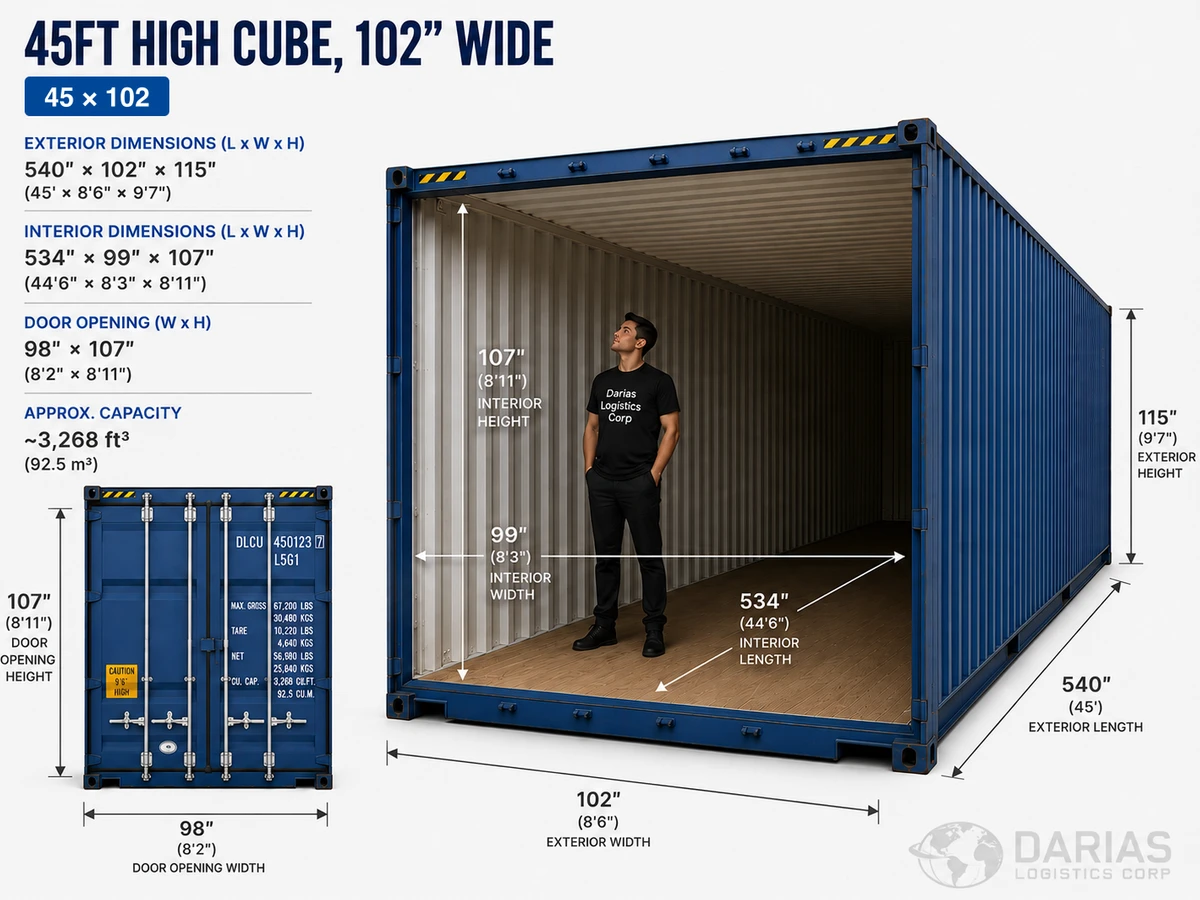
规格参数
| 项目 | 45 英尺 high cube,102 英寸宽 |
|---|---|
| 外长 | 540″ 45′ |
| 外宽 | 102″ 8′ 6″ |
| 外高 | 115″ 9′ 7″ |
| 内长 | 534″ 44′ 6″ |
| 内宽 | 99″ 8′ 3″ |
| 内高 | 107″ 8′ 11″ |
| 门宽 | 98″ 8′ 2″ |
| 门高 | 107″ 8′ 11″ |
| 皮重 | 10,220 lb |
| 最大载重 | 56,730 lb |
| 公路合法最大载重 | 41,700 lb |
| 最大总重 | 67,200 lb |
| 容积 | 3,268 立方英尺 |
| 底盘车 | 45ft or extendable |
数据来源 Crowley. 皮重仍会因制造批次不同而有差异,实际以您拿到那只箱子门上的钢印为准。把箱号发给我们,我们按实际箱子核对。
What the 102 in wide 45 is
This is a 45 ft high cube built 102 in wide instead of the usual 96. Outside it runs 45 ft long, about 8 ft 6 in wide and 9 ft 7 in tall. Inside, the published figures are roughly 44 ft 6 in by 8 ft 3 in by 8 ft 11 in, giving around 3,268 cu ft, and the door opening is about 8 ft 2 in wide by 8 ft 11 in tall, which is unusually generous on height for a container.
On the Caribbean and Central America trades through PortMiami and Port Everglades it is a common box rather than a curiosity, so a booking that says only 45 may well mean this one. Tare runs around 10,220 lb on the published figures, and as with any container the tare that governs your load is the one stencilled on the door of the unit you actually receive.
Why seven inches changes the load plan
Two standard 48 in pallets need 96 in of width. An ordinary container gives you about 92 in inside, so they do not go side by side and the whole floor plan has to be built around turning pallets and accepting dead space. This box gives you 99 in, so they do, all the way down 44 ft 6 in of floor. That is not a marginal gain: it is a different way of loading the same freight.
Against an 8 ft wide 45 it is about 225 more cu ft on nearly identical outside dimensions, and against a 40ft high cube it is more of everything. The comparison that actually matters is pallets landed rather than cubic feet quoted, and that is where the wide body separates from its neighbours. If your cargo is not palletized, the advantage shrinks to the seven inches themselves and the choice goes back to whichever box is available on the trade.
What people get wrong: width has no margin, and the rating is not the road limit
102 in is the legal highway width, not a width that needs a permit and not a width with anything spare. An ordinary 8 ft container travels with six inches of slack against the limit, and this one travels with none. Nothing about that is a problem on an ordinary route, but it means a box seated slightly off on a chassis, a narrow gate, a construction lane or a tight dock approach has less room to be wrong in than the crew may expect.
The other trap is the weight column. The container is rated at 67,200 lb gross, and that is a sea and stacking figure. The number that decides whether a truck is legal in Florida is the 80,000 lb gross of the whole combination, which leaves about 41,700 lb of cargo after the tractor, a 45 ft chassis and the box's own tare, the figure Crowley publishes for this box. Loading to the rating rather than the road figure is how a legally stuffed container becomes an illegal vehicle at the first scale.
What to send to get it booked
Say 102 in, or say wide body, at the first ask. The chassis question and the load plan both change with that one word, and a 45 assumed to be the ISO box gets planned with the wrong interior width. Then the container number, the steamship line and the terminal, which decide the gate requirement and the appointment.
After that the usual: delivery address, last free day, and the cargo weight as it reads on the bill of lading rather than a guess. If the receiving site is tight, describe it, because this is a 45 ft box at full legal width and the approach matters more than the door. If the freight is palletized, the pallet size and the count are worth sending too, since that is what the extra seven inches is being bought for.
Work it out first
提自
运往
常见问题
直接回答
How wide is a 102 in container inside?
About 8 ft 3 in, which is 99 in, against roughly 92 in in an ordinary 8 ft wide box. Seven inches does not sound like much until you put pallets in it. Two 48 in pallet edges need 96 in and they fit here with room to breathe, where in a 96 in wide container they do not fit at all. That single fact is the reason the wide body exists and the reason the two sizes are not interchangeable.
Is a 102 in wide container legal on the road without a permit?
Yes. 102 in is the legal highway width in the United States, so the box travels as an ordinary load and no width permit is involved. What it does not have is margin. An 8 ft wide container has half a foot of slack against the limit and this one has none, so a shifted box on a chassis, a tight gate or a narrow bridge approach is less forgiving than the crew may be used to.
Where do 102 in wide 45ft containers come from?
They run heavily on the Caribbean and Central America services out of PortMiami and Port Everglades, which is why South Florida sees them far more often than most of the country does. If your booking is on one of those trades and says 45, there is a real chance this is the box rather than the 8 ft wide ISO version, and it is worth confirming before a load plan is drawn around the wrong interior width.
Can a 45ft wide body be loaded at a standard dock?
Usually yes, since the door opening is around 8 ft 2 in wide and dock levellers and forklifts are not troubled by the extra few inches of box width. The thing to check is the approach rather than the door: a wider box on a 45 ft chassis needs a straighter run into the bay. As always, the tightest opening on the trip is worth measuring in advance, and it is often the receiver's door and not the container.
Is the payload of a wide body 45 lower than its rating?
Much lower, and the two numbers answer different questions. The box is rated to 67,200 lb gross, which is a sea figure covering how the steel and the corner castings are built. On a Florida road the limit is the 80,000 lb legal gross of the whole combination, which leaves roughly 41,700 lb of cargo once the tractor, a 45 ft chassis and about 10,220 lb of tare are taken out. Load to the road figure.
45 英尺 high cube,102 英寸宽 的内尺寸是多少?
内长、内宽和内高都列在本页的规格表里,外尺寸和箱门开口也在同一张表上。真正决定一台机器进不进得去的是箱门开口,它比内尺寸更小。
45 英尺 high cube,102 英寸宽 需要什么底盘车?
45ft or extendable. 底盘车由我们自备,所以订不订得成,不取决于码头那天早上有什么车。
超重的能拉吗?
能,用对的底盘车,配上对的许可。超重和箱型尺寸是两个分开的问题,而且各港口在州的限值之外还有自己的限值。
你们从哪里提 45 英尺 high cube,102 英寸宽?
Port of Miami, Port Everglades, Port of Palm Beach, POMTOC, South Florida Container Terminal, Seaboard Marine, Florida International Terminal, Port Everglades Terminal, Crowley, King Ocean, MSC, Tropical Shipping, Antillean Marine, FEC Port Everglades ICTF, FEC Hialeah rail ramp and CSX ramp.
什么是免堆期最后一天(last free day)?
您的箱子可以免费停在码头里面的最后一天。过了这一天,滞港费就开始按天累计,所以提前提箱几乎总是比干等便宜。
什么是提前提箱(pre-pull)?
在您准备好收货之前,我们先把箱子从码头提出来,放在堆场上。这样滞港费就不会按码头的费率往上跑,您的收货安排也不用再赶。
滞港费、滞箱费和车辆滞留费有什么区别?
这是三笔来自不同收费方的费用。滞港费是码头向您收的,因为超过免费时间之后货还留在闸口里面。滞箱费是船公司向您收的,因为超过免费时间之后您还占着他们的箱子。车辆滞留费是卡车方的时间成本,司机在您的月台等候超过免费时段之后开始计算。这三笔可以同时在跑,账单就是这样很快变得难看的。
怎么拿到运价?
把线路、设备、集装箱尺寸和港口发过来,我们回一个数字。报价和调度24小时都有人,邮箱 quotes@dariaslogistics.com。
一份拖车报价里到底包含什么?
运输本身,加上那些事后最容易让人措手不及的附加费:底盘车、提前提箱、滞箱费、滞港费、车辆滞留费和仓储费。我们宁可一开始就把它们说清楚,也不愿意事后加到账单上。