Service
Fret sur plateau
Fret sur plateau ouvert qui ne rentre pas, ou n'a pas sa place, dans une remorque fermée.
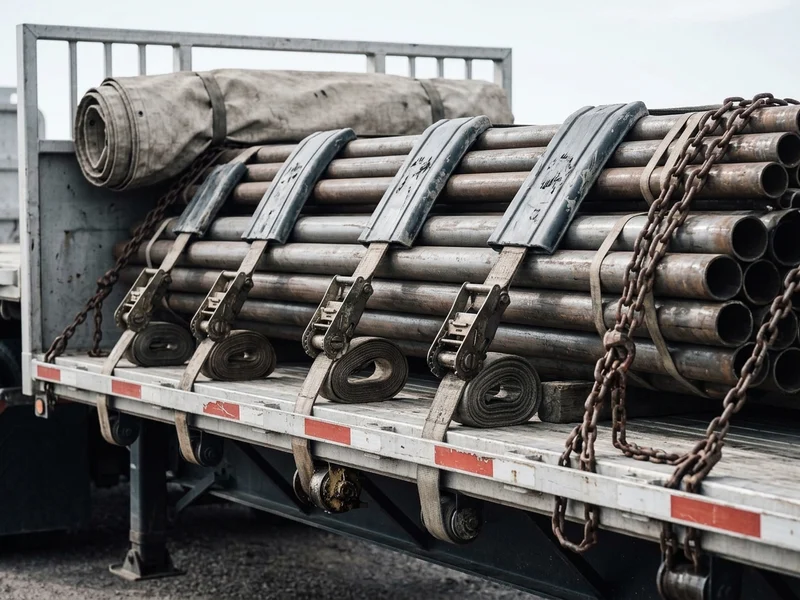
Quand la marchandise ne rentre pas dans une remorque fermée
Le plateau ouvert, c'est pour tout ce qui doit se charger par le côté ou par le haut, ce qui est trop haut ou trop large pour une remorque fermée, ou ce qui est simplement fait dans une forme qu'une porte de remorque ne pardonne pas. Machines, acier, tuyauterie, bois, équipement sur patins, tout ce qui se charge à la grue.
Le choix de la remorque suit la charge, et pas l'inverse. Un plateau standard, un step deck pour la hauteur, ou un lowboy quand la pièce est assez haute pour que même un step deck ne la garde pas légale.
L'arrimage et la météo, c'est ça le métier
La marchandise sur plateau ouvert tient par des sangles, des chaînes et du calage, et le plan de chargement n'est pas un détail de dernière minute : c'est ce qui garde la pièce sur la remorque et le chauffeur en règle. Le bâchage compte aussi, et savoir si une charge en a besoin change le prix, donc dites-le si ça ne peut pas prendre l'eau.
Dès qu'une pièce dépasse la largeur, la hauteur, la longueur ou le poids légaux, ce n'est plus du plateau ordinaire : ça devient permis, itinéraire et parfois escorte. C'est de la charge lourde et du hors gabarit, et ce sont les dimensions qui décident, pas la description.
What it costs
Work it out first
Long-haul lanes out of Miami
Équipements
Ports
Questions
Réponses directes
When do I need a flatbed instead of a dry van?
When the freight has to be loaded from the side or the top, when it is too tall or too wide for a van, or when it is simply built in a shape a van door does not forgive. Machinery, steel, pipe, lumber, equipment on skids and anything craned on all live on open deck. The trailer then follows the load rather than the other way round: a standard flatbed, a step deck for height, or a lowboy when the piece is tall enough that even a step deck will not keep it legal.
What is the difference between a flatbed and a step deck?
Deck height, and what that buys you in cargo height. A step deck drops behind the gooseneck, so a taller piece still comes in under Florida's 13 foot 6 inch limit without a permit. A standard flatbed carries a higher deck and suits freight that is long or awkward rather than tall. When even a step deck will not keep the piece legal, the next moves are a lowboy or an RGN. Measure the piece as it will actually sit, including any skid or crate underneath it.
Does my flatbed load need to be tarped?
Say so at the rate request if it cannot get wet, because tarping changes both the price and the loading time. Open deck freight travels exposed unless it is covered, and tarps are labor as well as material. Steel and machinery are usually tarped as a matter of course; lumber and pipe often are not. The securement plan, the straps, chains and dunnage that keep the piece on the trailer and the driver legal, gets built with the tarping question settled rather than after it.
Where does flatbed freight go from Miami?
Anywhere in Florida and out to the other 47 states. Geography shapes the answer: almost everything leaving Florida travels north through a narrow corridor before it goes anywhere, so a run out of Miami carries several hundred miles before it is really on its way, and honest transit times start from that rather than from a mileage calculator. Local open-deck work around PortMiami, Port Everglades and the Hialeah rail ramps is the other half of the board.
When does flatbed work become heavy haul?
The moment the piece goes past legal width, height, length or weight. Then it is permitted, routed and sometimes escorted, and the dimensions decide that rather than the description. Two pieces that read the same on a packing list can be an ordinary flatbed lane and a permitted job with pilot cars. Send measured length, width, height and gross weight with the request and the answer comes back with the right trailer and the right paperwork already worked out.
Comment obtenir un tarif ?
Envoyez la route, l'équipement, la taille du conteneur et le port, et nous revenons avec un chiffre. Tarifs et répartition 24h/24 à quotes@dariaslogistics.com.
Que comprend vraiment un devis de drayage ?
Le déplacement lui-même, plus les accessoires qui surprennent après coup : châssis, pre-pull, per diem, demurrage, detention et stockage. Nous préférons les nommer d'entrée plutôt que les ajouter à une facture.