Service
Transloading in Miami
The hinge: freight comes out of the box and onto a trailer, so the inland run is not paying container rates.
The move that stops the line's clock
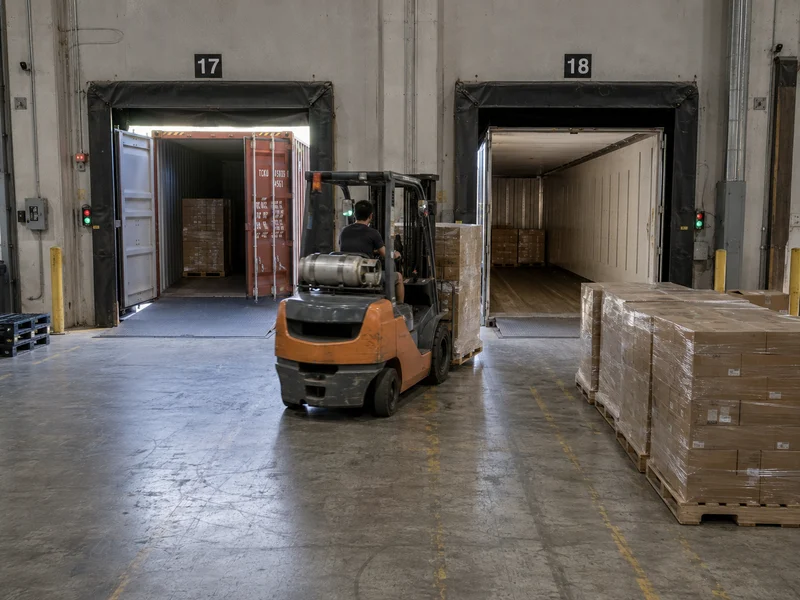
Transloading takes the freight out of the ocean container and puts it onto a domestic trailer. The container goes back to the port empty and early, which ends per diem, and the long run inland stops paying container and chassis rates.
For anything travelling a serious distance this is usually the cheaper shape by a wide margin, and it is the single most useful thing we can suggest on a quote that arrives written as a through-move.
When it is worth it, and when it is not
Worth it when the inland leg is long, when per diem is already running, or when the freight can be re-stacked to fill a trailer better than it filled the box. A 40ft container's contents often do not need a 53ft trailer to themselves, and consolidating is where the saving comes from.
Not worth it for a short local delivery, where the extra handling costs more than the container time it saves. If the freight simply needs to change vehicles and keep moving the same day without being stored, that is cross-dock. If it needs to stay in the box the whole way, that is an inland container move.
Splitting an overweight box into legal truckloads
A container that was legal on the water is not automatically legal on the road. An overweight box coming off PortMiami or Port Everglades either moves under a permit on a tri-axle or quad chassis, or it comes to the dock and gets split. Splitting means the contents come out, get weighed and restacked, and go back out across two trailers that each sit inside the legal gross rather than one that does not.
Which of those is cheaper depends on how far the freight is going. For a short local delivery the permit route usually wins, because the handling costs more than the paperwork it avoids. For a long run the split usually wins, because the permit and the specialised chassis ride the whole distance while a transload is paid for once. Weight distribution is part of the work rather than an afterthought: two trailers under the limit on the scale ticket can still be over on an axle.
What a transload needs from you before the freight arrives
A packing list that matches what is actually in the box, because the whole exercise is rebuilding the load and that cannot be done from a description. Tell us whether the container is palletized or floor loaded, since those are two different jobs: pallets come off in an hour or two, and a floor-loaded 40 is a day's work for a crew.
Then the outbound end: who receives it, where, and whether they have a dock or need the truck to bring its own unloading. If the freight is going out on more than one trailer, say how it should be divided, by destination, by customer, or simply by what fills a trailer best. A 40ft container's contents often do not need a 53ft trailer to themselves, and consolidating with something else heading the same way is where a lot of the saving comes from.
Timing it against the per diem clock
Per diem runs from the moment the container comes off the terminal until it goes back empty, which makes a transload a race worth planning rather than a job to improvise. A box pulled in the morning and worked the same day goes back the same day. A box that arrives with no packing list, no decision about how the freight should be divided and nowhere confirmed for it to go sits on the yard while those get sorted out, and the line bills every one of those days.
The warehouse sits roughly 20 road miles from PortMiami and about 25 from Port Everglades, with the Hialeah rail ramps 5 to 8 miles away, so the driving is not what costs the days. The dock runs 8 to 5 Monday to Friday, first come first served with no appointment system, and freight released by 4pm ships the same day. Sending the paperwork before the container moves is most of what turns a two-day transload into a one-day one.
Work it out first
If the freight has not cleared yet
Equipment
Ports
Questions
Straight answers
What does it cost to unload a container?
It depends on one thing more than any other: whether the freight is on pallets or stacked loose on the floor. Palletized is a forklift job. Floor-loaded is a crew by hand, and a floor-loaded 40ft is roughly double a 20ft because it is roughly double the box. The published rates are on the warehousing cost page, and they are separated exactly that way rather than hidden behind one devanning number.
Do you unload floor-loaded containers?
Yes, and it is worth telling us before you book rather than after. Nobody can tell from a packing list whether a container is floor-loaded; if it lists cartons with no pallet count, assume it is, because discovering it at the dock costs an afternoon and a crew.
Can you restack or rework a damaged pallet load?
Yes. Pallet restacking and rework is ordinary work here: a load that shifted, a pallet built too high for the receiver, cartons that need re-squaring and re-wrapping before anyone will take them. It is also the moment to photograph what arrived, while the container it came out of is still in front of us.
Does unloading here get the container back to the line faster?
That is usually the whole reason to do it here. Per diem runs the entire time the box is out of the terminal, including the days it waits at your dock for a crew. Minutes from the port, the container is emptied and returned the same day and the freight waits on your schedule instead of the line's.
Is there a 45ft standard height container?
No, not in practice. 20ft and 40ft boxes come in both 8ft 6in standard and 9ft 6in high cube, but the 45 standardised on high cube only, which is why its ISO code is L5G1: the 5 is the 9ft 6in height. If someone quotes you a 45, it is a high cube. The real question on a 45 is the width, because the 102in wide body is common on the South Florida trades and it is 7in wider inside than the ISO box.
How do I get a rate?
Send the lane, the equipment, the container size and the port, and we come back with a number. Quotes and dispatch run 24 hours a day at quotes@dariaslogistics.com.